Gas to Liquid: Condensation — Reading Comprehension
Rate this
Premium Resource
Present
Present in classroom. No work saved
Assign
Classroom with student accounts, Track progress
Quick Play
No student accounts, assign with a link
Grades
3
4
5
6
PRINT+DIGITAL RESOURCE
This learning resource is available in interactive and printable formats. The interactive worksheet can be played online and assigned to students. The Printable PDF version can be downloaded and printed for completion by hand.
This engaging science passage for Grades 4-5 introduces students to the concept of condensation, the process where a gas turns into a liquid. Aligned with NGSS standards, the passage explains key scientific vocabulary like evaporation, condensation, and dew point in simple terms, with real-world examples such as dew on grass and water droplets on cold drinks. Students will learn about the water cycle and how condensation is important for weather and daily life. The resource includes a glossary of key terms, a Spanish translation of the passage, reading comprehension questions, and writing prompts to promote critical thinking and application. Audio integration is available to support diverse learners. This resource is ideal for classroom or at-home science learning and supports NGSS standards for understanding states of matter.
CONTENT PREVIEW
Expand content preview
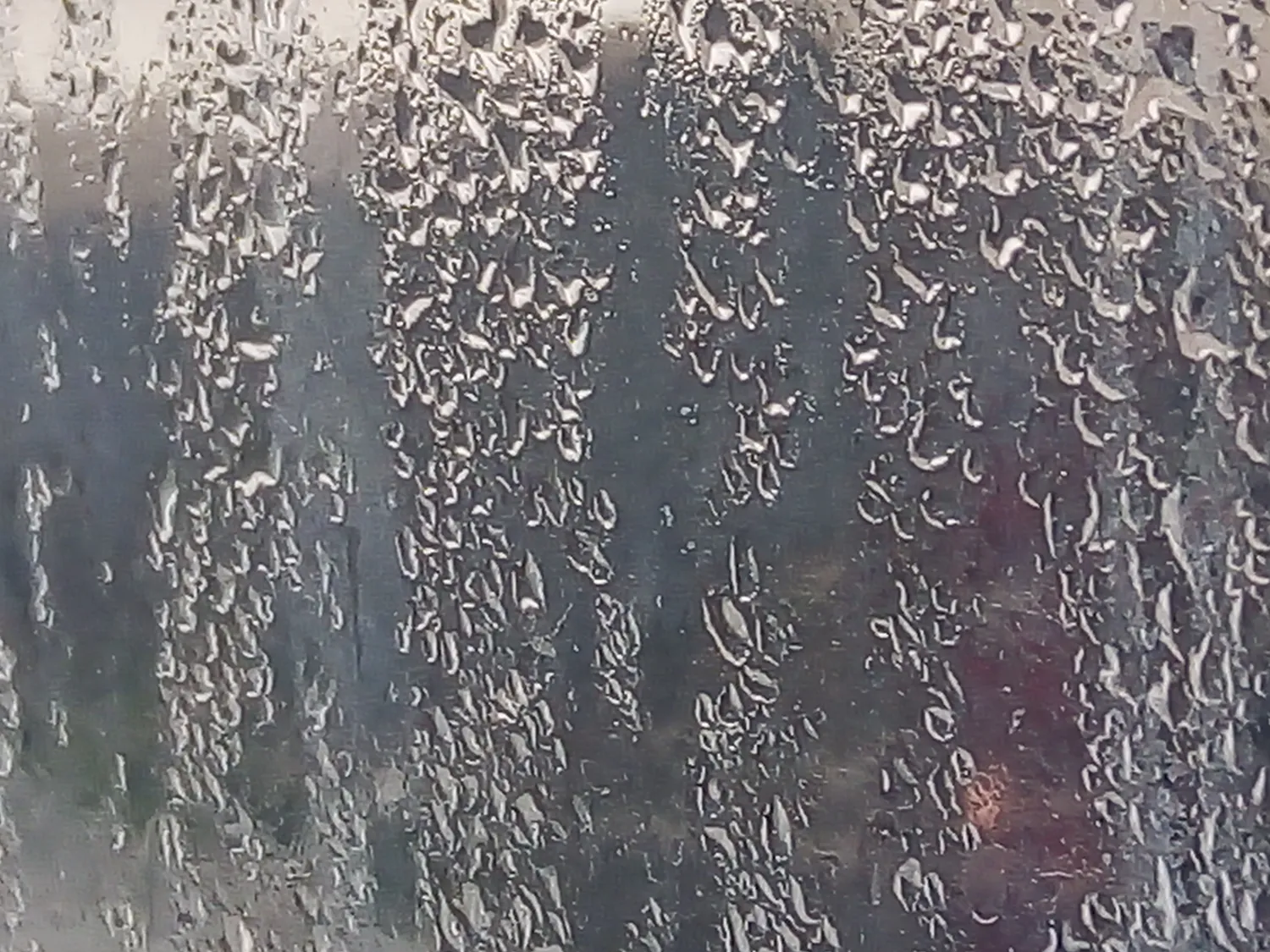
"Condensation on car window. Image by Doggo19292 / Wikimedia Commons
Condensation is the process when a gas changes into a liquid. This happens when gas cools down. The most common example is when water vapor in the air turns into liquid water. This is an important part of the water cycle.
When water is heated, it turns into a gas called water vapor. This is called evaporation. The water vapor rises into the air. When the air cools down, water vapor loses heat energy. The particles slow down and come closer together. Then, the gas changes back into a liquid. This change is called condensation.
You can see condensation in your daily life. On a hot day, if you have a cold glass of water, water droplets form on the outside of the glass. This is because water vapor in the warm air touches the cold glass, cools down, and turns into liquid water. In the morning, you might see dew on grass or car windows. Dew forms because the air cools overnight, causing water vapor to condense into tiny water droplets.
Clouds are also made by condensation. High up in the sky, air is colder. When warm, moist air rises, it cools. The water vapor in the air condenses into tiny drops of water, which come together to form clouds. This process is a key part of how rain is made.
Condensation is used in many ways. At home, dehumidifiers use condensation to remove water from the air. In science labs, condensation helps collect pure water. Without condensation, there would be no rain, and plants and animals would not get the water they need.
Interesting Fact: The largest cloud on Earth is over the Amazon Rainforest and is formed by condensation of water vapor from millions of trees!
What is condensation?
Gas turns into liquidLiquid turns into gasSolid turns into gasLiquid freezes into solid
What forms on grass in the morning?
DewFrostSmokeSand
What does a dehumidifier do?
Removes water from airAdds water to airHeats the airCools the air
Why do clouds form in the sky?
Air cools and vapor condensesAir heats up quicklyGas becomes solidRain falls upward
How does condensation help plants?
Creates rain for waterMakes leaves dryHeats the soilRemoves sunlight
What happens when air cools at night?
Dew formsIce meltsClouds disappearSnow falls
Condensation is when a gas turns into a liquid.
TrueFalse
What is water vapor?
Water as a gasIce crystalsLiquid waterSolid water
Perfect For:
👩🏫 Teachers
• Reading comprehension practice
• Auto-graded assessments
• Literacy skill development
👨👩👧👦 Parents
• Reading practice at home
• Comprehension improvement
• Educational reading time
🏠 Homeschoolers
• Reading curriculum support
• Independent reading practice
• Progress monitoring
Reading Features:
📖
Reading Passage
Engaging fiction or nonfiction text
❓
Comprehension Quiz
Auto-graded questions
📊
Instant Feedback
Immediate results and scoring
📄
Printable Version
Download for offline reading
🔊
Read Aloud
Voice-over with word highlighting
Reviews & Ratings
No reviews yet. Be the first to share your experience!
Related Content
Physical Properties of Matter
This comprehensive reading passage introduces grades 6-8 students to the concept of physical properties of matter, perfe...
MS-PS1-1
Changes in Matter
This engaging science passage introduces Grade 4-5 students to the concept of how matter can change, meeting NGSS standa...
What Are Physical Changes?
This engaging Grade 4-5 science passage introduces students to the concept of physical changes in matter, aligning with ...
Kinetic Theory of Matter
This middle school science reading passage introduces students to the kinetic theory of matter, aligning with NGSS MS-PS...
MS-PS1-4
The Nature of Science
This passage explores the nature of science for middle school students, aligning with NGSS standards MS-ETS1-4, MS-PS1-1...
MS-ETS1-4MS-PS1-1MS-LS1-1
Particle Model of Matter
This comprehensive science reading passage for grades 6-8 explores the particle model of matter, aligning with NGSS stan...
MS-PS1-1MS-PS1-4
Evaporation as Physical Change
This middle school science passage examines the process of evaporation, a fundamental physical change where a liquid tur...
MS-PS1-4
Physical Changes: Deposition
This middle school science passage explores the concept of deposition, a type of physical change where matter transition...
MS-PS1-4
Sublimation as Physical Change
This educational passage for grades 6-8 explores the science of sublimation—a physical change where a solid transforms d...
MS-PS1-4
Physical Changes: Condensation
This middle school science passage explores the process of condensation, the physical change where a gas becomes a liqui...
MS-PS1-4
Is Evaporation a Physical Change
"This reading passage is designed for middle school students to explore the concept of evaporation and its classificatio...
Chemical Properties of Matter
This engaging middle school science passage explores the chemical properties of matter, focusing on how these properties...
MS-PS1-2
Science Vocabulary
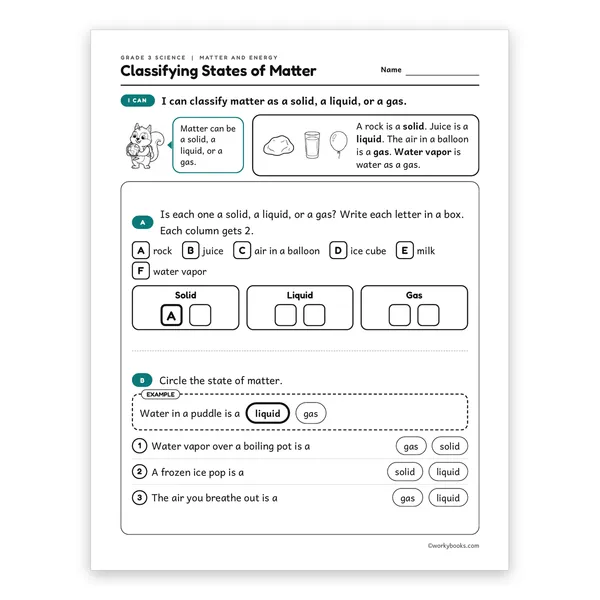
This worksheet on domain-specific words will help students learn some science vocabulary. Students will be asked to matc...
L.3.6L.3.4.A
Simple Machines Science Report
This science writing task requires students to clearly explain how three simple machines work using precise domain-speci...
W.5.4
Matter States Word Sort
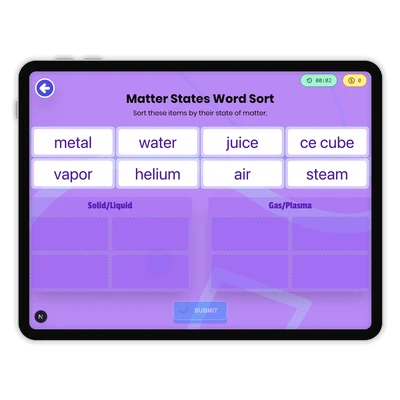
This interactive word sort focuses on helping students understand the different states of matter through real-world exam...
PS1.A
The Idea of the Atom
This informational science passage introduces middle school students (grades 6-8) to the concept that all matter is made...
MS-PS1-1
Matter States Word Sort
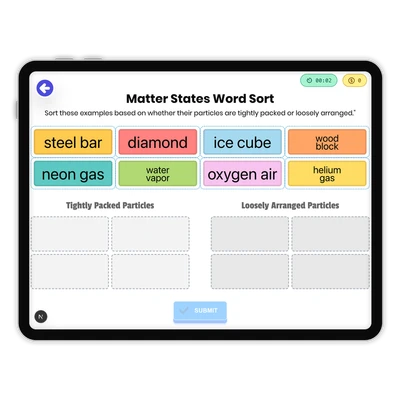
This classification activity helps students understand how particles are arranged in different states of matter. Student...
5-PS1-1
What Is Density?
This comprehensive science passage introduces middle school students (grades 6-8) to the concept of density, aligned wit...
MS-PS1-1
What Is Earth Science?
This engaging middle school science passage introduces students to the field of Earth science, aligning with NGSS standa...
MS-ESS1MS-ESS2MS-ESS3SEP
Citizen Science and Ecological Monitoring
This engaging passage for grades 6-8 introduces the concept of citizen science and its critical role in ecological monit...