Gene Expression: How Your DNA Works — Reading Comprehension
Rate this
Premium Resource
Present
Present in classroom. No work saved
Assign
Classroom with student accounts, Track progress
Quick Play
No student accounts, assign with a link
Grades
5
6
7
8
Standards
MS-LS3-1
PRINT+DIGITAL RESOURCE
This learning resource is available in interactive and printable formats. The interactive worksheet can be played online and assigned to students. The Printable PDF version can be downloaded and printed for completion by hand.
This passage explains the fundamental process of gene expression, covering transcription, translation, and gene regulation. It aligns with NGSS standard MS-LS3-1 (Heredity: Inheritance and Variation of Traits) by showing how genetic information flows from DNA to proteins. Real-world examples include hemoglobin production and medical applications. The content supports middle school life science curriculum while improving reading comprehension through clear explanations of complex concepts.
CONTENT PREVIEW
Expand content preview
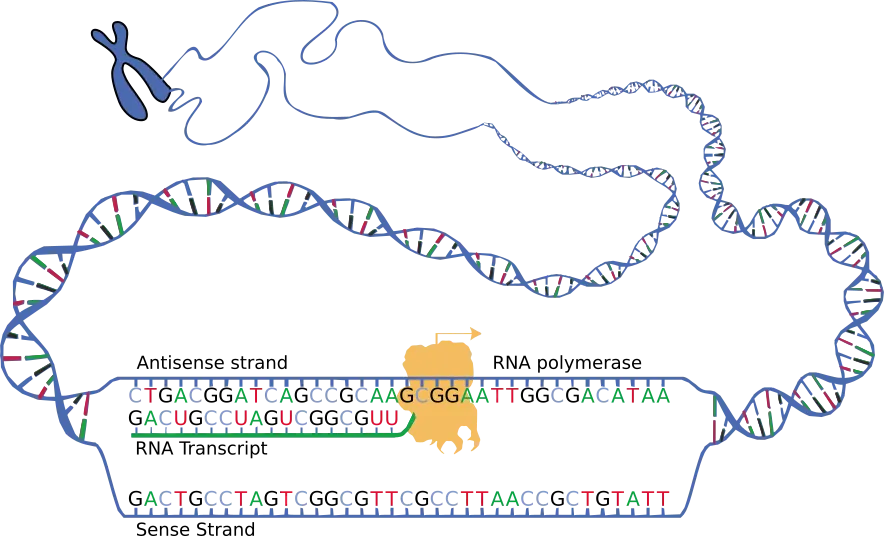
"DNA transcription" by Sulai / Wikimedia Commons
Gene expression is the process by which instructions in our DNA are converted into functional products like proteins. This carefully controlled mechanism determines how cells function and why organisms look and behave the way they do. Understanding gene expression helps explain everything from eye color to disease susceptibility.
The Central Dogma of Biology
Gene expression follows two key steps:
Transcription – DNA is copied into messenger RNA (mRNA) in the nucleus.
Translation – mRNA travels to ribosomes, where it directs protein assembly.
For example, the hemoglobin gene is expressed in red blood cells to produce oxygen-carrying proteins, but not in skin cells.
Regulation of Gene Expression
Cells control which genes are expressed through:
● Transcription factors (proteins that turn genes on/off)
● Epigenetics (chemical tags that modify DNA activity without changing the sequence)
This explains why identical twins can develop differences over time despite having the same DNA.
Real-World Importance
● Medical applications: Cancer treatments target abnormal gene expression.
● Genetic engineering: Scientists modify gene expression to produce insulin.
● Evolution: Changes in gene regulation drive species adaptation.
Fun Fact: The human genome contains ~20,000 genes, but less than 2% actually code for proteins - the rest regulates gene expression!
What is gene expression?
DNA replicationConverting DNA instructions into functional productsCell divisionProtein breakdown
Where does transcription occur?
RibosomesNucleusMitochondriaCell membrane
What molecule carries genetic information to ribosomes?
DNAmRNAtRNArRNA
Why don't all cells express the same genes?
They have different DNAGene expression is regulatedRibosomes don't work properlyProteins block gene expression
What can influence gene expression?
Temperature onlyTranscription factors onlyBoth environmental signals and transcription factorsNeither environmental signals nor transcription factors
How is gene expression related to identical twins?
They always express identical genesDifferent environments can lead to different gene expressionThey share no gene regulationTheir genes mutate constantly
What percentage of human DNA codes for proteins?
50%10%Less than 2%100%
Why is studying gene expression important for medicine?
It helps develop targeted cancer treatmentsIt explains planetary motionIt predicts weather patternsIt improves computer programming
Perfect For:
👩🏫 Teachers
• Reading comprehension practice
• Auto-graded assessments
• Literacy skill development
👨👩👧👦 Parents
• Reading practice at home
• Comprehension improvement
• Educational reading time
🏠 Homeschoolers
• Reading curriculum support
• Independent reading practice
• Progress monitoring
Reading Features:
📖
Reading Passage
Engaging fiction or nonfiction text
❓
Comprehension Quiz
Auto-graded questions
📊
Instant Feedback
Immediate results and scoring
📄
Printable Version
Download for offline reading
🔊
Read Aloud
Voice-over with word highlighting
Reviews & Ratings
No reviews yet. Be the first to share your experience!
Related Content
Gregor Mendel: The Father of Genetics
This informational reading passage introduces students to Gregor Mendel, the Austrian monk whose pea plant experiments l...