What Are Alleles
Interactive passage with audio narration, comprehension questions, and printable PDF.
What's included
What Are Alleles preview and details
About this printable What Are Alleles science reading passage, NGSS-aligned (Grades 5-8)
Sample passage and quiz from What Are Alleles
Reading passage and comprehension quiz preview
What Are Alleles?

In genetics, alleles are different versions of the same gene. Every organism has two alleles for most genes—one from each parent. These alleles work together to determine an organism’s traits, such as eye color, blood type, or the ability to roll your tongue.
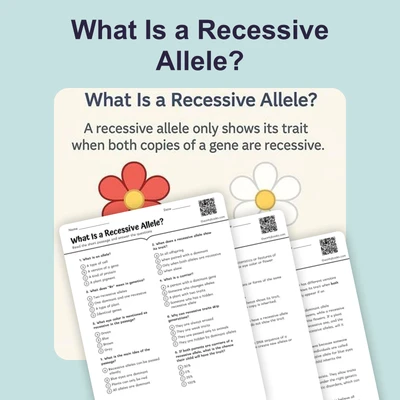
Each gene controls a specific trait, but the way that trait appears can change depending on which alleles you inherit. Some alleles are dominant, meaning they will show up in your traits even if you only inherit one copy. Others are recessive, which means they only appear if you inherit two copies—one from each parent. For example, the allele for brown eyes is usually dominant, while the allele for blue eyes is recessive.
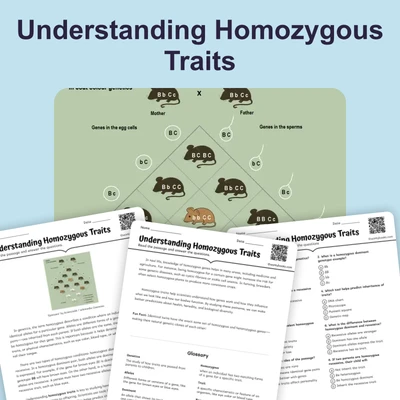
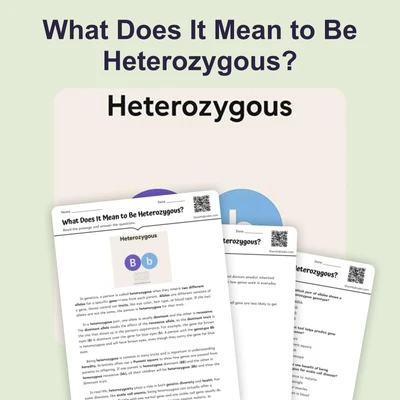
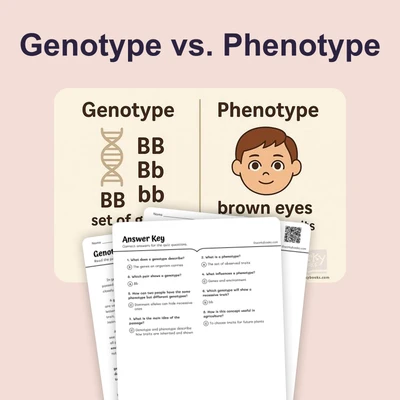
The combination of alleles you inherit makes up your genotype. If you inherit two of the same alleles (like BB or bb), you are homozygous for that gene. If you inherit two different alleles (like Bb), you are heterozygous. Even though someone who is heterozygous carries a recessive allele, they won’t show the recessive trait unless they pass it on to their children with another recessive allele.
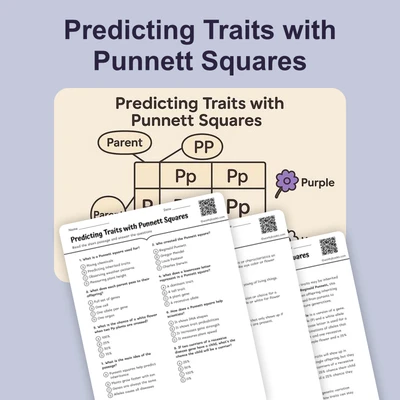
Alleles help explain how traits are passed from one generation to the next. Scientists use tools like Punnett squares to predict how alleles will combine and which traits might appear in offspring.
Understanding alleles helps us explore heredity, genetic variation, and even disease risk. In farming, choosing plants with the right alleles can improve crop growth, color, and flavor. In medicine, knowing which alleles a person carries can help doctors understand their health needs.
Fun Fact: Even a tiny change in a single allele can create a completely different trait—like changing flower color from red to white!
Comprehension quiz (8 questions)
1. What are alleles?
2. How many alleles does a person usually have for each gene?
3. Which allele type shows up with just one copy?
4. What does it mean to be homozygous?
5. What is the genotype of someone who is heterozygous?
6. Why might a person carry a recessive allele but not show it?
7. What is the main idea of the passage?
8. How do farmers use knowledge of alleles?
Perfect for the way you teach
- Build comprehension skills
- Auto-graded quiz
- Differentiated reading
- Read together at home
- Improve fluency
- Quiet reading time
- Reading curriculum support
- Independent practice
- Track Lexile growth