Self-Pollination
Interactive passage with audio narration, comprehension questions, and printable PDF.
What's included
Self-Pollination preview and details
About this printable Self-Pollination science reading passage, NGSS-aligned (Grades 5-8)
Sample passage and quiz from Self-Pollination
Reading passage and comprehension quiz preview
Understanding Self-Pollination

Self-pollination is a type of reproduction that happens in many flowering plants. It occurs when pollen from a flower lands on the same flower’s stigma or on another flower of the same plant. This means that the plant does not need pollen from another individual to reproduce. The plant uses its own pollen to fertilize its ovules and produce seeds.
In self-pollination, both the male and female reproductive parts are found on the same plant. This allows the plant to reproduce on its own, even if there are no other plants nearby. Plants like peas, tomatoes, and some orchids use self-pollination. Since the pollen and ovule come from the same plant, the offspring usually have very little genetic variation. They are often genetically similar or identical to the parent.
While this method can be helpful for survival when pollinators like bees are not available, it also has some drawbacks. Without genetic diversity, the plant population may be more vulnerable to disease or environmental changes. If all the plants have the same traits, they may all be affected in the same way.
Self-pollination is different from cross-pollination, where pollen comes from a different plant. Cross-pollination usually leads to more variation in traits, which can be helpful for a species’ long-term survival.
Understanding self-pollination helps scientists and farmers predict how traits are passed on in plants. It also explains why some crops are more uniform in size and shape.
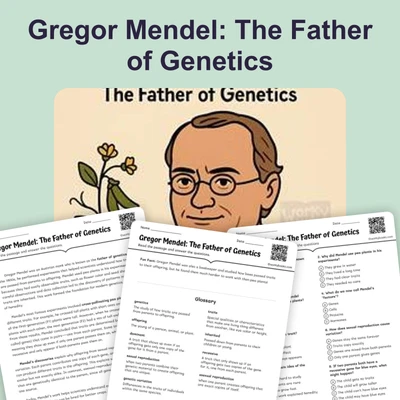
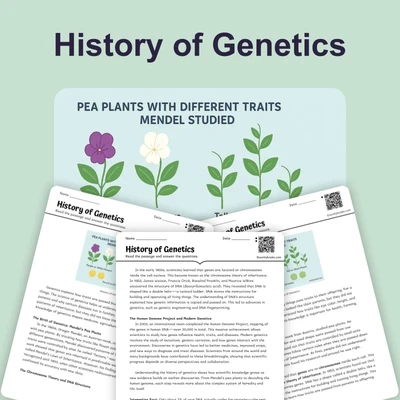
Fun Fact: The pea plants that Gregor Mendel used in his experiments were naturally self-pollinating, which helped him control how traits were passed on from one generation to the next!
Comprehension quiz (8 questions)
1. What is self-pollination?
2. What part of the plant receives the pollen?
3. Which of these plants uses self-pollination?
4. Why is genetic variation low in self-pollination?
5. What is one advantage of self-pollination?
6. What is a risk of low genetic diversity?
7. What is the main idea of the passage?
8. How did self-pollinating pea plants help Gregor Mendel?
Perfect for the way you teach
- Build comprehension skills
- Auto-graded quiz
- Differentiated reading
- Read together at home
- Improve fluency
- Quiet reading time
- Reading curriculum support
- Independent practice
- Track Lexile growth