Natural Selection
Interactive passage with audio narration, comprehension questions, and printable PDF.
By completing this purchase you agree to our Terms of Use and Privacy Policy. Your subscription renews automatically until you cancel. You can cancel anytime from your account settings. All sales are final and non-refundable. Digital content is available for download in your account immediately upon purchase.
What's included
Natural Selection preview and details
About this printable Natural Selection science reading passage, NGSS-aligned (Grades 5-8)
Sample passage and quiz from Natural Selection
Reading passage and comprehension quiz preview
Natural Selection: Nature’s Way of Choosing Traits
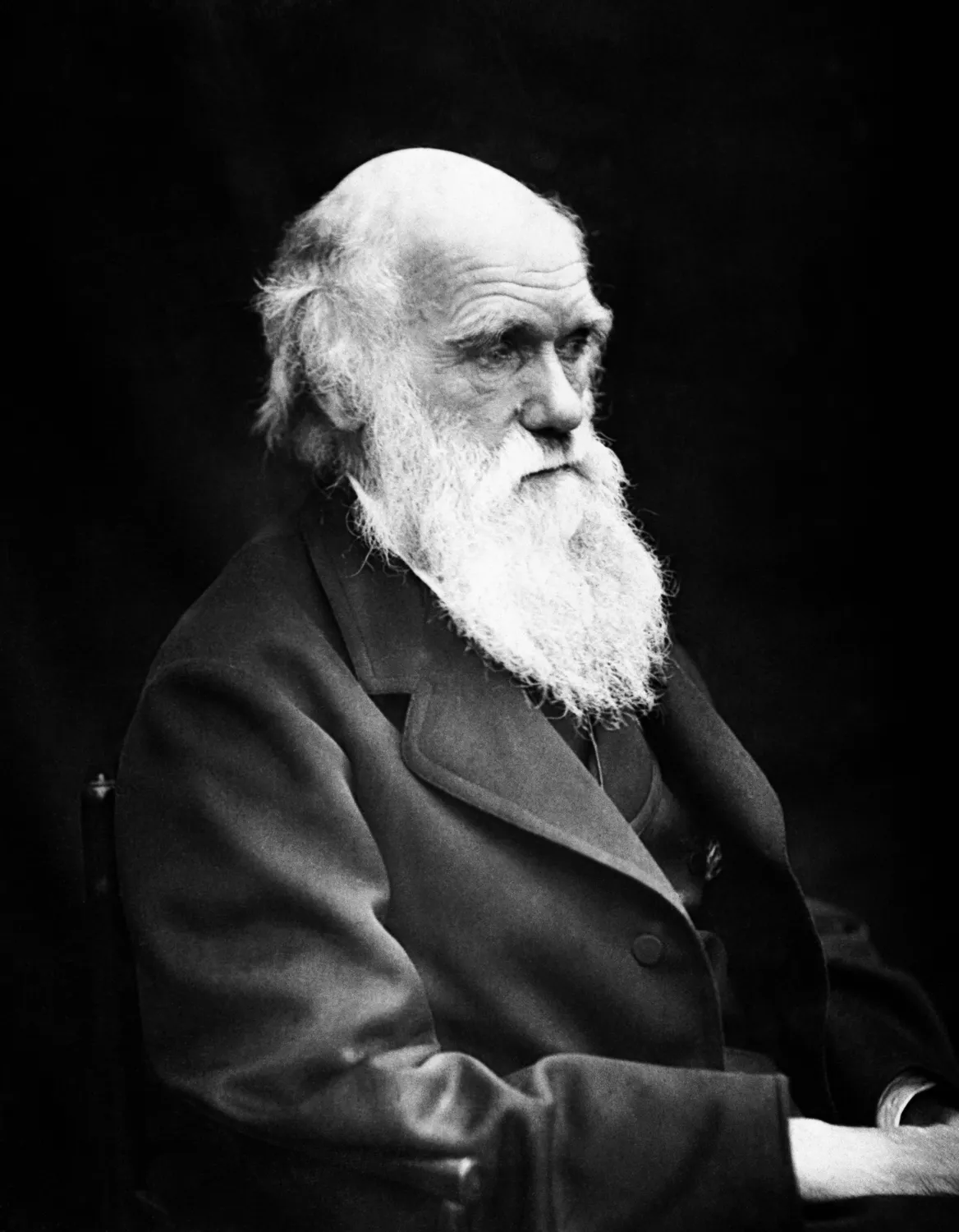
"Charles Darwin" by Julia Margaret Cameron / Wikimedia Commons.
Natural selection is the process by which organisms that are better adapted to their environment are more likely to survive and reproduce. Over time, their traits become more common in the population. This idea was first described by Charles Darwin and is one of the main ways evolution happens.
In every species, individuals are born with slight differences, or variations, in traits like color, size, or speed. These variations are caused by genetic differences and can be passed from parents to offspring. Some traits give an organism an advantage—such as helping it find food, avoid predators, or survive harsh conditions. When these individuals survive and reproduce, they pass those helpful traits to the next generation.
For example, in a forest, green-colored insects may be harder for birds to see. If birds eat more brown insects, the green ones survive longer and have more offspring. Over many generations, more of the insect population becomes green. This is natural selection at work: traits that help survival become more common.
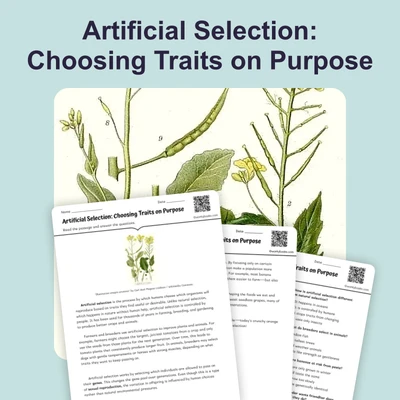
Natural selection is different from artificial selection, where humans choose which traits to pass on. In natural selection, the environment does the “choosing.” It shapes the traits of populations over time, often leading to new species.
Understanding natural selection helps explain why living things are so well-suited to their habitats and why traits can change over generations.
Fun Fact: Darwin’s study of finches in the Galápagos Islands showed how their beak shapes evolved based on the type of food they ate—some for seeds, others for insects!
Comprehension quiz (8 questions)
1. What is natural selection?
2. Who first described natural selection?
3. What causes variation in traits?
4. Why do green insects survive better in a forest?
5. What happens to helpful traits over time?
6. How is natural selection different from artificial selection?
7. What is the main idea of the passage?
8. If a drought affects a plant species, which plants will likely survive?
Perfect for the way you teach
- Build comprehension skills
- Auto-graded quiz
- Differentiated reading
- Read together at home
- Improve fluency
- Quiet reading time
- Reading curriculum support
- Independent practice
- Track Lexile growth