Homozygous Traits
Interactive passage with audio narration, comprehension questions, and printable PDF.
What's included
Homozygous Traits preview and details
About this printable Homozygous Traits science reading passage, NGSS-aligned (Grades 5-8)
Sample passage and quiz from Homozygous Traits
Reading passage and comprehension quiz preview
Understanding Homozygous Traits
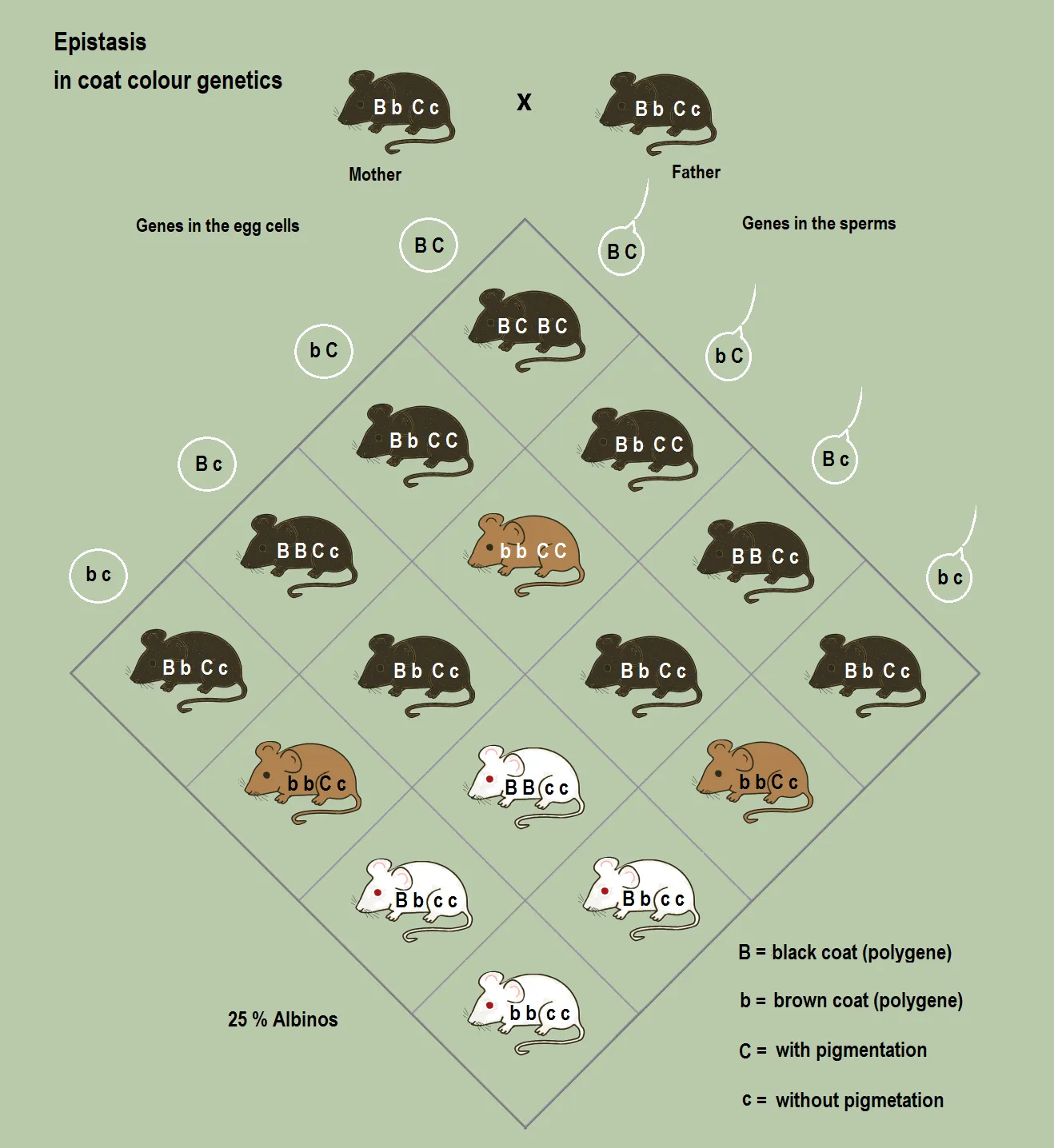
"Epistasis" by Sciencia58 / Wikimedia Commons.
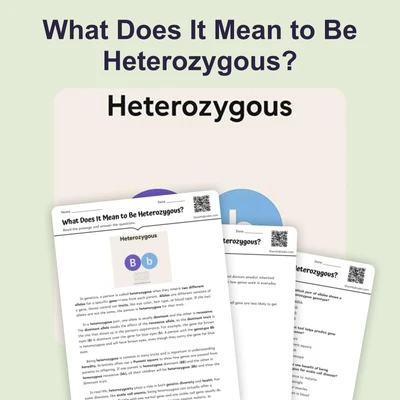
In genetics, the term homozygous describes a condition where an individual has two identical alleles for a particular gene. Alleles are different forms of a gene, and they come in pairs—one inherited from each parent. If both alleles are the same, the person is said to be homozygous for that gene. This is important because it helps determine an organism's traits, or physical characteristics, such as eye color, blood type, or whether a person can roll their tongue.
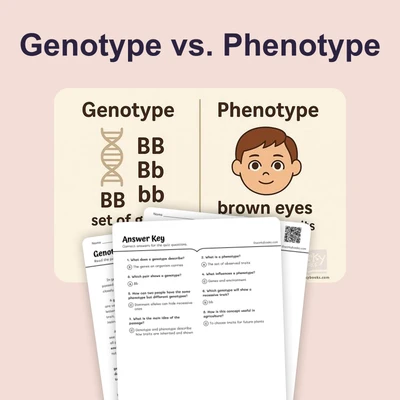
There are two types of homozygous conditions: homozygous dominant and homozygous recessive. In a homozygous dominant pair, both alleles are dominant, and the dominant trait is expressed. For example, if the gene for brown eyes (B) is dominant, a person with the genotype BB will have brown eyes. On the other hand, in a homozygous recessive pair, both alleles are recessive. A person must have two recessive alleles (like bb) to express a recessive trait, such as blue eyes.
Understanding homozygous traits is key to studying heredity and predicting how traits are passed from parents to offspring. Scientists use tools like Punnett squares to model how alleles combine during reproduction. This helps predict the likelihood of offspring inheriting certain traits. For example, if both parents are homozygous for a recessive trait, their children will also inherit that trait.
In real life, knowledge of homozygous genes helps in many areas, including medicine and agriculture. For instance, being homozygous for a certain gene might increase the risk for some genetic diseases, such as cystic fibrosis or sickle cell anemia. In farming, breeders often select homozygous plants to produce more consistent crops.
Homozygous traits help scientists understand how genes work and how they influence what we look like and how our bodies function. By studying these patterns, we can make better predictions about health, heredity, and biological diversity.
Fun Fact: Identical twins have the exact same set of homozygous and heterozygous genes—making them natural genetic clones of each other!
Comprehension quiz (8 questions)
1. What does homozygous mean in genetics?
2. What is a homozygous dominant genotype example?
3. What is required to express a recessive trait?
4. Which tool helps predict inheritance of traits?
5. Why might scientists select homozygous plants?
6. What is the difference between homozygous dominant and recessive?
7. What is the main idea of the passage?
8. If two parents are homozygous recessive, their child will:
Perfect for the way you teach
- Build comprehension skills
- Auto-graded quiz
- Differentiated reading
- Read together at home
- Improve fluency
- Quiet reading time
- Reading curriculum support
- Independent practice
- Track Lexile growth