Genotype vs. Phenotype
Interactive passage with audio narration, comprehension questions, and printable PDF.
By completing this purchase you agree to our Terms of Use and Privacy Policy. Your subscription renews automatically until you cancel. You can cancel anytime from your account settings. All sales are final and non-refundable. Digital content is available for download in your account immediately upon purchase.
What's included
Genotype vs. Phenotype preview and details
About this printable Genotype vs. Phenotype science reading passage, NGSS-aligned (Grades 5-8)
Sample passage and quiz from Genotype vs. Phenotype
Reading passage and comprehension quiz preview
Genotype vs. Phenotype

In genetics, the terms genotype and phenotype help us understand how traits are passed from parents to offspring and how they appear in living things. While they are closely related, they mean different things.
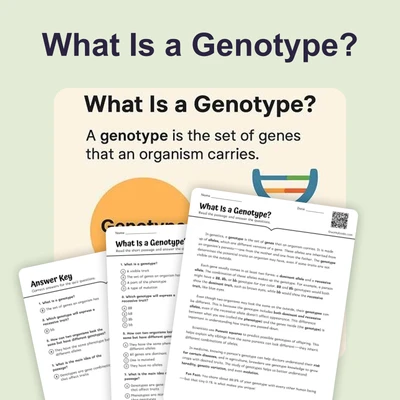
A genotype is the set of genes an organism carries. It is made up of alleles, which are versions of a gene inherited from each parent. Genotypes are written using letters. For example, a person might have a genotype of BB, Bb, or bb for a certain trait. Even though we can’t see a genotype just by looking at someone, it holds the instructions for traits like eye color, height, and blood type.
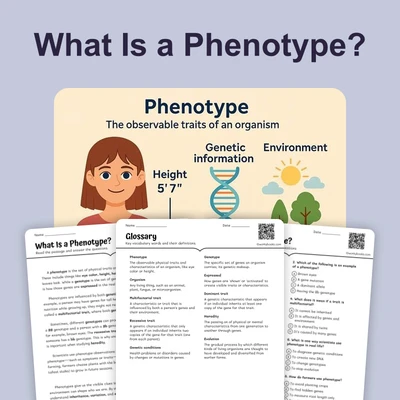
A phenotype, on the other hand, is the set of observable traits—what you can see or measure. For example, having brown eyes, curly hair, or being 5 feet tall are all phenotypes. These traits are influenced by both the genotype and the environment. A person might have the genes to be tall, but if they don’t get the right nutrients while growing up, they may not reach that height.
It’s also possible for two individuals to have the same phenotype but different genotypes. For instance, someone with BB or Bb genotype will both show the dominant trait, such as brown eyes. Only someone with bb will show the recessive trait, like blue eyes.
Understanding the difference between genotype and phenotype helps scientists predict how traits will appear in future generations. It also plays an important role in fields like medicine, agriculture, and evolutionary biology.
Fun Fact: You can have a genotype for dimples but not show them—some traits need both copies of the gene to appear in your phenotype!
Comprehension quiz (8 questions)
1. What does a genotype describe?
2. What is a phenotype?
3. Which pair shows a genotype?
4. What influences a phenotype?
5. How can two people have the same phenotype but different genotypes?
6. Which genotype will show a recessive trait?
7. What is the main idea of the passage?
8. How is this concept useful in agriculture?
Perfect for the way you teach
- Build comprehension skills
- Auto-graded quiz
- Differentiated reading
- Read together at home
- Improve fluency
- Quiet reading time
- Reading curriculum support
- Independent practice
- Track Lexile growth