This learning resource is available in interactive and printable formats. The interactive worksheet can be played online and assigned to students. The Printable PDF version can be downloaded and printed for completion by hand.
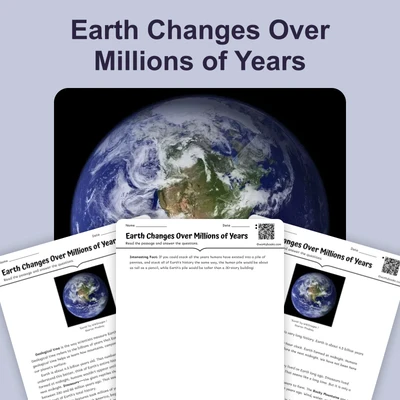
This educational passage for grade 4-5 students introduces the concept of geologic time on Earth, helping learners understand how our planet has changed over millions of years. The passage explains key scientific terms like fossils, eras, and extinction, and describes how scientists use clues from rocks and fossils to learn about Earth's history. Students will discover why geologic time is divided into different eras and periods, and how major events, such as the rise of dinosaurs or the extinction of certain species, have shaped life on our planet. The passage is aligned with NGSS science standards and supports vocabulary development with a glossary. Activities include a multiple-choice quiz and writing prompts that encourage critical thinking and connections to real-world science. Integrated audio and a Spanish translation make this resource accessible for diverse learners. The content is ideal for classroom or home learning and is designed to spark curiosity about geology and Earth's past.
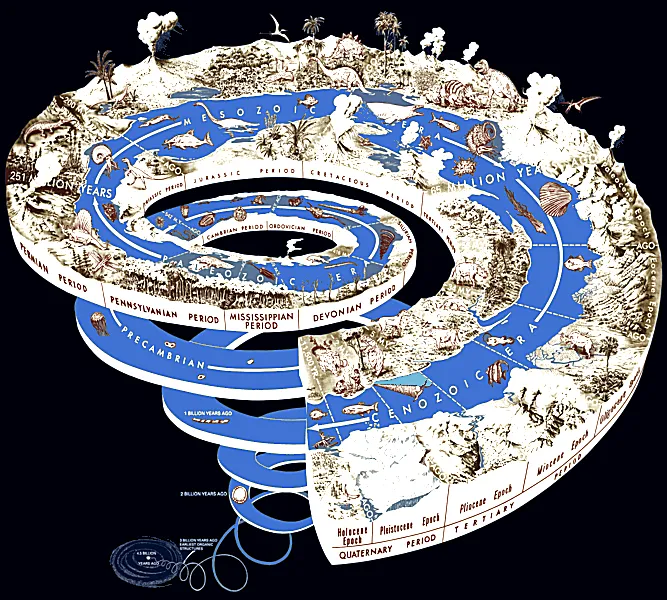
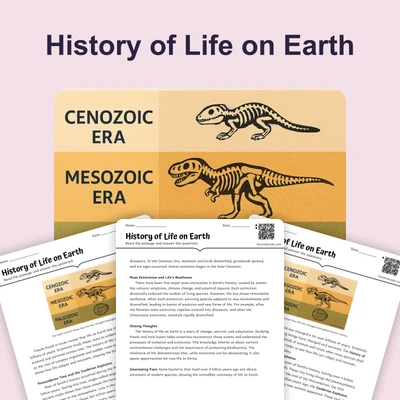
Geologic time is the way scientists describe the long history of Earth. Instead of using days or years, they use millions and billions of years to show how our planet has changed over time. The geologic time scale helps scientists organize Earth’s history into different sections, called eras and periods.
Earth is about 4.6 billion years old. Over this huge amount of time, the planet has gone through many changes. Scientists use fossils as clues to learn about what life was like long ago. A fossil is the remains or imprint of a plant or animal that lived a long time ago and became trapped in rock. For example, dinosaur bones and ancient leaves are fossils. By studying them, scientists can tell when certain animals lived and when they disappeared.
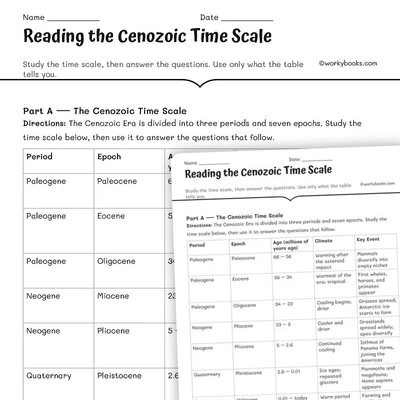
The geologic time scale is divided into major eras: the Paleozoic Era, the Mesozoic Era, and the Cenozoic Era. Each era is marked by big changes in life on Earth. For example, the Mesozoic Era is known as the Age of Dinosaurs, because dinosaurs were the main animals alive then. The Cenozoic Era is called the Age of Mammals, because mammals became more common after the dinosaurs went extinct.
Extinction happens when a type of plant or animal dies out completely. Mass extinctions, like the one that ended the dinosaurs, changed the course of life on Earth. These events help scientists divide time into different eras and periods.
Geologic time helps us understand how Earth’s surface, climate, and life have changed. For example, rocks and fossils found in the Grand Canyon tell us about ancient oceans and creatures that lived there millions of years ago. Learning about geologic time teaches us how slow and amazing Earth’s changes can be.
Interesting Fact: The oldest rocks on Earth are over 4 billion years old, almost as old as the planet itself!
What are fossils?
Remains or imprints of ancient lifeTypes of rocks found in riversTools used by scientistsWeather patterns from the past
How old is Earth?
About 4.6 billion years oldAbout 500 million years oldAbout 2,000 years oldAbout 6 million years old
What is an era?
A major division of geologic timeA type of dinosaurA type of rockA kind of fossil
Why do scientists use geologic time?
To organize Earth's historyTo measure weather changesTo find goldTo grow plants
What caused the Age of Mammals?
Dinosaurs went extinctVolcanoes formedOceans dried upIce Age started
What do fossils help scientists do?
Learn about past lifeMake new rocksCreate new animalsChange Earth's climate
Dinosaurs lived in the Cenozoic Era.
TrueFalse
What does extinction mean?
All of a kind die outA fossil formsA new species appearsAnimals change color
Perfect For:
👩🏫 Teachers
• Reading comprehension practice
• Auto-graded assessments
• Literacy skill development
👨👩👧👦 Parents
• Reading practice at home
• Comprehension improvement
• Educational reading time
🏠 Homeschoolers
• Reading curriculum support
• Independent reading practice
• Progress monitoring
Reading Features:
📖
Reading Passage
Engaging fiction or nonfiction text
❓
Comprehension Quiz
Auto-graded questions
📊
Instant Feedback
Immediate results and scoring
📄
Printable Version
Download for offline reading
🔊
Read Aloud
Voice-over with word highlighting
Reviews & Ratings
No reviews yet. Be the first to share your experience!
Related Content
Tools and Technology in Earth Science
This middle school science reading passage explores the wide range of tools and technologies used in Earth science, from...
MS-ESS2-2MS-ESS3-2MS-ETS1-1MS-PS4-3
Scientific Inquiry in Earth Science
This passage explores scientific inquiry in Earth science for grades 6-8, aligned with NGSS standards MS-ESS1-4, MS-ESS2...
MS-ESS1-4MS-ESS2-1MS-ESS3-5SEP
What Is Earth Science?
This engaging middle school science passage introduces students to the field of Earth science, aligning with NGSS standa...
MS-ESS1MS-ESS2MS-ESS3SEP
Earth: Our Home in Space
This engaging Grade 4-5 science passage, aligned to NGSS, introduces students to Earth's special place in the solar syst...
Earth's Spheres
This middle school science passage introduces students to Earth's four major spheres: the geosphere, hydrosphere, atmosp...
MS-ESS2-4MS-ESS2-6
What Is Space Weather and How Does It Affect the Earth?
This NGSS-aligned science passage for middle school explains what space weather is and how it affects Earth. Students le...
MS-ESS2-2
Earth's Energy Balance
This engaging, NGSS-aligned science passage for grades 6–8 explores Earth's energy balance, a key process that keeps our...
MS-ESS2-6
Earth's Rotation
This middle school science passage, aligned with NGSS standard MS-ESS1-1, focuses on Earth's rotation—how Earth spins on...
MS-ESS1-1
Earth's Land and Water
This 250-word reading passage introduces fourth-grade students to the fundamental concept of how land and water are dist...
NGSS 4-ESS2-2ESS2.B
Earth's Interior
This comprehensive passage for grades 6-8 explores Earth's layered interior, including the crust, mantle, outer core, an...
MS-ESS2-1MS-ESS2-2
Facts About Earth
This engaging science reading passage introduces Grade 4 and 5 students to Earth, our home planet. Aligned with NGSS sta...
Meteorite Impacts on Earth
This engaging science reading passage for Grades 4-5 explores meteorite impacts on Earth, aligning with NGSS standards. ...
Venus: Earth's Twin?
This comprehensive science passage for grades 6-8 examines Venus—often called Earth's twin—by exploring its similarities...
MS-ESS1-2MS-ESS1-3
Earth Changes Over Millions of Years
This engaging, audio-integrated science passage for Grade 4-5 students explores how Earth has changed over millions of y...
Volcano Patterns on Earth
This Grade 4 science reading passage introduces students to volcano patterns on Earth, aligned with NGSS standard 4-ESS2...
NGSS 4-ESS2-2
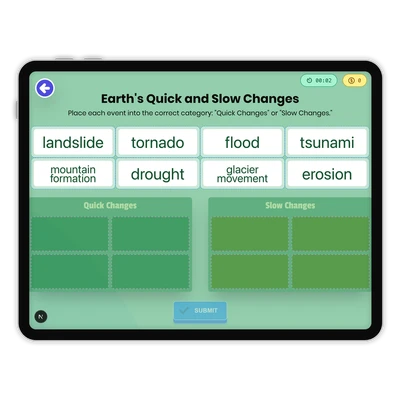
Earth's Quick and Slow Changes
In 'Earth's Quick and Slow Changes,' students categorize 12 Earth events by their speed of occurrence, enhancing underst...
Earth: Our Home Planet
This comprehensive science passage for grades 6-8 explores Earth’s unique characteristics and the interconnected systems...
MS-ESS1-2
Earth's Moon Facts
This engaging science passage, 'The Moon: Earth's Companion,' is designed for Grade 4-5 students and aligns with NGSS ge...
Earth's Revolution
This middle school science passage explores the science behind Earth's revolution around the Sun, closely aligned with N...
MS-ESS1-1
Earthquake Patterns on Earth
This engaging 250-word reading passage introduces fourth-grade students to earthquake patterns on Earth, aligned with NG...