Earth's Revolution
Interactive passage with audio narration, comprehension questions, and printable PDF.
By completing this purchase you agree to our Terms of Use and Privacy Policy. Your subscription renews automatically until you cancel. You can cancel anytime from your account settings. All sales are final and non-refundable. Digital content is available for download in your account immediately upon purchase.
What's included
Earth's Revolution preview and details
About this printable Earth's Revolution science reading passage, NGSS-aligned (Grades 5-8)
Sample passage and quiz from Earth's Revolution
Reading passage and comprehension quiz preview
Earth's Revolution
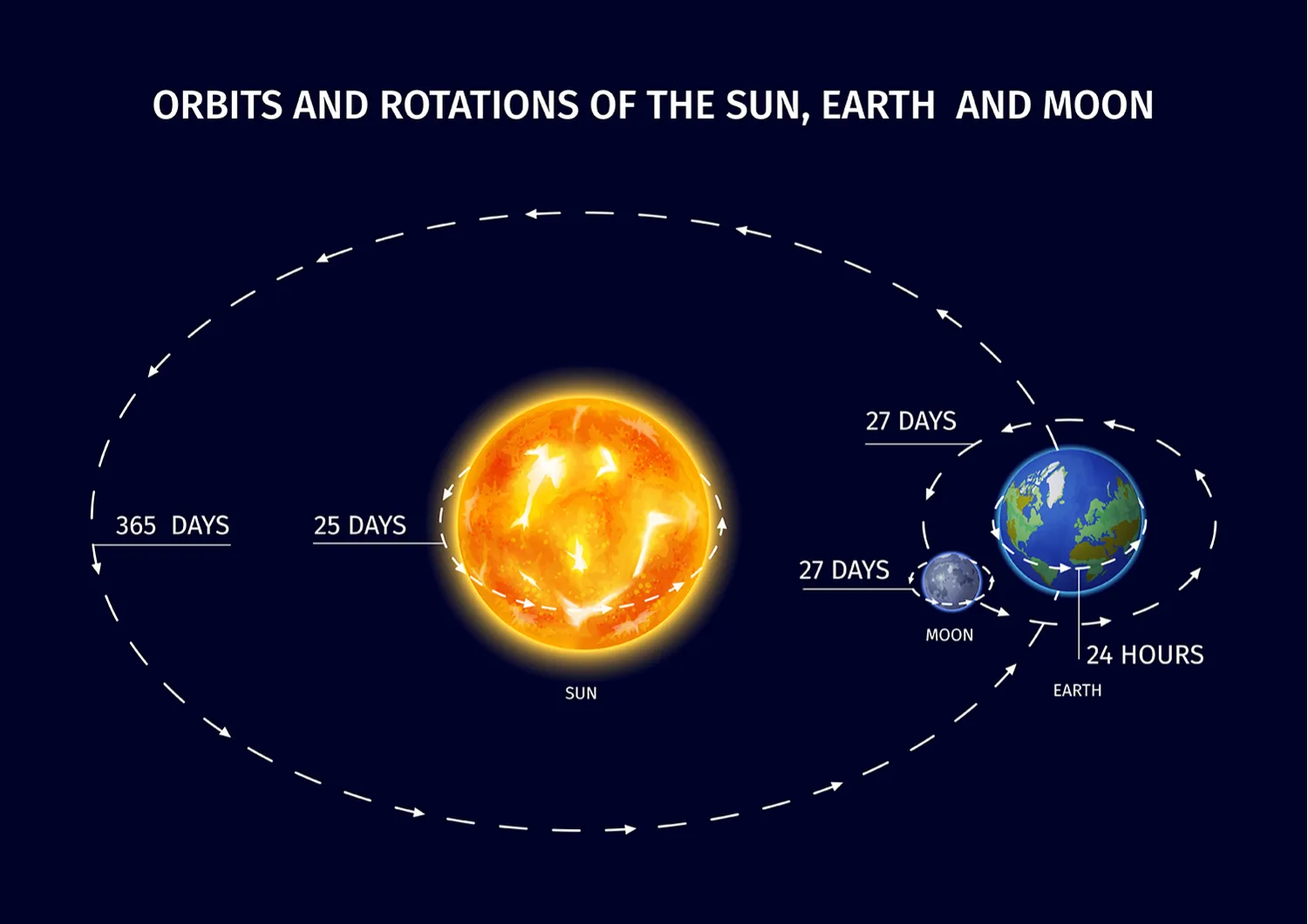
Earth's revolution is the movement of our planet as it travels around the Sun. This process is fundamental for understanding why we experience changing seasons and why different constellations appear in the night sky throughout the year. Scientists have studied Earth's path and gathered evidence to explain how this revolution works and why it happens.
How Earth Orbits the Sun
Earth does not move in a perfect circle around the Sun. Instead, its path is an ellipse, which is a slightly stretched oval shape. At its closest point to the Sun, called perihelion, Earth is about 147 million kilometers away, occurring in early January. At its farthest point, called aphelion, Earth is about 152 million kilometers away, which happens in early July. The average speed of Earth during this journey is about 30 kilometers per second (around 67,000 miles per hour). Despite this incredible speed, we do not feel Earth's motion because everything on the planet—including the atmosphere—moves at the same speed.
The Forces Behind Revolution
Earth's revolution is the result of a balance between two factors: the gravitational pull of the Sun and Earth's own forward motion, which is called inertia. Gravity acts like a tether, pulling Earth toward the Sun, while inertia keeps Earth moving forward in its path. The result is that Earth follows a curved, elliptical orbit instead of falling into the Sun or flying off into space. If you looked down at the solar system from above, you would see Earth moving in a counter-clockwise direction around the Sun.
Evidence for Earth’s Revolution
Scientists have several ways to demonstrate that Earth is truly orbiting the Sun. One method is called parallax. As Earth moves, the position of nearby stars appears to shift slightly compared to distant stars. Another is the aberration of starlight, where the direction of incoming starlight changes due to Earth’s motion. These observations can only be explained if Earth is in motion around the Sun. The shifting appearance of constellations also provides evidence; we can only see some constellations during certain times of the year because of our planet’s changing position.
Connections to History and Science
For centuries, people believed in a geocentric model, where Earth was thought to be at the center of the universe. This changed with the work of scientists like Copernicus, who proposed the heliocentric model, placing the Sun at the center. The revolution of Earth is a critical part of this model and helps explain many observable phenomena, from the changing length of days to the cycle of zodiac constellations along the ecliptic—the apparent path the Sun traces across the sky.
Understanding Earth's revolution helps us make sense of time, calendars, and our place within the solar system. It connects directly to broader principles in science, including motion, gravity, and the use of evidence to test ideas.
Interesting Fact: Because it takes about 365.25 days for Earth to complete one revolution, we add a leap day every four years to keep our calendar in sync with Earth's orbit.
Comprehension quiz (10 questions)
1. What is the shape of Earth's orbit around the Sun?
2. How long does it take Earth to complete one revolution around the Sun?
3. What is the term for the point when Earth is closest to the Sun?
4. What two forces keep Earth moving in its orbit?
5. Which word best describes the force that keeps Earth attracted to the Sun?
6. In the context of the passage, what does 'inertia' mean?
7. Why do we see different constellations at different times of year?
8. If Earth's orbit was a perfect circle, what would change?
9. Earth’s revolution is evidence for the heliocentric model of the solar system.
10. Earth moves at about 67,000 miles per hour around the Sun, but we do not feel this motion.
Perfect for the way you teach
- Build comprehension skills
- Auto-graded quiz
- Differentiated reading
- Read together at home
- Improve fluency
- Quiet reading time
- Reading curriculum support
- Independent practice
- Track Lexile growth