This learning resource is available in interactive and printable formats. The interactive worksheet can be played online and assigned to students. The Printable PDF version can be downloaded and printed for completion by hand.
This comprehensive science passage for grades 6-8 examines Venus—often called Earth's twin—by exploring its similarities and dramatic differences from Earth. Covering key NGSS standards MS-ESS1-2 and MS-ESS1-3, students will learn about Venus's retrograde rotation, dense atmosphere, runaway greenhouse effect, volcanic activity, and scientific exploration by Soviet Venera landers and the Magellan mission. The passage emphasizes cause-and-effect relationships, such as how Venus's thick carbon dioxide atmosphere leads to its surface being hot enough to melt lead. Students will develop scientific thinking by connecting observable phenomena, data, and underlying mechanisms, while also building academic vocabulary. Activities include multiple-choice questions, writing prompts, and graphic organizers, making the resource ideal for inquiry-based learning. Audio integration and Spanish translations enhance accessibility for diverse learners.
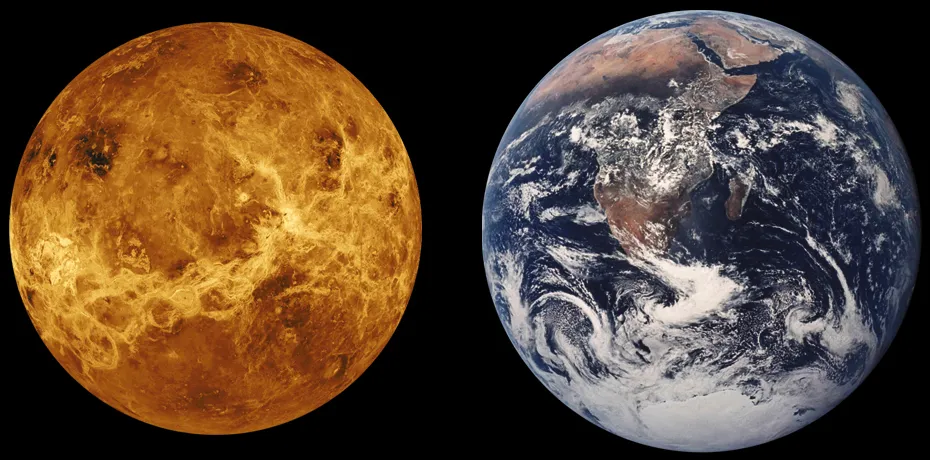
Venus is the brightest planet in the night sky after the Moon and is often called the "morning star" or "evening star." Its similar size—about 12,100 kilometers in diameter—and mass, which is 0.82 times that of Earth, have led scientists to nickname it "Earth's twin." Yet, beneath this resemblance, Venus is one of the most extreme planets in our solar system, making scientists question what makes two similar planets so different.
Why Is Venus So Hot?
One of the most striking features of Venus is its surface temperature, which reaches 465°C (870°F)—hot enough to melt lead. This is hotter than Mercury, even though Venus is farther from the Sun. The main cause is Venus’s atmosphere, which is 96% carbon dioxide (CO₂) and about 90 times thicker than Earth’s. This dense atmosphere creates a runaway greenhouse effect: sunlight passes through the atmosphere and heats the surface, but the thick CO₂ traps the heat and prevents it from escaping back into space. Over millions of years, this process caused Venus to become a scorching world. The planet’s thick, yellowish clouds of sulfuric acid also block our view of the surface and add to the heat-trapping effect.
Rotation, Surface, and Exploration
Venus rotates in the opposite direction of most planets (retrograde rotation) and does so very slowly—one day on Venus lasts 243 Earth days, which is longer than its year (225 Earth days). Because of this rotation, a day on Venus (from one sunrise to the next) is about 117 Earth days. The surface is covered in volcanic plains, mountains, and impact craters. Scientists think volcanoes may still be active. Venus has no moons. Most of what we know about the surface comes from radar images, especially those taken by NASA's Magellan spacecraft, and data from Soviet Venera landers, which survived only a few hours in the hostile environment before being destroyed by the pressure and heat.
Why Are Venus and Earth So Different?
Even though Venus and Earth started out similarly, Venus’s closer orbit to the Sun and its thick CO₂ atmosphere led to very different outcomes. Scientists think Venus once had water, like Earth, but higher temperatures caused the water to evaporate and escape into space. As a result, carbon dioxide built up in the atmosphere instead of being locked away in oceans or rocks. This created the runaway greenhouse effect that now makes Venus so inhospitable. The study of Venus helps us understand planetary systems and the importance of atmospheric balance for life.
Venus remains a bright point in our sky and a warning of how planet-wide changes can transform a world.
Interesting Fact: Venus is so bright that it can cast shadows on Earth and is sometimes visible in daylight!
What is the main reason Venus is hotter than Mercury, even though it is farther from the Sun?
Its thick carbon dioxide atmosphere traps heat.It is larger than Mercury.It has more volcanoes than Mercury.It rotates faster than Mercury.
How long does one day on Venus last compared to its year?
A day is shorter than a year.A day is exactly the same as a year.A day is longer than its year.A day and a year are both 24 hours.
What is the composition of Venus's atmosphere?
Mostly nitrogen.96% carbon dioxide.Mostly oxygen.Hydrogen and helium.
Which word in the passage describes the process that keeps Venus extremely hot by trapping heat?
What is a 'morning star' as mentioned in the passage?
A type of star found in the morning.A nickname for Mercury.A name for Venus when it's bright in the morning sky.A phase of Earth's Moon.
Why do scientists think Venus once had water?
Because Venus is blue like Earth.Because Venus's early atmosphere and position allowed for liquid water before it evaporated.Because Venus has moons.Because it has the same length of day as Earth.
If a planet has a thick carbon dioxide atmosphere and is close to its star, what might happen to its surface temperature?
The surface temperature would likely increase a lot.The temperature would drop below freezing.It would have no effect on temperature.It would be the same as Earth's temperature.
Scientists can study Venus's surface using radar images because:
Radar can see through the thick clouds.Radar bounces off the Sun.Venus has no clouds.Radar is only used on Earth.
Venus has no moons. (True/False)
TrueFalse
The surface of Venus is cool and covered in ice. (True/False)
TrueFalse
Perfect For:
👩🏫 Teachers
• Reading comprehension practice
• Auto-graded assessments
• Literacy skill development
👨👩👧👦 Parents
• Reading practice at home
• Comprehension improvement
• Educational reading time
🏠 Homeschoolers
• Reading curriculum support
• Independent reading practice
• Progress monitoring
Reading Features:
📖
Reading Passage
Engaging fiction or nonfiction text
❓
Comprehension Quiz
Auto-graded questions
📊
Instant Feedback
Immediate results and scoring
📄
Printable Version
Download for offline reading
🔊
Read Aloud
Voice-over with word highlighting
Reviews & Ratings
No reviews yet. Be the first to share your experience!
Related Content
Comets
This middle school science passage explores the fascinating world of comets, commonly known as 'dirty snowballs.' Studen...
MS-ESS1-2
Mercury: Closest to the Sun
This comprehensive, standards-aligned passage explores Mercury—the smallest and closest planet to the Sun. Students in g...
MS-ESS1-2MS-ESS1-3
Earth: Our Home Planet
This comprehensive science passage for grades 6-8 explores Earth’s unique characteristics and the interconnected systems...
MS-ESS1-2
Mars: The Red Planet
This middle school science passage explores Mars, the Red Planet, providing students in grades 6-8 with a comprehensive ...
MS-ESS1-2MS-ESS1-3
What Is Gravity?
This comprehensive middle school science reading passage explores the concept of gravity, aligning with NGSS standards M...
MS-ESS1-2MS-PS2-4
Kepler's Laws of Planetary Motion
This comprehensive middle school science passage explores Kepler's Laws of Planetary Motion, meeting NGSS Standard MS-ES...
MS-ESS1-2
Tides and Tidal Forces
This middle school science passage explores the mechanisms of tides and tidal forces, aligning with NGSS standards MS-ES...
MS-ESS1-1MS-ESS1-2
Escape Velocity and Space Travel
This middle school science passage introduces students to the concept of escape velocity—the minimum speed required to b...
MS-ESS1-2MS-PS2-4
Weightlessness and Microgravity
This science reading passage for middle school students explores the phenomenon of weightlessness and microgravity. Alig...
MS-PS2-4MS-ESS1-2
Orbits and Orbital Motion
This middle school science passage, aligned with NGSS MS-ESS1-2 and MS-PS2-4, explores the science of orbits and orbital...
MS-ESS1-2MS-PS2-4
What Is the Solar System?
This passage provides a comprehensive overview of the solar system for grades 6-8, aligned with NGSS standards MS-ESS1-2...
MS-ESS1-2MS-ESS1-3
Structure of the Solar System
This comprehensive science reading passage introduces middle school students (grades 6-8) to the structure of the solar ...
MS-ESS1-2MS-ESS1-3
Moons of the Solar System
This comprehensive passage, designed for grades 6-8 and aligned to NGSS standard MS-ESS1-2, delves into the fascinating ...
MS-ESS1-2
Defining Life: What Are We Looking For?
This informational science passage for middle school students explores the question: What is life, and how do we define ...
MS-LS1-1MS-ESS1-2
Astronomy
This comprehensive reading passage introduces middle school students to the science of astronomy, which is the study of ...
MS-ESS1-2MS-ESS1-3MS-PS4-2MS-ETS1-1
The Solar System
This middle school science passage introduces students to the solar system, aligning with NGSS standards MS-ESS1-2 and M...
MS-ESS1-2MS-ESS1-3
Gravity and Orbits
This comprehensive passage for grades 6-8 explains the science of gravity and orbits, aligning with NGSS standard MS-ESS...
MS-ESS1-2
The Inner Planets
This comprehensive science passage for grades 6-8 explores the inner (terrestrial) planets of our solar system—Mercury, ...
MS-ESS1-2MS-ESS1-3
The Outer Planets
This engaging science passage for grades 6-8 introduces students to the outer planets—Jupiter, Saturn, Uranus, and Neptu...