This learning resource is available in interactive and printable formats. The interactive worksheet can be played online and assigned to students. The Printable PDF version can be downloaded and printed for completion by hand.
This comprehensive reading passage for grades 6-8 explains why Earth has seasons, revealing the scientific mechanisms behind this familiar phenomenon. Aligned with NGSS MS-ESS1-1, students will learn how Earth's 23.5° axial tilt and annual revolution around the Sun create seasonal changes, rather than the planet's distance from the Sun. The passage explores cause-and-effect relationships, including how the tilt determines the amount of direct sunlight each hemisphere receives, leading to summer and winter, and why equinoxes bring equal day and night. It also addresses why the equator experiences little seasonal variation and why seasons are reversed in the northern and southern hemispheres. The resource includes a Spanish translation, differentiated version, glossary, quiz, writing prompts, and graphic organizers, making it ideal for diverse learners. Audio integration supports accessibility. This passage is perfect for building scientific literacy and understanding Earth's place in the solar system.
CONTENT PREVIEW
Expand content preview
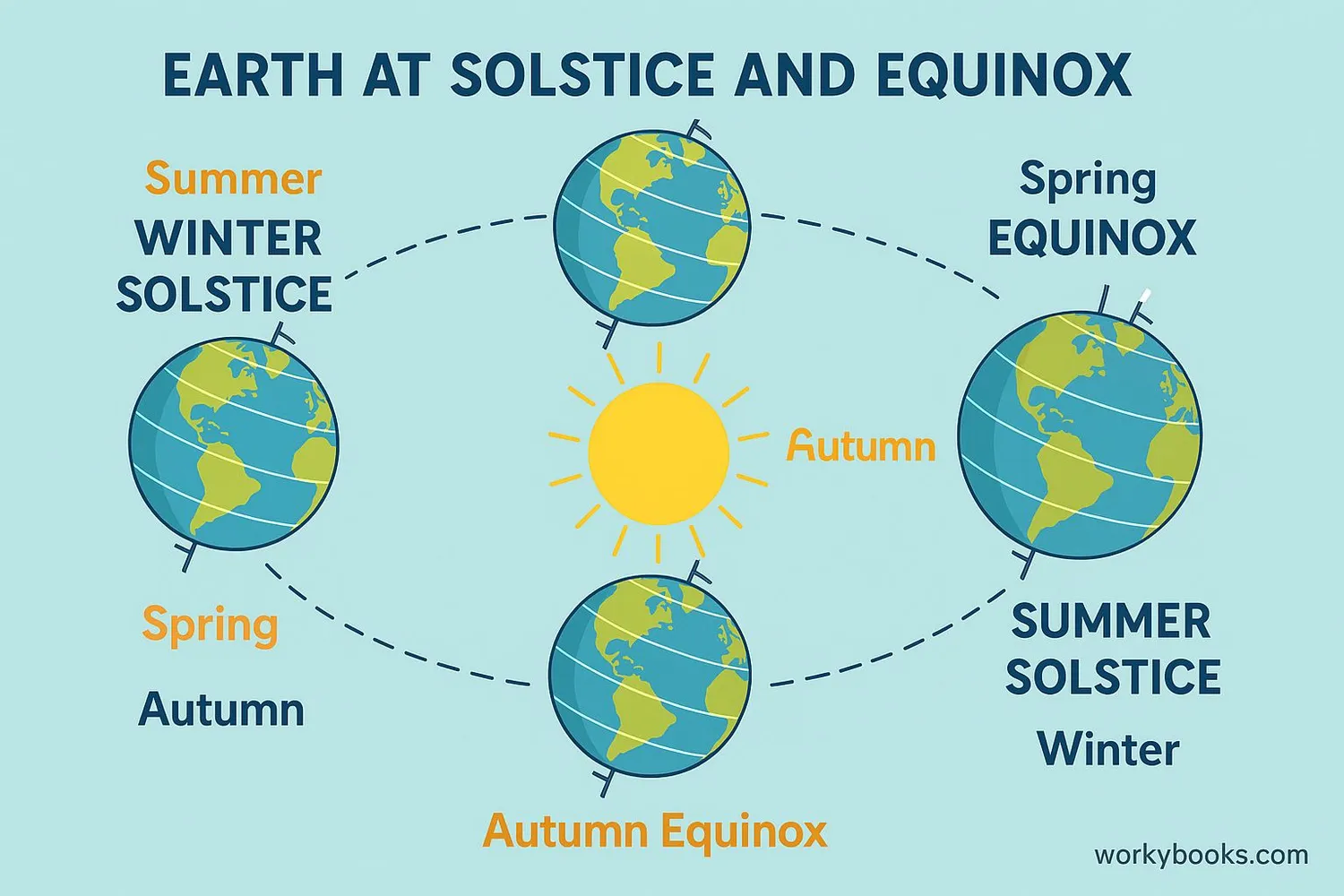
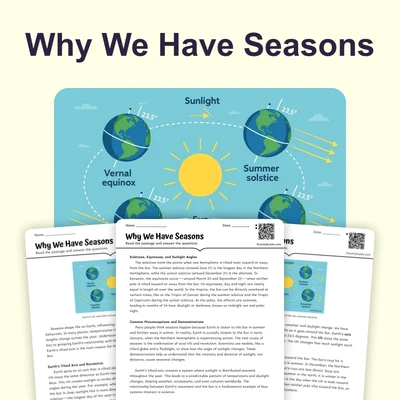
The four key positions in Earth's orbit around the Sun
Earth’s seasons are a fundamental pattern observed in nature, influencing life across the planet. Temperatures rise and fall, days grow longer or shorter, and ecosystems change throughout the year. Scientists have discovered that these regular changes are not caused by Earth’s distance from the Sun. In fact, Earth is closest to the Sun in January, during the Northern Hemisphere’s winter. Instead, the main reason for seasonal changes is the combination of Earth’s 23.5° axial tilt and its annual revolution around the Sun.
How Axial Tilt and Revolution Cause Seasons
Earth’s axis is an invisible line running from the North Pole to the South Pole. This axis is tilted at an angle of 23.5° relative to the plane of its orbit. As Earth revolves around the Sun once every 365.25 days, the orientation of this tilt does not change. This means that at different times of the year, either the Northern or Southern Hemisphere is tilted toward the Sun. When a hemisphere is tilted toward the Sun, it receives more direct sunlight and experiences summer—days are longer, and the Sun’s rays strike the ground more directly. When the same hemisphere is tilted away from the Sun six months later, it receives less direct sunlight, resulting in winter with shorter days and cooler temperatures. The amount of solar energy per square meter can be up to 90% higher in summer than in winter for some regions.
Equinoxes, Solstices, and Regional Differences
The equinoxes occur twice a year, around March 21 and September 23. During these times, neither hemisphere is tilted toward or away from the Sun, creating nearly equal day and night lengths everywhere on Earth. The solstices, around June 21 and December 21, mark the longest and shortest days of the year. At the June solstice, the Northern Hemisphere receives the most direct sunlight and has its longest day, while the Southern Hemisphere has its shortest day and vice versa in December. The equator experiences little seasonal variation because sunlight strikes it almost directly all year, so day length and temperatures are more consistent. In contrast, regions farther from the equator have greater differences between seasons.
Seasonal Reversals and Global Impacts
Because of Earth’s tilt, when it is summer in the Northern Hemisphere, the Southern Hemisphere experiences winter, and the seasons are reversed. This global pattern affects agriculture, animal behavior, and even human traditions. Scientists use data such as sunlight angles, day length measurements, and temperature records to study these patterns. Understanding the mechanisms behind Earth’s seasons helps explain phenomena like migratory bird patterns, plant growth cycles, and the design of solar energy systems. It also connects to broader scientific principles about how the orientation and movement of objects in space affect conditions on Earth.
In summary, Earth’s seasons are the result of a complex interaction between its axial tilt and annual journey around the Sun. This knowledge allows us to better understand climate, ecosystems, and our own place within the solar system.
Interesting Fact: The word “solstice” comes from Latin and means “sun stands still” because the Sun’s position in the sky appears to pause before reversing direction.
What is the main cause of Earth's seasons?
The 23.5° tilt of Earth's axis and its revolution around the SunEarth's distance from the SunThe speed of Earth's rotationThe shape of Earth's orbit
When is Earth closest to the Sun?
In January, during Northern Hemisphere's winterIn June, during Northern Hemisphere's summerDuring both equinoxesAt the December solstice
What happens during an equinox?
Day and night are nearly equal everywhere on EarthThe Northern Hemisphere has its longest dayThe Sun is closest to EarthThe Southern Hemisphere receives no sunlight
What is 'direct sunlight' as described in the passage?
Sunlight that hits Earth at a steep angle, giving more energySunlight that shines only at the equatorSunlight during nighttimeFiltered sunlight through clouds
Why does the equator experience little seasonal variation?
Sunlight strikes it almost directly all yearIt rotates faster than other regionsIt is closest to the SunIt has higher mountains
Which of the following is true about solstices?
They mark the longest and shortest days of the yearThey occur every monthThey cause equal day and nightThey only affect the equator
If it is summer in the Northern Hemisphere, what season is it in the Southern Hemisphere?
WinterFallSpringSummer
Which statement best describes the relationship between Earth's tilt and day length?
The tilt causes longer days in the hemisphere tilted toward the SunThe tilt causes equal day and night everywhereThe tilt has no effect on day lengthThe tilt only affects the equator
True or False: Earth's distance from the Sun is the main reason for seasons.
TrueFalse
True or False: Scientists use sunlight angles and temperature records to study Earth's seasons.
TrueFalse
Perfect For:
👩🏫 Teachers
• Reading comprehension practice
• Auto-graded assessments
• Literacy skill development
👨👩👧👦 Parents
• Reading practice at home
• Comprehension improvement
• Educational reading time
🏠 Homeschoolers
• Reading curriculum support
• Independent reading practice
• Progress monitoring
Reading Features:
📖
Reading Passage
Engaging fiction or nonfiction text
❓
Comprehension Quiz
Auto-graded questions
📊
Instant Feedback
Immediate results and scoring
📄
Printable Version
Download for offline reading
🔊
Read Aloud
Voice-over with word highlighting
Reviews & Ratings
No reviews yet. Be the first to share your experience!
Related Content
What is Solar Radiation
This NGSS-aligned science reading passage for middle school students explores the concept of solar radiation. Solar radi...
MS-ESS1-1
How Incoming Solar Radiation Changes with Latitude
This NGSS-aligned science reading passage helps middle school students understand how solar radiation, or insolation, ch...
MS-ESS1-1
Tides and Tidal Forces
This middle school science passage explores the mechanisms of tides and tidal forces, aligning with NGSS standards MS-ES...
MS-ESS1-1MS-ESS1-2
The Night Sky
This comprehensive science reading passage for grades 6-8 aligns with NGSS standard MS-ESS1-1 and explores the systems a...
MS-ESS1-1
Ancient Astronomy
This engaging passage for grades 6-8 explores the history of astronomy through the lens of ancient observations. Student...
MS-ESS1-1
Tools of Modern Astronomy
This passage introduces middle school students to modern astronomy, aligning with NGSS standard MS-ESS1-1. It explains h...
MS-ESS1-1
How Astronomy Became a Science
This passage explores the transformative period known as the Scientific Revolution, with a special focus on the history ...
MS-ESS1-1
Earth's Rotation
This middle school science passage, aligned with NGSS standard MS-ESS1-1, focuses on Earth's rotation—how Earth spins on...
MS-ESS1-1
Earth's Revolution
This middle school science passage explores the science behind Earth's revolution around the Sun, closely aligned with N...
MS-ESS1-1
Why We Have Seasons
This comprehensive middle school science reading passage explains the mechanisms behind Earth's seasons, directly addres...
MS-ESS1-1
Phases of the Moon
This comprehensive middle school science passage explains the phases of the Moon, focusing on the mechanisms behind the ...
MS-ESS1-1
Tides
This comprehensive middle school science reading passage explores the phenomenon of ocean tides, aligned to NGSS standar...
MS-ESS1-1MS-ESS1-2
Eclipses
This comprehensive passage for grades 6-8 explores the science behind eclipses, including solar and lunar eclipses, thei...
MS-ESS1-1
The Moon's Characteristics
This comprehensive science reading passage for grades 6-8 examines the Moon's physical characteristics, including its si...
MS-ESS1-1MS-ESS1-2
Lunar Eclipses
This passage introduces middle school students to the phenomenon of lunar eclipses, connecting observable events to the ...
MS-ESS1-1
The Sun's Characteristics
This engaging science passage introduces middle school students to the Sun’s key characteristics, such as its classifica...
MS-ESS1-1MS-ESS1-2
What Is a Galaxy?
This comprehensive middle school science passage answers the question: What is a galaxy? Aligned to NGSS standard MS-ESS...
MS-ESS1-1
The Milky Way: Our Home Galaxy
This comprehensive science passage introduces middle school students to the Milky Way, the barred spiral galaxy that is ...
MS-ESS1-1
Types of Galaxies
This comprehensive middle school science passage introduces students to the classification and characteristics of galaxi...