This learning resource is available in interactive and printable formats. The interactive worksheet can be played online and assigned to students. The Printable PDF version can be downloaded and printed for completion by hand.
This engaging reading passage, titled 'Giant Panda Conservation,' is designed for Grade 5 students and aligns with NGSS LS4.D: Biodiversity and Humans. Students will discover the fascinating world of giant pandas, learn about the threats they face, such as habitat loss, and explore the vital conservation efforts being made to protect these iconic animals and their bamboo forest homes. The passage defines key terms like 'biodiversity' and 'endangered species' in simple language. It emphasizes how human actions can help restore healthy ecosystems and safeguard biodiversity. The content is audio integrated to enhance accessibility and learning. Through this passage and its accompanying activities, students will gain a deeper understanding of wildlife protection and the importance of conservation for our planet's future.
CONTENT PREVIEW
Expand content preview
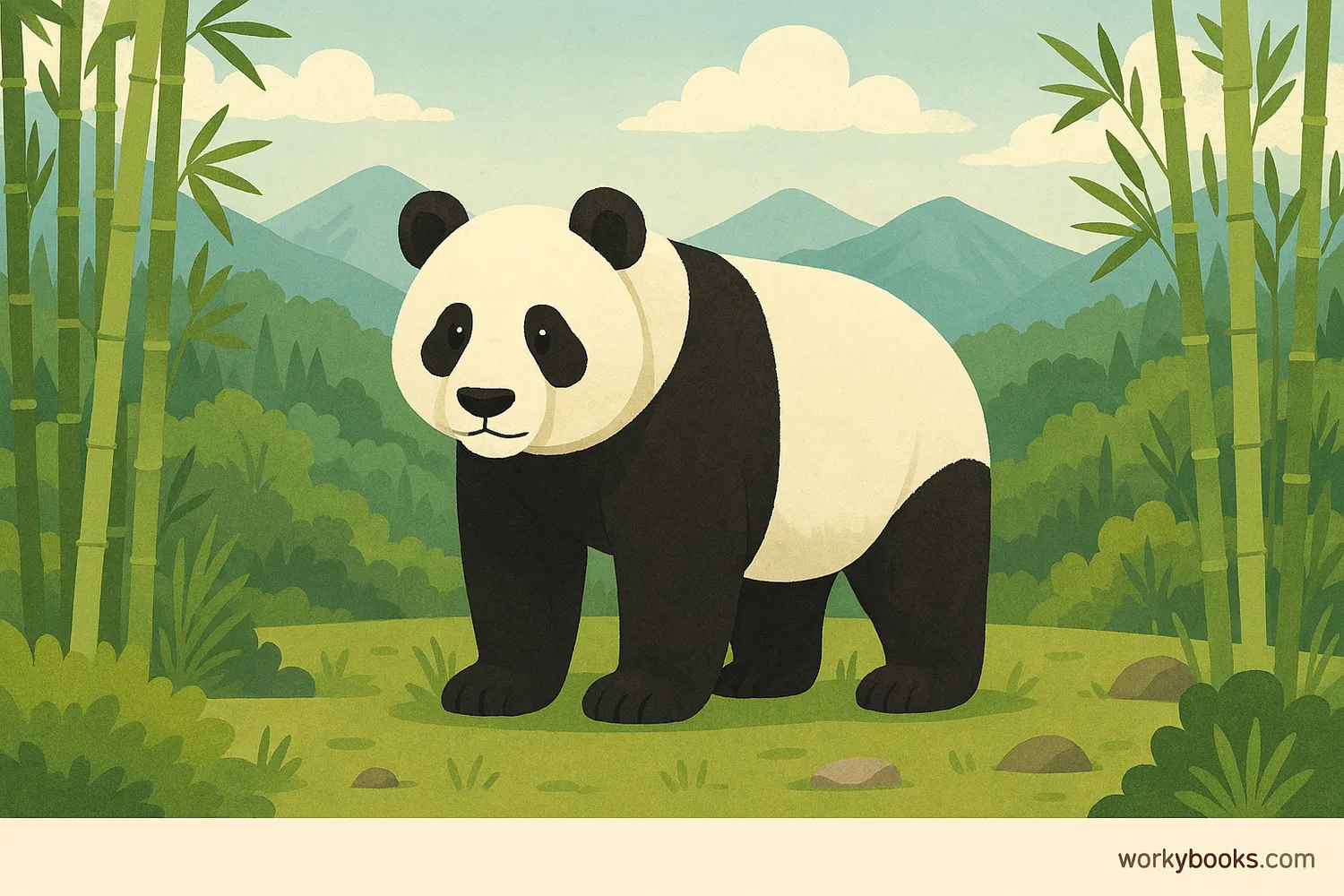
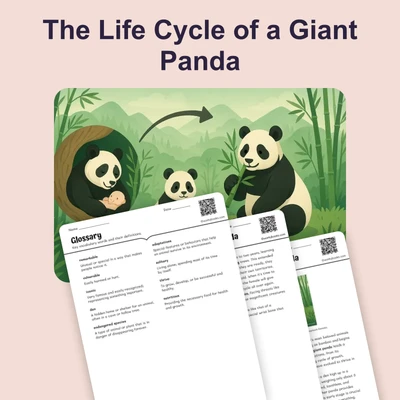
Panda in nature reserve, surrounded by bamboo and mountains, symbolizing conservation success.
Giant Panda Conservation
The giant panda is a rare black-and-white bear that lives in the bamboo forests of central China. Pandas are famous for their unique look and gentle nature. They are a powerful symbol for wildlife conservation around the world.
Pandas mostly eat bamboo. In fact, bamboo makes up almost their entire diet! Pandas eat up to 38 pounds of bamboo every day and spend over 12 hours eating. This is because bamboo does not have much nutrition, so pandas must eat a lot to get enough energy.
There are only about 1,800 pandas left in the wild. Pandas became endangered for several reasons. First, their habitat—the bamboo forests—was cut down for farming and building. This caused fragmented populations, meaning pandas were separated into small groups by roads and villages. Pandas also have slow reproduction. Females are only able to have babies for 2-3 days each year, and the cubs are tiny and fragile when born, about the size of a stick of butter!
Thanks to conservation, pandas have a better chance now. China created 67 panda reserves to protect their habitat. Scientists planted bamboo corridors to connect separated panda groups. Zoos have special breeding programs to help pandas have more cubs. Patrols watch for poachers to keep wild pandas safe. Because of all these efforts, the panda’s status changed from ‘Endangered’ to ‘Vulnerable’ in 2016—a real conservation success!
Panda diplomacy is another way China helps pandas and builds friendships. China loans pandas to zoos around the world. This helps raise money and support for panda conservation. But challenges remain: climate change threatens bamboo forests, pandas still need large territories, and some habitats are still shrinking.
Protecting pandas also saves other plants and animals. Since so many species live in panda forests, the panda is called an umbrella species. The famous World Wildlife Fund (WWF) logo even features a panda!
Giant panda conservation is like growing a garden—scientists planted new bamboo forests, protected pandas like precious seeds, and now the panda population is slowly blooming!
Interesting Fact: A newborn panda cub is 900 times smaller than its mother!
Where do giant pandas live?
Bamboo forests in ChinaDeserts in AfricaRainforests in BrazilMountains in Alaska
What do pandas mostly eat?
BambooFishGrassFruit
About how many wild pandas remain?
1,80018,000800180,000
Why is bamboo important to pandas?
It is their main foodThey build nests with itIt is a toyIt gives them water
How did China help pandas?
Built panda reservesMoved them to desertsGave them fruitTaught them to swim
What is a bamboo corridor?
A planted bamboo pathA zoo enclosureA panda houseA kind of food
Pandas are an umbrella species.
TrueFalse
What does 'habitat' mean?
An animal's homeA type of foodA kind of treeA group of pandas
Perfect For:
👩🏫 Teachers
• Reading comprehension practice
• Auto-graded assessments
• Literacy skill development
👨👩👧👦 Parents
• Reading practice at home
• Comprehension improvement
• Educational reading time
🏠 Homeschoolers
• Reading curriculum support
• Independent reading practice
• Progress monitoring
Reading Features:
📖
Reading Passage
Engaging fiction or nonfiction text
❓
Comprehension Quiz
Auto-graded questions
📊
Instant Feedback
Immediate results and scoring
📄
Printable Version
Download for offline reading
🔊
Read Aloud
Voice-over with word highlighting
Reviews & Ratings
No reviews yet. Be the first to share your experience!
Related Content
Understanding Biological Evolution and Diversity
This passage addresses the NGSS standard 3-LS4-2 focusing on biological evolution and the unity and diversity of life. T...
RI.3.3RI.4.3RI.5.33-LS4-2
Theory of Evolution
This middle school science passage explains the theory of evolution and the concept of common ancestry, aligning with NG...
MS-LS4-1MS-LS4-2
Evidence for Evolution: Comparative Anatomy
This middle school science reading passage explores the evidence for evolution through comparative anatomy, aligning wit...
MS-LS4-2MS-LS4-3
The Nature of Life Science
This passage, aligned with NGSS MS-LS1-1, introduces students in grades 6-8 to the foundational concepts of life science...
MS-LS1-1
Human Evolution
This middle school science passage explains the scientific evidence for human evolution, aligning with NGSS standards MS...
MS-LS4-1MS-LS4-2
The Giant Isopod: Biological Evolution
This NGSS passage examines how giant isopods evolved for deep-sea survival, including slow metabolism for food scarcity,...
MS-LS4-4RI.6.3RI.7.3RI.8.8
Evidence for Evolution: The Fossil Record
This middle school science passage explains the importance of fossils as preserved evidence of ancient life and their ro...
MS-LS4-1
Science Vocabulary
This worksheet on domain-specific words will help students learn some science vocabulary. Students will be asked to matc...
L.3.6L.3.4.A
Simple Machines Science Report
This science writing task requires students to clearly explain how three simple machines work using precise domain-speci...
W.5.4
The Science of Hibernation
This educational module, featuring an audio-integrated reading passage titled 'The Science of Hibernation,' is designed ...
What is an amphibian
This audio-integrated reading passage, "The Life of Amphibians," is designed for 4th-grade students to explore the fasci...
The Levels of Australopithecus
This educational content offers an engaging, audio-integrated reading passage titled 'The Levels of Biological Classific...
The Pumpkin Life Cycle
This informational worksheet explores the pumpkin lifecycle, guiding students through procedural steps in a scientific t...
RI.2.3RI.2.10
The Nature of Science
This passage explores the nature of science for middle school students, aligning with NGSS standards MS-ETS1-4, MS-PS1-1...
MS-ETS1-4MS-PS1-1MS-LS1-1
What Is Earth Science?
This engaging middle school science passage introduces students to the field of Earth science, aligning with NGSS standa...
MS-ESS1MS-ESS2MS-ESS3SEP
The Life Cycle of an Angiosperm
This educational content package delves into the intriguing world of angiosperms and their complex life cycles, perfectl...
Citizen Science and Ecological Monitoring
This engaging passage for grades 6-8 introduces the concept of citizen science and its critical role in ecological monit...
MS-LS2-1
Tools and Technology in Earth Science
This middle school science reading passage explores the wide range of tools and technologies used in Earth science, from...
MS-ESS2-2MS-ESS3-2MS-ETS1-1MS-PS4-3
Barnacle Life Cycle
This audio-integrated reading passage, "Barnacle Life Cycle," delves into the intriguing growth and development of barna...
History of Life on Earth
This comprehensive middle school science reading passage provides an engaging overview of the history of life on Earth, ...