This learning resource is available in interactive and printable formats. The interactive worksheet can be played online and assigned to students. The Printable PDF version can be downloaded and printed for completion by hand.
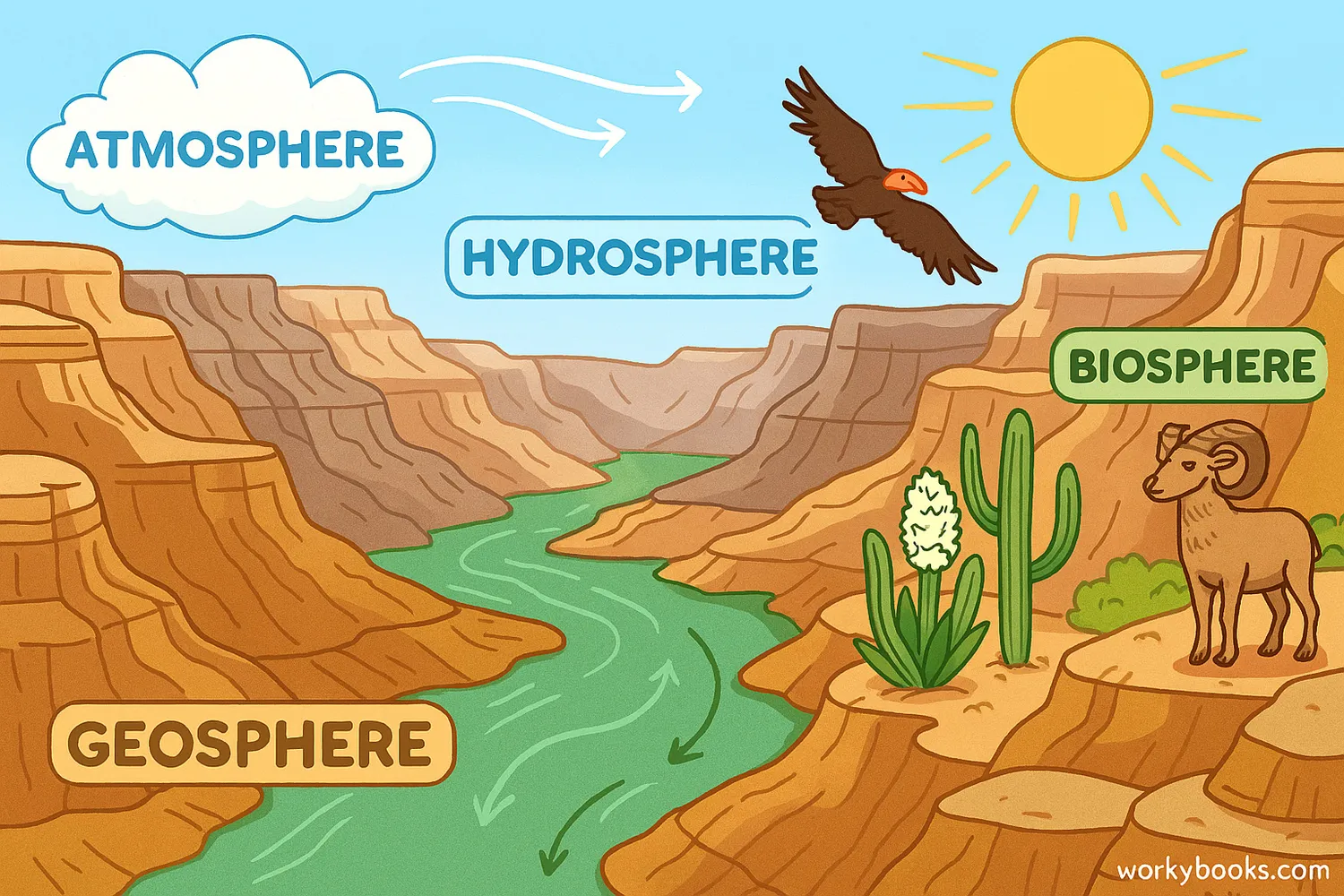
This educational passage, audio integrated, delves into the fascinating Grand Canyon ecosystems, highlighting the intricate interactions between Earth's systems: the geosphere (rocks and landforms), biosphere (living things), hydrosphere (water), and atmosphere (air). Students will explore how the powerful Colorado River carves through rock, how unique desert plants and animals adapt to the arid environment, and how weather patterns influence this majestic landscape. Aligned with NGSS 5-ESS2-1, this content helps students develop a model to describe these interactions using the Grand Canyon as a vivid example. Keywords: Grand Canyon, ecosystems, geosphere, biosphere, hydrosphere, atmosphere, Colorado River, desert plants, NGSS 5-ESS2-1.
CONTENT PREVIEW
Expand content preview
Earth’s systems interact in the Grand Canyon: rocks, river, life, wind, and sun.
Grand Canyon Ecosystems
The Grand Canyon is one of Earth's most amazing places. It is over a mile deep and stretches for 277 miles. The canyon is special because it has several different ecosystems stacked on top of each other, from the cool rim at the top to the hot desert at the bottom. This is called the effect of elevation, which means how high or low a place is above sea level.
At the top rim, more than 7,000 feet above sea level, the air is cool and there are forests of pine and fir trees. Animals like mule deer, elk, mountain lions, and wild turkeys live here. This part of the canyon is like a mountain forest.
As you go down into the canyon, it gets warmer and drier. In the middle, there are pinyon-juniper woodlands with tough trees and shrubs. You can spot desert bighorn sheep, ringtails, and many reptiles here. This area is more like a dry, rocky land.
The lowest part, called the inner canyon, is about 2,400 feet above sea level. Here, the climate is hot and dry like a desert. Cacti grow here, and animals such as scorpions, rattlesnakes, and bighorn sheep survive in the heat. The Colorado River runs through the bottom, creating a special riparian ecosystem with cottonwood trees, fish, beavers, and river otters. Some fish in the river are found nowhere else in the world!
Why are there so many ecosystems stacked in the Grand Canyon? As you go down, the temperature rises and rainfall drops. Different plants and animals need different conditions, so they live where they can survive best. Some animals, like bighorn sheep, can survive with little water. Others, like certain reptiles, are active at night to stay cool. This is called an adaptation.
The Grand Canyon is like a layer cake of nature—each layer has its own weather, plants, and animals. Hiking from the rim to the river is like traveling from Canada to Mexico, all in one place!
Interesting Fact: The Grand Canyon is home to over 1,500 plant species and nearly 500 kinds of animals!
What is an ecosystem?
Living things and their environmentA kind of animalA type of rockA weather pattern
What is found at the top rim?
Cool forests with pine treesHot desert and cactiOnly rocks and sandCoral reefs
What animal lives in the middle canyon?
Desert bighorn sheepPolar bearsAlligatorsPenguins
Why do animals adapt in the canyon?
To survive their environmentTo change colorTo become biggerTo find new rivers
What happens as you go down?
It gets hotter and drierIt gets colderIt gets more rainyIt snows a lot
If a plant needs lots of water, where will it grow?
Near the Colorado RiverIn the hot desertOn the rocky cliffsAt the bottom only
The Grand Canyon is like a layer cake.
TrueFalse
What does 'elevation' mean?
How high or low a place isType of animalA kind of fishPlant color
Perfect For:
👩🏫 Teachers
• Reading comprehension practice
• Auto-graded assessments
• Literacy skill development
👨👩👧👦 Parents
• Reading practice at home
• Comprehension improvement
• Educational reading time
🏠 Homeschoolers
• Reading curriculum support
• Independent reading practice
• Progress monitoring
Reading Features:
📖
Reading Passage
Engaging fiction or nonfiction text
❓
Comprehension Quiz
Auto-graded questions
📊
Instant Feedback
Immediate results and scoring
📄
Printable Version
Download for offline reading
🔊
Read Aloud
Voice-over with word highlighting
Reviews & Ratings
No reviews yet. Be the first to share your experience!
Related Content
Tools and Technology in Earth Science
This middle school science reading passage explores the wide range of tools and technologies used in Earth science, from...
MS-ESS2-2MS-ESS3-2MS-ETS1-1MS-PS4-3
Scientific Inquiry in Earth Science
This passage explores scientific inquiry in Earth science for grades 6-8, aligned with NGSS standards MS-ESS1-4, MS-ESS2...
MS-ESS1-4MS-ESS2-1MS-ESS3-5SEP
What Is Earth Science?
This engaging middle school science passage introduces students to the field of Earth science, aligning with NGSS standa...
MS-ESS1MS-ESS2MS-ESS3SEP
Earth: Our Home in Space
This engaging Grade 4-5 science passage, aligned to NGSS, introduces students to Earth's special place in the solar syst...
Earth's Spheres
This middle school science passage introduces students to Earth's four major spheres: the geosphere, hydrosphere, atmosp...
MS-ESS2-4MS-ESS2-6
What Is Space Weather and How Does It Affect the Earth?
This NGSS-aligned science passage for middle school explains what space weather is and how it affects Earth. Students le...
MS-ESS2-2
Earth's Energy Balance
This engaging, NGSS-aligned science passage for grades 6–8 explores Earth's energy balance, a key process that keeps our...
MS-ESS2-6
Earth's Rotation
This middle school science passage, aligned with NGSS standard MS-ESS1-1, focuses on Earth's rotation—how Earth spins on...
MS-ESS1-1
Earth's Land and Water
This 250-word reading passage introduces fourth-grade students to the fundamental concept of how land and water are dist...
NGSS 4-ESS2-2ESS2.B
Earth's Interior
This comprehensive passage for grades 6-8 explores Earth's layered interior, including the crust, mantle, outer core, an...
MS-ESS2-1MS-ESS2-2
Facts About Earth
This engaging science reading passage introduces Grade 4 and 5 students to Earth, our home planet. Aligned with NGSS sta...
Meteorite Impacts on Earth
This engaging science reading passage for Grades 4-5 explores meteorite impacts on Earth, aligning with NGSS standards. ...
Venus: Earth's Twin?
This comprehensive science passage for grades 6-8 examines Venus—often called Earth's twin—by exploring its similarities...
MS-ESS1-2MS-ESS1-3
Earth Changes Over Millions of Years
This engaging, audio-integrated science passage for Grade 4-5 students explores how Earth has changed over millions of y...
Volcano Patterns on Earth
This Grade 4 science reading passage introduces students to volcano patterns on Earth, aligned with NGSS standard 4-ESS2...
NGSS 4-ESS2-2
Earth's Moon Facts
This engaging science passage, 'The Moon: Earth's Companion,' is designed for Grade 4-5 students and aligns with NGSS ge...
Earth's Quick and Slow Changes
In 'Earth's Quick and Slow Changes,' students categorize 12 Earth events by their speed of occurrence, enhancing underst...
Earth: Our Home Planet
This comprehensive science passage for grades 6-8 explores Earth’s unique characteristics and the interconnected systems...
MS-ESS1-2
Earth's Revolution
This middle school science passage explores the science behind Earth's revolution around the Sun, closely aligned with N...
MS-ESS1-1
Earthquake Patterns on Earth
This engaging 250-word reading passage introduces fourth-grade students to earthquake patterns on Earth, aligned with NG...