Homozygous vs. Heterozygous: Genotype Definitions — Reading Comprehension
Rate this
Premium Resource
Present
Present in classroom. No work saved
Assign
Classroom with student accounts, Track progress
Quick Play
No student accounts, assign with a link
Grades
6
PRINT+DIGITAL RESOURCE
This learning resource is available in interactive and printable formats. The interactive worksheet can be played online and assigned to students. The Printable PDF version can be downloaded and printed for completion by hand.
This audio-integrated reading passage, "Homozygous vs. Heterozygous: Genotype Definitions," is designed for Grade 6 students to understand fundamental concepts in genetics. It delves into how traits are inherited, explaining key terms like 'gene,' 'allele,' 'homozygous,' and 'heterozygous.' Students will learn that genes exist in different forms called alleles, which are responsible for an organism's unique traits, directly aligning with NGSS Standard LS3.A: Inheritance of Traits. The passage uses simple language to make complex ideas accessible and includes relevant SEO keywords. Following the passage, students will engage in a multiple-choice quiz, a glossary activity, and short answer questions to reinforce their comprehension and application of these genetic concepts.
CONTENT PREVIEW
Expand content preview
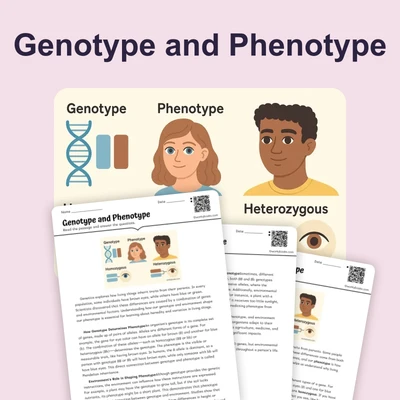
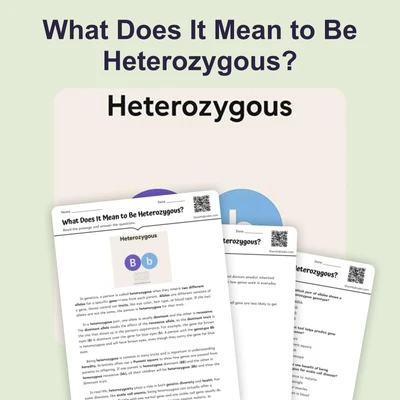
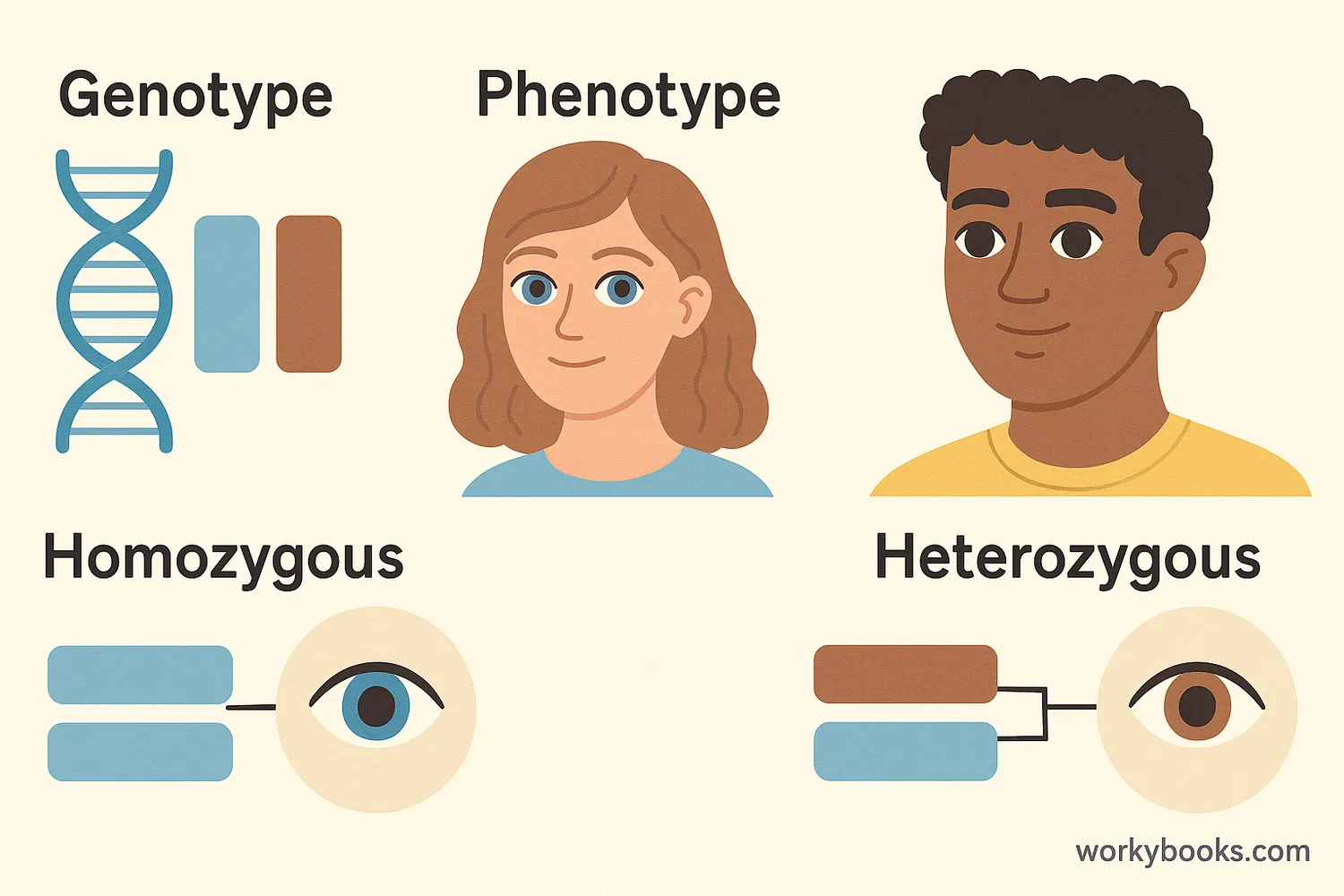
Genetic traits illustrated: genotype, phenotype, homozygous and heterozygous with eye color examples.
Imagine looking at your family. You might notice you have your mother’s eye color or your father’s hair color. How do these traits get passed down? The answer lies in something called genetics, the study of heredity. Every living thing, including you, has a special set of instructions inside its cells. These instructions are called genes. Think of genes as tiny recipe cards that tell your body how to grow and what traits to have.
For each trait, like eye color or hair type, you usually get two copies of a gene – one from your mother and one from your father. These different versions of a gene are called alleles. For example, the gene for eye color might have an allele for blue eyes and an allele for brown eyes. Your unique combination of these alleles is what determines your specific traits.
The specific set of alleles an organism has is called its genotype. This is the genetic makeup you can't always see. What you *can* see, like brown eyes or curly hair, is called the phenotype. The genotype is the internal code, and the phenotype is the observable trait.
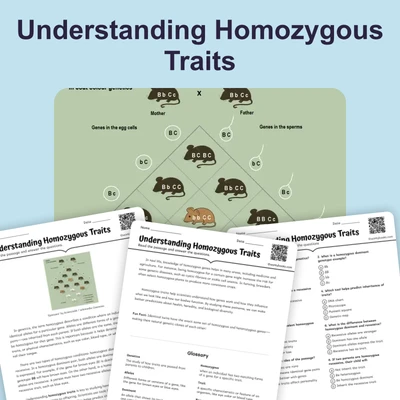
Now let's talk about the different kinds of genotypes. If you receive two identical alleles for a particular trait from your parents, you are homozygous for that trait. For instance, if you get an allele for blue eyes from your mother and an allele for blue eyes from your father, you are homozygous for blue eyes. This means your genetic code for that specific trait is uniform.
On the other hand, if you receive two different alleles for a trait – like one allele for brown eyes and one allele for blue eyes – you are heterozygous for that trait. In this case, one allele might be stronger, or dominant, and show up as your phenotype, while the other, recessive, allele is still present in your genotype but doesn't show. Understanding homozygous and heterozygous genotypes helps us predict how traits are passed through generations in all kinds of organisms, from pea plants to people. These fundamental concepts are key to understanding the diversity of life and how we inherit our unique characteristics.
Interesting Fact: Humans share about 99.9% of their genes with each other, with the slight variations in alleles accounting for all our unique differences!
What are the instructions inside cells called?
GenesTraitsAllelesPhenotypes
What is the study of heredity called?
BiologyGeneticsZoologyBotany
If you have two identical alleles for a trait, you are:
HeterozygousHomozygousDominantRecessive
Which term describes the observable traits?
GenotypeAllelePhenotypeGene
A recessive allele only shows if a person is homozygous for it. This statement is:
TrueFalse
What is the definition of an allele?
A specific traitA version of a geneGenetic makeupObservable characteristic
Why do individuals have two alleles for each trait?
To be heterozygousOne from each parentTo hide traitsFor stronger genes
If a person has a genotype of one allele for brown eyes and one for blue eyes, what is their genotype called?
HomozygousDominantRecessiveHeterozygous
If a plant has a genotype for tallness (TT), and another for shortness (tt), what could be the genotype of their offspring if T is dominant?
TTttTtBoth TT and tt
A cat has fur with spots, but its parents both had solid-colored fur. This suggests the spotted fur allele is likely:
DominantRecessiveHomozygousHeterozygous
Perfect For:
👩🏫 Teachers
• Reading comprehension practice
• Auto-graded assessments
• Literacy skill development
👨👩👧👦 Parents
• Reading practice at home
• Comprehension improvement
• Educational reading time
🏠 Homeschoolers
• Reading curriculum support
• Independent reading practice
• Progress monitoring
Reading Features:
📖
Reading Passage
Engaging fiction or nonfiction text
❓
Comprehension Quiz
Auto-graded questions
📊
Instant Feedback
Immediate results and scoring
📄
Printable Version
Download for offline reading
🔊
Read Aloud
Voice-over with word highlighting
Reviews & Ratings
No reviews yet. Be the first to share your experience!
Related Content
Understanding Biological Evolution and Diversity
This passage addresses the NGSS standard 3-LS4-2 focusing on biological evolution and the unity and diversity of life. T...
RI.3.3RI.4.3RI.5.33-LS4-2
Theory of Evolution
This middle school science passage explains the theory of evolution and the concept of common ancestry, aligning with NG...
MS-LS4-1MS-LS4-2
Evidence for Evolution: Comparative Anatomy
This middle school science reading passage explores the evidence for evolution through comparative anatomy, aligning wit...
MS-LS4-2MS-LS4-3
The Nature of Life Science
This passage, aligned with NGSS MS-LS1-1, introduces students in grades 6-8 to the foundational concepts of life science...
MS-LS1-1
Human Evolution
This middle school science passage explains the scientific evidence for human evolution, aligning with NGSS standards MS...
MS-LS4-1MS-LS4-2
The Giant Isopod: Biological Evolution
This NGSS passage examines how giant isopods evolved for deep-sea survival, including slow metabolism for food scarcity,...
MS-LS4-4RI.6.3RI.7.3RI.8.8
Evidence for Evolution: The Fossil Record
This middle school science passage explains the importance of fossils as preserved evidence of ancient life and their ro...
MS-LS4-1
Science Vocabulary
This worksheet on domain-specific words will help students learn some science vocabulary. Students will be asked to matc...
L.3.6L.3.4.A
Simple Machines Science Report
This science writing task requires students to clearly explain how three simple machines work using precise domain-speci...
W.5.4
The Science of Hibernation
This educational module, featuring an audio-integrated reading passage titled 'The Science of Hibernation,' is designed ...
What is an amphibian
This audio-integrated reading passage, "The Life of Amphibians," is designed for 4th-grade students to explore the fasci...
The Levels of Australopithecus
This educational content offers an engaging, audio-integrated reading passage titled 'The Levels of Biological Classific...
The Nature of Science
This passage explores the nature of science for middle school students, aligning with NGSS standards MS-ETS1-4, MS-PS1-1...
MS-ETS1-4MS-PS1-1MS-LS1-1
The Pumpkin Life Cycle
This informational worksheet explores the pumpkin lifecycle, guiding students through procedural steps in a scientific t...
RI.2.3RI.2.10
What Is Earth Science?
This engaging middle school science passage introduces students to the field of Earth science, aligning with NGSS standa...
MS-ESS1MS-ESS2MS-ESS3SEP
The Life Cycle of an Angiosperm
This educational content package delves into the intriguing world of angiosperms and their complex life cycles, perfectl...
Citizen Science and Ecological Monitoring
This engaging passage for grades 6-8 introduces the concept of citizen science and its critical role in ecological monit...
MS-LS2-1
Tools and Technology in Earth Science
This middle school science reading passage explores the wide range of tools and technologies used in Earth science, from...
MS-ESS2-2MS-ESS3-2MS-ETS1-1MS-PS4-3
Barnacle Life Cycle
This audio-integrated reading passage, "Barnacle Life Cycle," delves into the intriguing growth and development of barna...
History of Life on Earth
This comprehensive middle school science reading passage provides an engaging overview of the history of life on Earth, ...