How Adiabatic Cooling Forms Clouds and Precipitation in the Atmosphere — Reading Comprehension
Rate this
Premium Resource
Present
Present in classroom. No work saved
Assign
Classroom with student accounts, Track progress
Quick Play
No student accounts, assign with a link
Grades
6
PRINT+DIGITAL RESOURCE
This learning resource is available in interactive and printable formats. The interactive worksheet can be played online and assigned to students. The Printable PDF version can be downloaded and printed for completion by hand.
This educational passage, designed for Grade 6 students, explores the fascinating process of adiabatic cooling and its role in forming clouds and precipitation. Aligned with NGSS standard MS-ESS2-5, it helps students understand how the complex interactions of air masses result in changes in weather conditions. Key concepts such as condensation, atmospheric pressure, and the **water cycle** are explained using simple language. Students will learn about how warm, moist air rises, cools, and forms **clouds**, eventually leading to **rain** or snow. This content is audio integrated, making learning accessible and engaging for all students. It's perfect for understanding **weather patterns** and **atmospheric science**.
CONTENT PREVIEW
Expand content preview
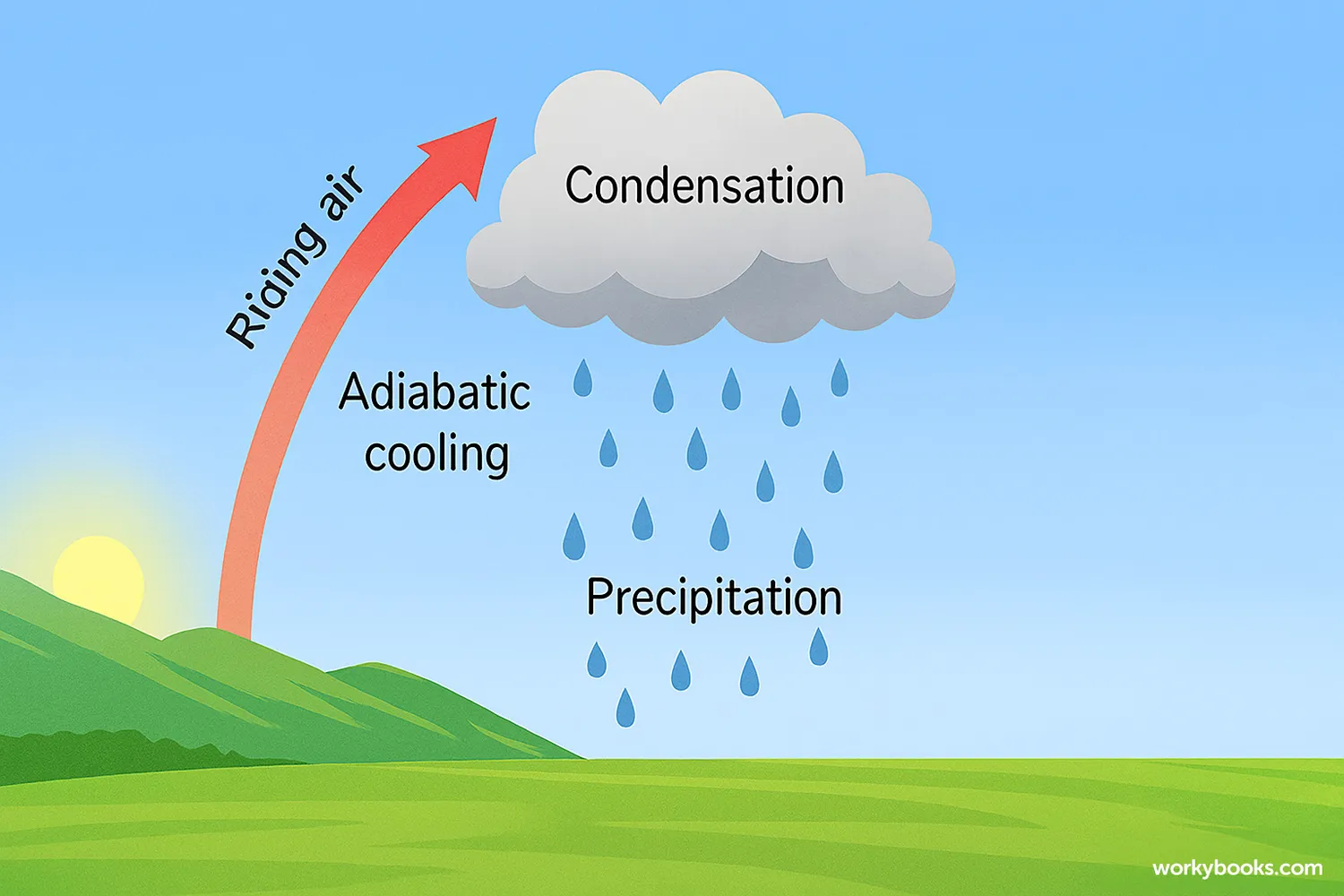
Air rises, cools, condenses into clouds, then falls as rain—completing the water cycle.
Have you ever wondered how clouds form high up in the sky, or why it sometimes rains? It's all thanks to a cool scientific process called adiabatic cooling. This process is a key part of the Earth's water cycle and plays a big role in our weather.
Think about what happens when you let air out of a bicycle tire – it feels cold, right? That's a simple example of adiabatic cooling in action! In the atmosphere, when a parcel of air rises, it moves into areas with lower atmospheric pressure. As the pressure around it decreases, the air parcel expands. When air expands, its molecules spread out, and they don't bump into each other as much. This causes the air to lose energy and cool down without losing any heat to its surroundings. This cooling without heat exchange is adiabatic cooling.
So, how does this lead to clouds? Warm, moist air near the Earth's surface is less dense than the cooler air around it, so it naturally starts to rise. As this warm, moist air rises, it experiences adiabatic cooling. The temperature of the air drops. Cool air cannot hold as much water vapor as warm air. Eventually, the rising air cools to its dew point, which is the temperature at which the air becomes saturated with water vapor. At this point, the invisible water vapor in the air begins to turn into tiny liquid water droplets or ice crystals. This process is called condensation.
These tiny water droplets or ice crystals are what we see as clouds. Clouds are essentially millions of these microscopic particles floating in the sky. If these tiny droplets or crystals continue to grow larger, they eventually become too heavy to remain suspended in the air. When they fall to Earth, we experience precipitation in the form of rain, snow, sleet, or hail. This continuous cycle of rising air, adiabatic cooling, condensation, and precipitation is fundamental to understanding global weather patterns and the distribution of freshwater.
Interesting Fact: The highest clouds, called noctilucent clouds, form at altitudes of up to 85 kilometers (53 miles) and can only be seen during twilight hours.
What causes air to cool during adiabatic cooling?
Heat loss to surroundingsAir expansionAir compressionWater vapor addition
What process turns water vapor into liquid droplets?
EvaporationCondensationPrecipitationSublimation
True or False: Warm air holds less water vapor than cool air.
TrueFalse
The 'dew point' is the temperature at which air becomes:
Very hotSaturated with vaporCompletely dryFrozen solid
What is precipitation?
Rising warm airFalling water to EarthCloud formationAir pressure change
What happens to air pressure as air rises?
IncreasesDecreasesStays the sameBecomes zero
What are clouds primarily made of?
Dry airDust particlesWater droplets/ice crystalsGases only
How does adiabatic cooling affect air temperature?
Makes it hotterMakes it coolerNo changeIncreases pressure
If a warm, moist air mass moves over a mountain range, what weather change would likely occur on the windward side?
Dry conditionsClear skiesCloud formationRising temperature
Imagine you are camping at a high altitude. Why might you notice more clouds forming around mountain peaks even on a sunny day?
Less sunlightMore pollutionAdiabatic coolingStronger winds
Perfect For:
👩🏫 Teachers
• Reading comprehension practice
• Auto-graded assessments
• Literacy skill development
👨👩👧👦 Parents
• Reading practice at home
• Comprehension improvement
• Educational reading time
🏠 Homeschoolers
• Reading curriculum support
• Independent reading practice
• Progress monitoring
Reading Features:
📖
Reading Passage
Engaging fiction or nonfiction text
❓
Comprehension Quiz
Auto-graded questions
📊
Instant Feedback
Immediate results and scoring
📄
Printable Version
Download for offline reading
🔊
Read Aloud
Voice-over with word highlighting
Reviews & Ratings
No reviews yet. Be the first to share your experience!
Related Content
Climate and weather activity
This worksheet is perfect for understanding the differences between climate and weather. Students will read the phrases ...
Climate and Weather — Distinguishing Characterstics
This worksheet highlights the differences between climate and weather. The chart format makes comparing and contrasting ...
Comparing Weather and Climate Texts
This reading comprehension worksheet has 5th graders read two informational texts about Weather and Climate. Students th...
RI.5.9
Tools and Technology in Earth Science
This middle school science reading passage explores the wide range of tools and technologies used in Earth science, from...
MS-ESS2-2MS-ESS3-2MS-ETS1-1MS-PS4-3
What Is Earth Science?
This engaging middle school science passage introduces students to the field of Earth science, aligning with NGSS standa...
MS-ESS1MS-ESS2MS-ESS3SEP
What Is Space Weather and How Does It Affect the Earth?
This NGSS-aligned science passage for middle school explains what space weather is and how it affects Earth. Students le...
MS-ESS2-2
Extreme Weather and Climate Change
This Grade 6-8 science passage, aligned to NGSS standards, explores the impact of climate change on extreme weather even...
What Is The Difference Between Climate Model And Weather Model?
This reading passage delves into the fundamental differences between weather models and climate models, explaining their...
Scientific Inquiry in Earth Science
This passage explores scientific inquiry in Earth science for grades 6-8, aligned with NGSS standards MS-ESS1-4, MS-ESS2...
MS-ESS1-4MS-ESS2-1MS-ESS3-5SEP
Earth's Major Climate Zones Explained
This engaging science passage for grades 6-8 explains Earth's major climate zones, including tropical, temperate, and po...
Climate Through Earth's History
This engaging passage for grades 6-8 explores how Earth's climate has naturally changed over millions of years, highligh...
MS-ESS1-4MS-ESS2-6
Earth: Our Home in Space
This engaging Grade 4-5 science passage, aligned to NGSS, introduces students to Earth's special place in the solar syst...
Weather vs. Climate
This comprehensive passage for grades 6-8 explores the difference between weather and climate, aligning with NGSS standa...
MS-ESS2-6
Air Masses and Weather
This audio-integrated passage, "Air Masses and Weather," is designed for 6th-grade students to understand how the moveme...
How is Climate Different from Weather?
This passage distinguishes climate from weather for young readers. It defines climate as the usual weather patterns over...
RI.3.1RI.4.14.ESS2.D
Antarctica Climate
This engaging science passage for grades 6-8 explores Antarctica, the coldest climate zone on Earth. Students will learn...
How Climate Change Affects Weather
This middle school science passage explores how and why weather patterns are changing globally. Students will learn abou...
MS-ESS3-5
Climate Zones Word Sort
This word sort activity helps students understand different climate zones through real-world locations. Students classif...
Escape Velocity and Space Travel
This middle school science passage introduces students to the concept of escape velocity—the minimum speed required to b...
MS-ESS1-2MS-PS2-4
Weather Tools & Measurements Word Sort
This word sort activity connects weather measurement tools with their corresponding measurements. Students match 12 weat...