How Animals Adapt To Their Environment — Reading Comprehension
Rate this
Premium Resource
Present
Present in classroom. No work saved
Assign
Classroom with student accounts, Track progress
Quick Play
No student accounts, assign with a link
Grades
6
PRINT+DIGITAL RESOURCE
This learning resource is available in interactive and printable formats. The interactive worksheet can be played online and assigned to students. The Printable PDF version can be downloaded and printed for completion by hand.
This educational passage, ideal for Grade 5 students, delves into the fascinating world of how animals adapt to their environments to survive. It covers key concepts like adaptation, natural selection, and various strategies animals use, such as camouflage, migration, and hibernation. Designed to align with NGSS LS4.C: Adaptation, the content is presented in simple language, making complex ideas accessible. The passage is audio-integrated and includes engaging activities like multiple-choice questions, a glossary, and short answer questions to enhance comprehension and critical thinking skills. It's a great resource for understanding animal survival strategies.
CONTENT PREVIEW
Expand content preview
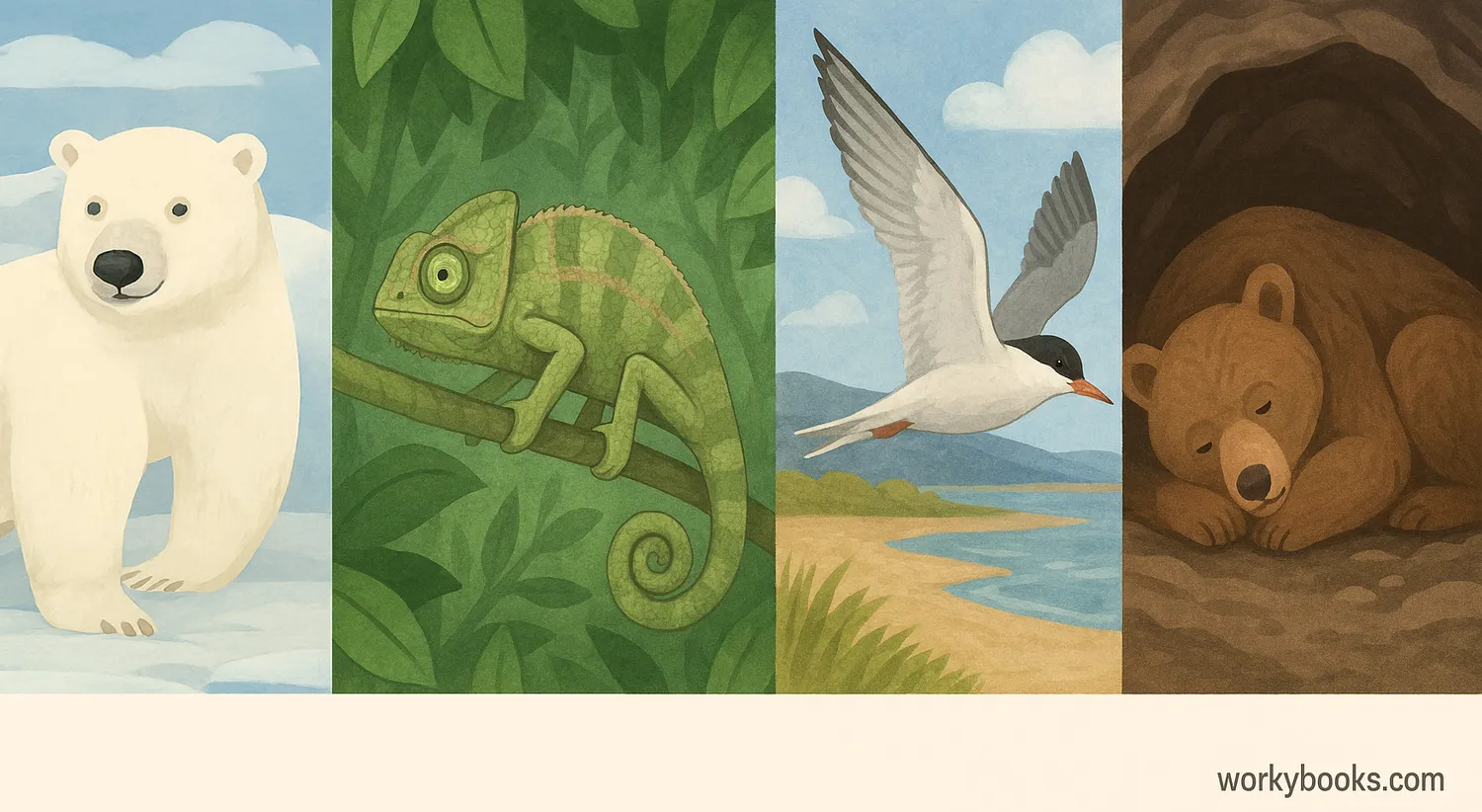
Illustration of animal adaptations: camouflage, migration, hibernation, desert cooling, and underwater breathing.
How Animals Adapt To Their Environment
Every animal lives in a special place called a habitat. To survive, animals need to fit their habitat perfectly. They do this using adaptations. An adaptation is a special feature or behavior that helps an animal survive in its environment. Think of adaptations as custom-designed survival tools—each animal comes equipped with exactly what it needs for its own special home!
There are two main types of adaptations. The first is physical adaptation. These are body parts and features animals are born with. For example, a camel has a hump to store fat for long desert trips. A fennec fox has huge ears to release heat. In cold places like the Arctic, polar bears have thick white fur and black skin to keep warm. In the ocean, fish have gills to breathe underwater, and dolphins have blowholes on top of their heads. Some rainforest animals have bright colors or large beaks, like the toucan, to help them find food or warn predators.
The second type is behavioral adaptation. These are things animals do, either instinctively or by learning. Some animals hibernate in winter, like bears sleeping through cold months. Others migrate, such as birds flying south when it gets cold. Kangaroo rats in the desert never drink water—they get moisture from seeds. Sloths move slowly in the rainforest to avoid being seen by predators.
Adaptations happen over a long time. Through natural selection, animals with helpful traits survive and have babies who also have those traits. Over many generations, these traits become common in the species. But if an environment changes too quickly, some animals may not adapt fast enough. This can put them at risk of extinction.
No animal can survive everywhere. A polar bear cannot live in a desert, and a cactus cannot grow in Antarctica. Each living thing fits its own home. Adaptations help create biodiversity, which means there are many different kinds of living things on Earth.
Interesting Fact: The Arctic fox changes its fur color with the seasons—white in winter to blend in with snow and brown in summer to hide in rocks and plants!
What is an adaptation?
A special feature or behaviorA type of foodA kind of plantA weather event
Which is a physical adaptation?
Hibernating in winterMigrating southA camel’s humpMoving slowly
Why do sloths move slowly?
To avoid being seenTo find more foodTo stay warmTo swim faster
What helps fish breathe underwater?
Webbed feetBlowholesGillsThick fur
What might happen if an environment changes too fast?
Animals adapt instantlyAnimals may risk extinctionMore food appearsAnimals get new habitats
Why can't polar bears live in deserts?
They can live anywhereThey like hot weatherThey need cold environmentsThey eat desert plants
Animals can survive everywhere. True or false?
TrueFalse
What does 'biodiversity' mean?
One kind of animalMany different living thingsNo living thingsA type of adaptation
Perfect For:
👩🏫 Teachers
• Reading comprehension practice
• Auto-graded assessments
• Literacy skill development
👨👩👧👦 Parents
• Reading practice at home
• Comprehension improvement
• Educational reading time
🏠 Homeschoolers
• Reading curriculum support
• Independent reading practice
• Progress monitoring
Reading Features:
📖
Reading Passage
Engaging fiction or nonfiction text
❓
Comprehension Quiz
Auto-graded questions
📊
Instant Feedback
Immediate results and scoring
📄
Printable Version
Download for offline reading
🔊
Read Aloud
Voice-over with word highlighting
Reviews & Ratings
No reviews yet. Be the first to share your experience!
Related Content
Understanding Biological Evolution and Diversity
This passage addresses the NGSS standard 3-LS4-2 focusing on biological evolution and the unity and diversity of life. T...
RI.3.3RI.4.3RI.5.33-LS4-2
Theory of Evolution
This middle school science passage explains the theory of evolution and the concept of common ancestry, aligning with NG...
MS-LS4-1MS-LS4-2
Evidence for Evolution: Comparative Anatomy
This middle school science reading passage explores the evidence for evolution through comparative anatomy, aligning wit...
MS-LS4-2MS-LS4-3
The Nature of Life Science
This passage, aligned with NGSS MS-LS1-1, introduces students in grades 6-8 to the foundational concepts of life science...
MS-LS1-1
Human Evolution
This middle school science passage explains the scientific evidence for human evolution, aligning with NGSS standards MS...
MS-LS4-1MS-LS4-2
The Giant Isopod: Biological Evolution
This NGSS passage examines how giant isopods evolved for deep-sea survival, including slow metabolism for food scarcity,...
MS-LS4-4RI.6.3RI.7.3RI.8.8
Evidence for Evolution: The Fossil Record
This middle school science passage explains the importance of fossils as preserved evidence of ancient life and their ro...
MS-LS4-1
Science Vocabulary
This worksheet on domain-specific words will help students learn some science vocabulary. Students will be asked to matc...
L.3.6L.3.4.A
Simple Machines Science Report
This science writing task requires students to clearly explain how three simple machines work using precise domain-speci...
W.5.4
The Science of Hibernation
This educational module, featuring an audio-integrated reading passage titled 'The Science of Hibernation,' is designed ...
What is an amphibian
This audio-integrated reading passage, "The Life of Amphibians," is designed for 4th-grade students to explore the fasci...
The Levels of Australopithecus
This educational content offers an engaging, audio-integrated reading passage titled 'The Levels of Biological Classific...
The Pumpkin Life Cycle
This informational worksheet explores the pumpkin lifecycle, guiding students through procedural steps in a scientific t...
RI.2.3RI.2.10
The Nature of Science
This passage explores the nature of science for middle school students, aligning with NGSS standards MS-ETS1-4, MS-PS1-1...
MS-ETS1-4MS-PS1-1MS-LS1-1
What Is Earth Science?
This engaging middle school science passage introduces students to the field of Earth science, aligning with NGSS standa...
MS-ESS1MS-ESS2MS-ESS3SEP
The Life Cycle of an Angiosperm
This educational content package delves into the intriguing world of angiosperms and their complex life cycles, perfectl...
Citizen Science and Ecological Monitoring
This engaging passage for grades 6-8 introduces the concept of citizen science and its critical role in ecological monit...
MS-LS2-1
Tools and Technology in Earth Science
This middle school science reading passage explores the wide range of tools and technologies used in Earth science, from...
MS-ESS2-2MS-ESS3-2MS-ETS1-1MS-PS4-3
Barnacle Life Cycle
This audio-integrated reading passage, "Barnacle Life Cycle," delves into the intriguing growth and development of barna...
History of Life on Earth
This comprehensive middle school science reading passage provides an engaging overview of the history of life on Earth, ...