How Climate Defines a Biome — Reading Comprehension
Rate this
Premium Resource
Present
Present in classroom. No work saved
Assign
Classroom with student accounts, Track progress
Quick Play
No student accounts, assign with a link
Grades
6
PRINT+DIGITAL RESOURCE
This learning resource is available in interactive and printable formats. The interactive worksheet can be played online and assigned to students. The Printable PDF version can be downloaded and printed for completion by hand.
This engaging reading passage, 'How Climate Defines a Biome,' explores the crucial role of climate patterns in shaping the Earth's diverse ecosystems. Students will learn about key abiotic factors like temperature and precipitation and how they influence the types of plants and animals that can thrive in specific regions. The passage defines important terms like 'biome' and 'climate' and uses relatable examples like deserts and rainforests. This content is aligned with NGSS Standard ESS2.D: Weather and Climate, focusing on how climate patterns determine ecosystems. It is designed for a 6th-grade reading level, features relevant SEO keywords, and is audio-integrated for enhanced learning.
CONTENT PREVIEW
Expand content preview
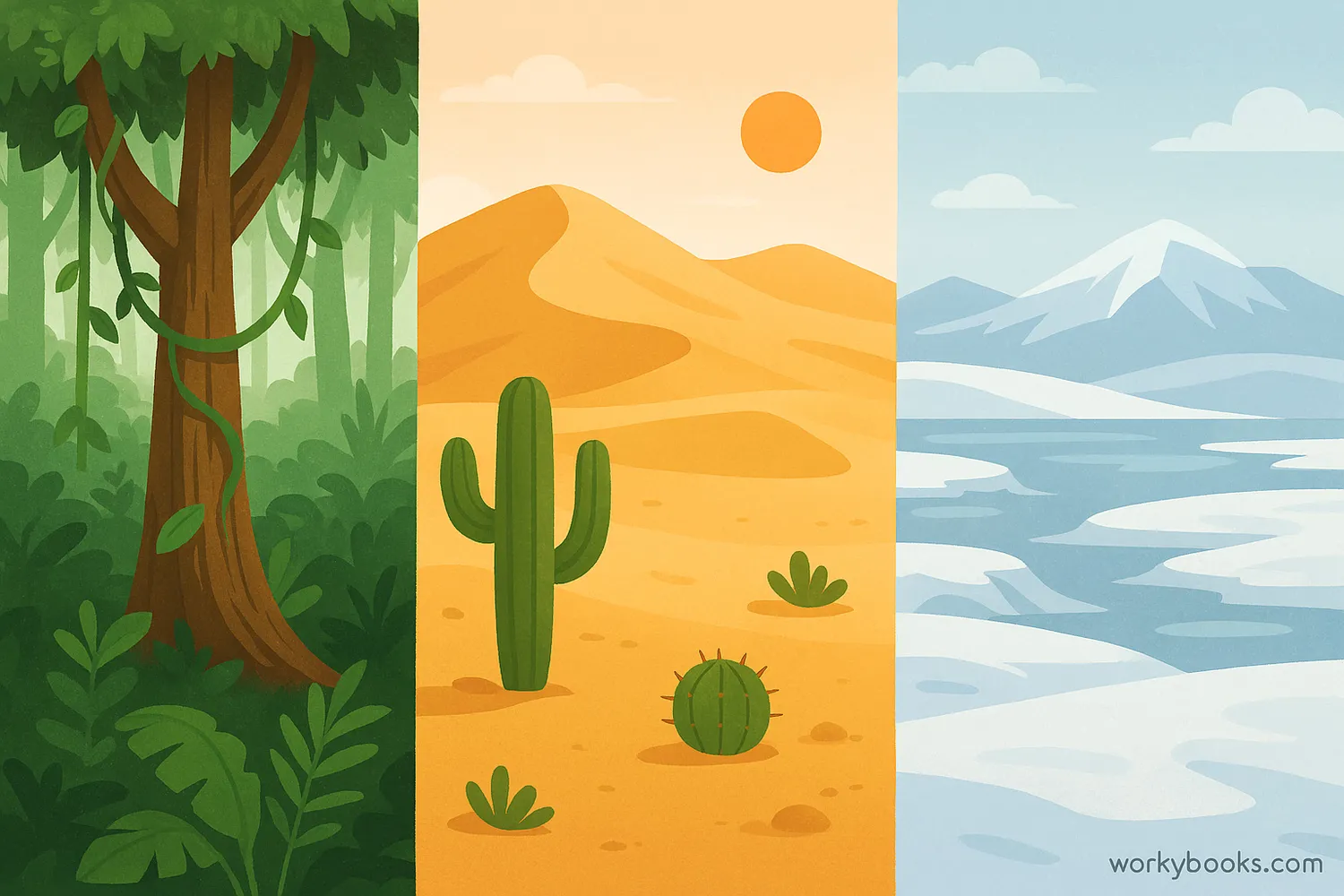
Three biomes—rainforest, desert, tundra—illustrated to show climate’s role in shaping ecosystems.
Imagine traveling across the Earth. You might see towering trees covered in vines, then vast stretches of sand, and finally, icy plains. What makes each of these places so different? The answer lies in their climate. Climate isn't just the weather on a particular day; it's the average weather conditions in a region over a long period, usually 30 years or more. Things like temperature and precipitation (rain, snow, or sleet) are the main ingredients of climate.
Climate is a powerful force that shapes the natural world. It directly influences the types of plants and animals that can survive in an area. When we look at a large region with a similar climate and the same types of plants and animals, we call it a biome. Think of biomes as giant natural neighborhoods, each with its own specific climate recipe.
One of the most important aspects of climate is temperature. Some biomes, like tropical rainforests, are hot and humid year-round, while others, like the tundra, are extremely cold for most of the year. The amount of precipitation is equally vital. A desert biome, for example, receives very little rainfall, leading to dry conditions and specialized plants like cacti. In contrast, a rainforest biome gets a huge amount of rain, allowing for lush, dense vegetation.
These climate patterns – the unique combinations of temperature and precipitation – are considered abiotic factors. Abiotic factors are the non-living parts of an ecosystem that affect living organisms. Wind, sunlight, and soil type are also abiotic factors. The climate patterns dictate which plants can grow, which in turn determines which animals can live there, forming a unique ecosystem within each biome. Without the right climate, certain life forms simply cannot thrive.
Understanding how climate defines a biome helps us appreciate the incredible diversity of life on Earth and why different regions look so distinct. From scorching deserts to frozen tundras, climate is the master architect.
Interesting Fact: The largest biome on Earth is the marine biome, which includes all the oceans, seas, and coral reefs, covering about 70% of the Earth's surface.
What is climate?
Weather on a dayAverage weather over timeAmount of sunlightSpecific wind patterns
Which of these is NOT an abiotic factor?
WindTemperatureAnimalsSunlight
True or False: Climate patterns are non-living parts of an ecosystem.
TrueFalse
What is the definition of a biome?
A type of animalA large region with similar climateA single plant speciesA short weather event
What two factors are main ingredients of climate?
Soil and windPlants and animalsTemperature and precipitationSunlight and altitude
Why do rainforests have dense vegetation?
Because they are coldThey receive little rainThey get lots of rainDue to sandy soil
What kind of plants would you expect in a desert?
Lush, tall treesPlants needing much waterCacti and succulentsMosses and lichens
Which biome is characterized by very cold temperatures?
Tropical rainforestDesertTundraGrassland
If a region suddenly became very dry, what might happen to its biome?
It would become a rainforestPlants would need more waterIt might turn into a desertAnimals would grow larger
A new plant species is discovered that needs constant warmth and high humidity. In which biome would it most likely thrive?
TundraDesertTropical rainforestTemperate forest
Perfect For:
👩🏫 Teachers
• Reading comprehension practice
• Auto-graded assessments
• Literacy skill development
👨👩👧👦 Parents
• Reading practice at home
• Comprehension improvement
• Educational reading time
🏠 Homeschoolers
• Reading curriculum support
• Independent reading practice
• Progress monitoring
Reading Features:
📖
Reading Passage
Engaging fiction or nonfiction text
❓
Comprehension Quiz
Auto-graded questions
📊
Instant Feedback
Immediate results and scoring
📄
Printable Version
Download for offline reading
🔊
Read Aloud
Voice-over with word highlighting
Reviews & Ratings
No reviews yet. Be the first to share your experience!
Related Content
Understanding Biological Evolution and Diversity
This passage addresses the NGSS standard 3-LS4-2 focusing on biological evolution and the unity and diversity of life. T...
RI.3.3RI.4.3RI.5.33-LS4-2
Theory of Evolution
This middle school science passage explains the theory of evolution and the concept of common ancestry, aligning with NG...
MS-LS4-1MS-LS4-2
Evidence for Evolution: Comparative Anatomy
This middle school science reading passage explores the evidence for evolution through comparative anatomy, aligning wit...
MS-LS4-2MS-LS4-3
The Nature of Life Science
This passage, aligned with NGSS MS-LS1-1, introduces students in grades 6-8 to the foundational concepts of life science...
MS-LS1-1
Human Evolution
This middle school science passage explains the scientific evidence for human evolution, aligning with NGSS standards MS...
MS-LS4-1MS-LS4-2
Science Vocabulary
This worksheet on domain-specific words will help students learn some science vocabulary. Students will be asked to matc...
L.3.6L.3.4.A
The Giant Isopod: Biological Evolution
This NGSS passage examines how giant isopods evolved for deep-sea survival, including slow metabolism for food scarcity,...
MS-LS4-4RI.6.3RI.7.3RI.8.8
Evidence for Evolution: The Fossil Record
This middle school science passage explains the importance of fossils as preserved evidence of ancient life and their ro...
MS-LS4-1
Simple Machines Science Report
This science writing task requires students to clearly explain how three simple machines work using precise domain-speci...
W.5.4
The Science of Hibernation
This educational module, featuring an audio-integrated reading passage titled 'The Science of Hibernation,' is designed ...
What is an amphibian
This audio-integrated reading passage, "The Life of Amphibians," is designed for 4th-grade students to explore the fasci...
The Levels of Australopithecus
This educational content offers an engaging, audio-integrated reading passage titled 'The Levels of Biological Classific...
The Nature of Science
This passage explores the nature of science for middle school students, aligning with NGSS standards MS-ETS1-4, MS-PS1-1...
MS-ETS1-4MS-PS1-1MS-LS1-1
The Pumpkin Life Cycle
This informational worksheet explores the pumpkin lifecycle, guiding students through procedural steps in a scientific t...
RI.2.3RI.2.10
What Is Earth Science?
This engaging middle school science passage introduces students to the field of Earth science, aligning with NGSS standa...
MS-ESS1MS-ESS2MS-ESS3SEP
Citizen Science and Ecological Monitoring
This engaging passage for grades 6-8 introduces the concept of citizen science and its critical role in ecological monit...
MS-LS2-1
The Life Cycle of an Angiosperm
This educational content package delves into the intriguing world of angiosperms and their complex life cycles, perfectl...
Tools and Technology in Earth Science
This middle school science reading passage explores the wide range of tools and technologies used in Earth science, from...
MS-ESS2-2MS-ESS3-2MS-ETS1-1MS-PS4-3
Barnacle Life Cycle
This audio-integrated reading passage, "Barnacle Life Cycle," delves into the intriguing growth and development of barna...
History of Life on Earth
This comprehensive middle school science reading passage provides an engaging overview of the history of life on Earth, ...