How Colliding Air Masses Create Fronts and Severe Weather Systems
Interactive passage with audio narration, comprehension questions, and printable PDF.
By completing this purchase you agree to our Terms of Use and Privacy Policy. Your subscription renews automatically until you cancel. You can cancel anytime from your account settings. All sales are final and non-refundable. Digital content is available for download in your account immediately upon purchase.
What's included
How Colliding Air Masses Create Fronts and Severe Weather Systems preview and details
About this printable How Colliding Air Masses Create Fronts and Severe Weather Systems science reading passage, NGSS-aligned (Grade 6)
Sample passage and quiz from How Colliding Air Masses Create Fronts and Severe Weather Systems
Reading passage and comprehension quiz preview
How Colliding Air Masses Create Fronts and Severe Weather Systems
Have you ever wondered why the weather changes so much? One day it's sunny and warm, the next it's stormy and cold. These changes often happen because of air masses. An air mass is a huge body of air that has a similar temperature and amount of moisture throughout. Imagine a giant bubble of air over a large area – that's an air mass!
Air masses form over different parts of the Earth. For example, an air mass forming over the cold, snowy land of Canada will be cold and dry. An air mass forming over the warm, tropical ocean near the equator will be warm and humid. When these different air masses move, they often collide, or meet, with each other. This meeting point is called a weather front.
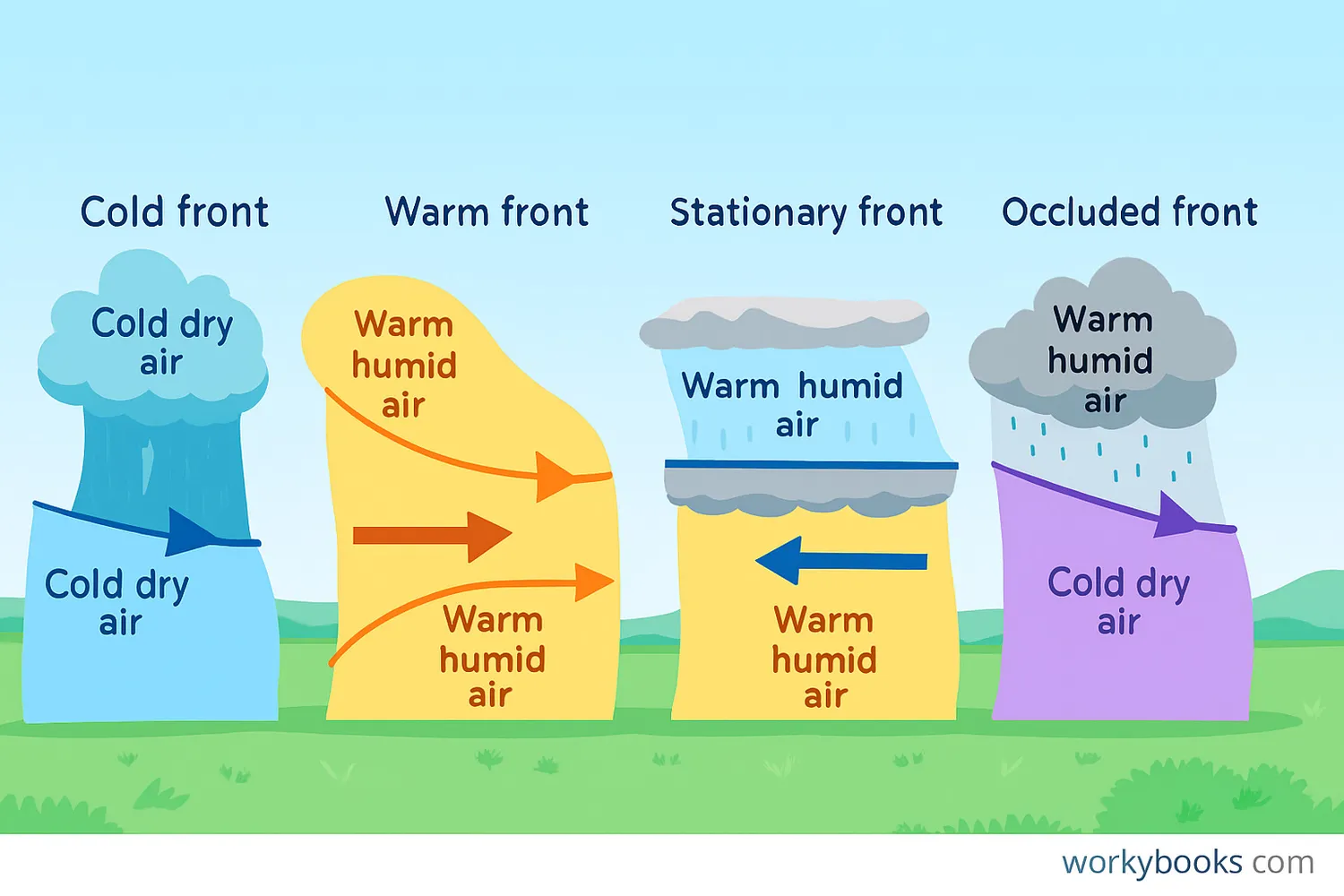
There are different types of weather fronts, and each brings its own kind of weather. A cold front forms when a colder air mass pushes into a warmer air mass. Since cold air is heavier, it acts like a wedge, lifting the warm air quickly. This rapid lifting can cause clouds to form, leading to sudden, heavy rain, thunderstorms, and sometimes even severe weather like blizzards in winter. After a cold front passes, the weather usually becomes cooler and drier.
On the other hand, a warm front occurs when a warm air mass moves over a slower-moving cold air mass. The warm air gently slides up and over the cold air. This slower lifting creates widespread, lighter precipitation that can last for many hours or even days, like a steady drizzle or light snow. After a warm front passes, the weather typically becomes warmer and more humid. Sometimes, a stationary front happens when two air masses meet but neither is strong enough to push the other away. This can lead to several days of cloudy, wet weather.
Understanding how air masses and weather fronts interact is key to predicting weather patterns and understanding why we experience different severe weather systems. These collisions are a major factor in the ever-changing weather conditions around the globe, from gentle rain to powerful storms. Meteorologists, scientists who study weather, use this knowledge to help us prepare for what's coming.
Interesting Fact: The biggest air mass on Earth is the Arctic air mass, which can cover vast areas of the northern hemisphere!
Comprehension quiz (10 questions)
1. What is an air mass?
2. What is a weather front?
3. Cold fronts bring sudden, heavy rain.
4. Which front causes widespread, lighter precipitation that lasts for hours?
5. What happens after a cold front passes?
6. What characterizes a stationary front?
7. If a warm air mass moves over a cold air mass, what results?
8. What is the role of meteorologists?
9. Which scenario suggests a cold front just passed?
10. What does 'collide' mean in the passage?
Perfect for the way you teach
- Build comprehension skills
- Auto-graded quiz
- Differentiated reading
- Read together at home
- Improve fluency
- Quiet reading time
- Reading curriculum support
- Independent practice
- Track Lexile growth