How Homozygosity Affects Phenotype — Reading Comprehension
Rate this
Premium Resource
Present
Present in classroom. No work saved
Assign
Classroom with student accounts, Track progress
Quick Play
No student accounts, assign with a link
Grades
6
PRINT+DIGITAL RESOURCE
This learning resource is available in interactive and printable formats. The interactive worksheet can be played online and assigned to students. The Printable PDF version can be downloaded and printed for completion by hand.
Dive into the fascinating world of genetics with this engaging reading passage, 'How Homozygosity Affects Phenotype.' This audio-integrated resource for 7th graders breaks down complex concepts like alleles, genotypes, and phenotypes using simple language. Students will learn how specific combinations of genes, particularly homozygous states, determine an organism's observable characteristics. Aligned with NGSS Standard LS3.A: Inheritance of Traits, this passage clarifies how an organism's phenotype is determined by the combinations of alleles it inherits, enhancing understanding of genetic inheritance and its impact on traits. Key terms like dominant and recessive alleles are defined, making the passage accessible and informative.
CONTENT PREVIEW
Expand content preview
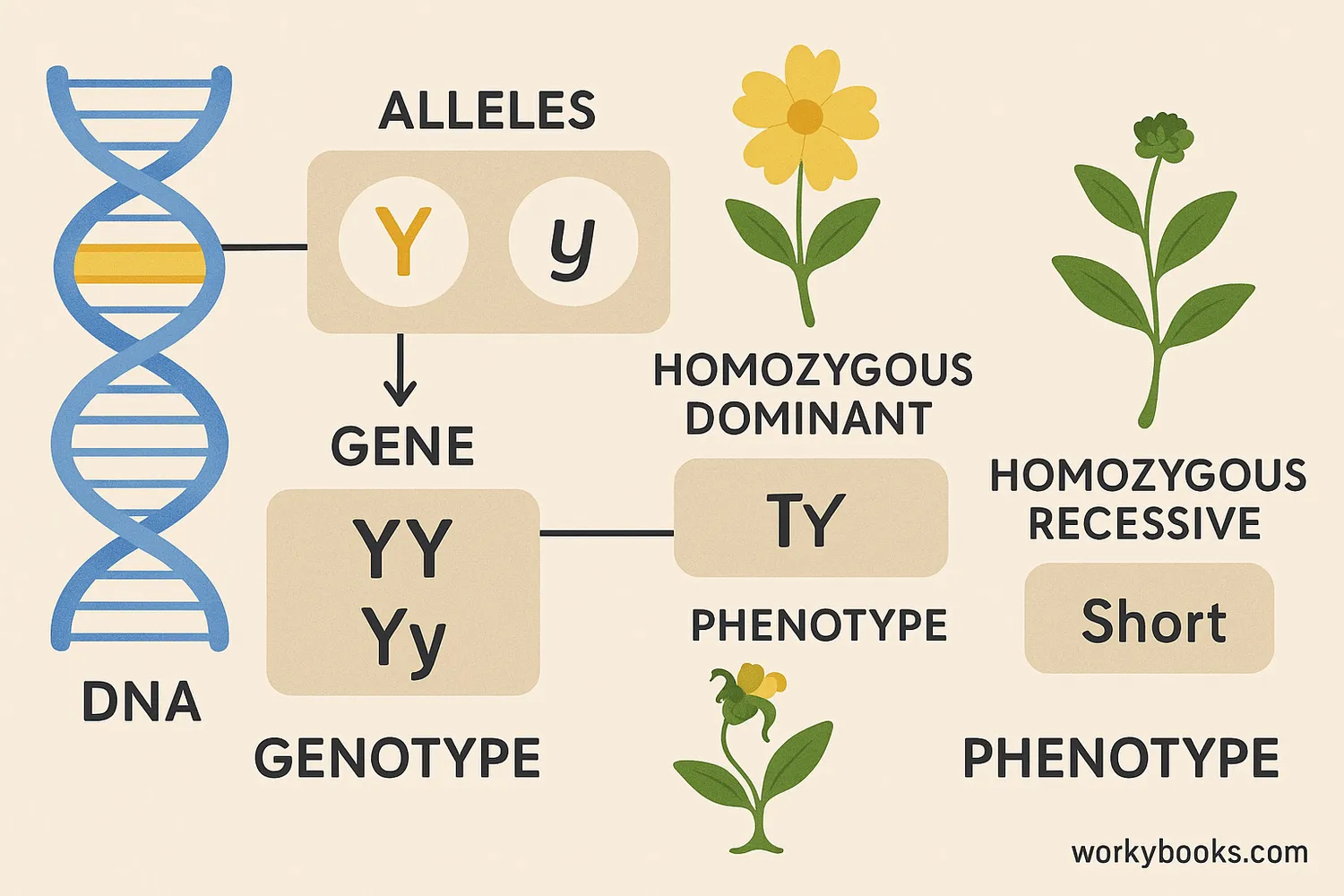
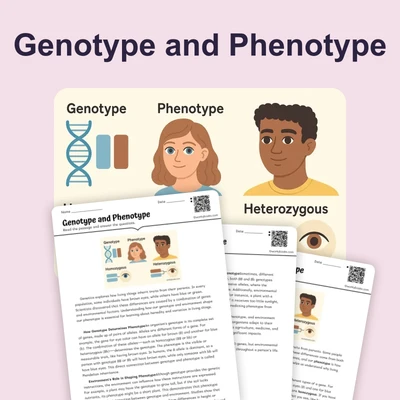
Wide educational illustration of homozygosity and phenotype inheritance in plants and humans
Imagine looking at a family, and you notice that a child has bright blue eyes, just like both of their parents. Or perhaps a plant in your garden produces only yellow flowers, generation after generation. These observations hint at the powerful principles of genetics, specifically how specific gene combinations lead to observable traits, also known as phenotype.
Every living thing, from humans to plants, has a set of instructions called DNA. Within this DNA are sections called genes. Genes are like recipes for different traits, such as eye color, hair texture, or even whether a plant's seeds are round or wrinkled. For each gene, an organism inherits two copies, one from each parent. These copies are called alleles.
Now, let's talk about how these alleles combine. The specific combination of alleles an organism has for a particular gene is called its genotype. When an organism inherits two identical alleles for a specific gene, it is said to be homozygous for that trait. For example, if a plant inherits two alleles for yellow flowers (let's say 'YY'), it is homozygous for yellow flowers. Similarly, if it inherits two alleles for green flowers ('yy'), it is homozygous for green flowers. In contrast, if it inherits one yellow and one green allele ('Yy'), it is heterozygous.
How does homozygosity affect the phenotype? This depends on whether the alleles are dominant or recessive. A dominant allele expresses its trait even if only one copy is present. A recessive allele, however, only expresses its trait if two copies are present, meaning the organism must be homozygous recessive. For instance, in pea plants, the allele for tallness (T) is dominant over the allele for shortness (t). A plant with a 'TT' genotype is homozygous dominant and will be tall. A plant with a 'tt' genotype is homozygous recessive and will be short. In both these homozygous cases, the phenotype directly reflects the alleles present.
Consider the blue eyes example. Blue eye color is often a recessive trait. So, for a child to have blue eyes, they usually must inherit the blue-eye allele from both parents, making them homozygous recessive for that specific eye color gene. If they inherited even one dominant allele for brown eyes, they would likely have brown eyes instead. Understanding homozygosity is crucial for predicting how traits are passed down through generations in genetics, from simple characteristics like flower color in peas to more complex traits in humans.
Interesting Fact: Some genetic conditions are more likely to appear if an individual is homozygous recessive for a particular gene.
True or False: A dominant allele always shows its trait.
TrueFalse
If an organism has a homozygous dominant genotype, what does this mean?
Two identical dominant allelesTwo different allelesTwo identical recessive allelesOne dominant, one recessive
Which of these is an example of a phenotype?
Blue eye colorGenotype 'Tt'DNA strandA specific gene
Why might blue eyes be considered a recessive trait?
Needs two blue alleles to showOnly needs one blue alleleIt is always dominantInherited from only one parent
What is the primary role of genes in DNA?
Recipes for traitsStoring energyFighting diseasesBuilding bones
The term 'homozygous' is best defined as:
Having identical allelesHaving different allelesObservable traitsGenetic instructions
If a plant with genotype 'TT' (tall) crosses with a plant with genotype 'tt' (short), and 'T' is dominant, what would be the phenotype of their offspring's height?
All tallAll shortHalf tall, half shortMedium height
A scientist observes a new species of flower where red (R) is dominant over white (r). If a flower shows a white phenotype, what can be concluded about its genotype?
It must be 'rr'It must be 'Rr'It could be 'RR' or 'Rr'It must be 'RR'
Perfect For:
👩🏫 Teachers
• Reading comprehension practice
• Auto-graded assessments
• Literacy skill development
👨👩👧👦 Parents
• Reading practice at home
• Comprehension improvement
• Educational reading time
🏠 Homeschoolers
• Reading curriculum support
• Independent reading practice
• Progress monitoring
Reading Features:
📖
Reading Passage
Engaging fiction or nonfiction text
❓
Comprehension Quiz
Auto-graded questions
📊
Instant Feedback
Immediate results and scoring
📄
Printable Version
Download for offline reading
🔊
Read Aloud
Voice-over with word highlighting
Reviews & Ratings
No reviews yet. Be the first to share your experience!
Related Content
Understanding Biological Evolution and Diversity
This passage addresses the NGSS standard 3-LS4-2 focusing on biological evolution and the unity and diversity of life. T...
RI.3.3RI.4.3RI.5.33-LS4-2
Theory of Evolution
This middle school science passage explains the theory of evolution and the concept of common ancestry, aligning with NG...
MS-LS4-1MS-LS4-2
Evidence for Evolution: Comparative Anatomy
This middle school science reading passage explores the evidence for evolution through comparative anatomy, aligning wit...
MS-LS4-2MS-LS4-3
The Nature of Life Science
This passage, aligned with NGSS MS-LS1-1, introduces students in grades 6-8 to the foundational concepts of life science...
MS-LS1-1
Human Evolution
This middle school science passage explains the scientific evidence for human evolution, aligning with NGSS standards MS...
MS-LS4-1MS-LS4-2
The Giant Isopod: Biological Evolution
This NGSS passage examines how giant isopods evolved for deep-sea survival, including slow metabolism for food scarcity,...
MS-LS4-4RI.6.3RI.7.3RI.8.8
Evidence for Evolution: The Fossil Record
This middle school science passage explains the importance of fossils as preserved evidence of ancient life and their ro...
MS-LS4-1
Science Vocabulary
This worksheet on domain-specific words will help students learn some science vocabulary. Students will be asked to matc...
L.3.6L.3.4.A
Simple Machines Science Report
This science writing task requires students to clearly explain how three simple machines work using precise domain-speci...
W.5.4
The Science of Hibernation
This educational module, featuring an audio-integrated reading passage titled 'The Science of Hibernation,' is designed ...
What is an amphibian
This audio-integrated reading passage, "The Life of Amphibians," is designed for 4th-grade students to explore the fasci...
The Levels of Australopithecus
This educational content offers an engaging, audio-integrated reading passage titled 'The Levels of Biological Classific...
The Nature of Science
This passage explores the nature of science for middle school students, aligning with NGSS standards MS-ETS1-4, MS-PS1-1...
MS-ETS1-4MS-PS1-1MS-LS1-1
The Pumpkin Life Cycle
This informational worksheet explores the pumpkin lifecycle, guiding students through procedural steps in a scientific t...
RI.2.3RI.2.10
What Is Earth Science?
This engaging middle school science passage introduces students to the field of Earth science, aligning with NGSS standa...
MS-ESS1MS-ESS2MS-ESS3SEP
Citizen Science and Ecological Monitoring
This engaging passage for grades 6-8 introduces the concept of citizen science and its critical role in ecological monit...
MS-LS2-1
The Life Cycle of an Angiosperm
This educational content package delves into the intriguing world of angiosperms and their complex life cycles, perfectl...
Tools and Technology in Earth Science
This middle school science reading passage explores the wide range of tools and technologies used in Earth science, from...
MS-ESS2-2MS-ESS3-2MS-ETS1-1MS-PS4-3
Barnacle Life Cycle
This audio-integrated reading passage, "Barnacle Life Cycle," delves into the intriguing growth and development of barna...
History of Life on Earth
This comprehensive middle school science reading passage provides an engaging overview of the history of life on Earth, ...