This learning resource is available in interactive and printable formats. The interactive worksheet can be played online and assigned to students. The Printable PDF version can be downloaded and printed for completion by hand.
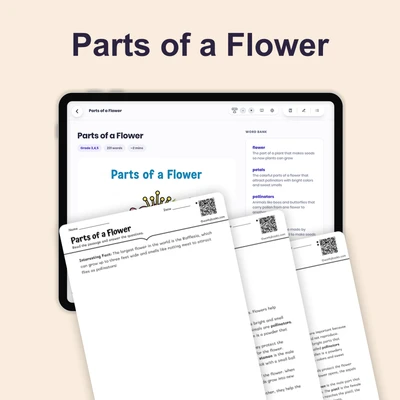
This 250-word reading passage introduces fourth-grade students to plant reproduction aligned with NGSS 4-LS1-1 and the Disciplinary Core Idea LS1.A. Students discover how plants reproduce by making seeds through the pollination process. The passage explains how flowers produce pollen that must reach the pistil for seeds to develop, and describes the important role of pollinators like bees, butterflies, and birds in carrying pollen between flowers. Students also learn that wind can carry pollen and that some plants can reproduce without seeds through runners or cuttings. Written in age-appropriate language for Grade 4 reading level, this passage builds foundational understanding of plant life cycles and reproduction. The content includes bolded key vocabulary terms with immediate definitions, real-world examples, and an interesting fact to engage young learners. Audio integration supports diverse learners and reading abilities. Supplementary activities include comprehension questions, writing prompts, and graphic organizers to reinforce understanding of pollination, seed production, and plant reproduction methods. This resource provides essential background knowledge for hands-on science investigations and supports NGSS performance expectations for elementary life science education.
CONTENT PREVIEW
Expand content preview
Pollination helps plants reproduce.
Plants make new plants through a process called reproduction. Reproduction means creating new living things of the same kind. Most plants reproduce by making seeds that can grow into new plants.
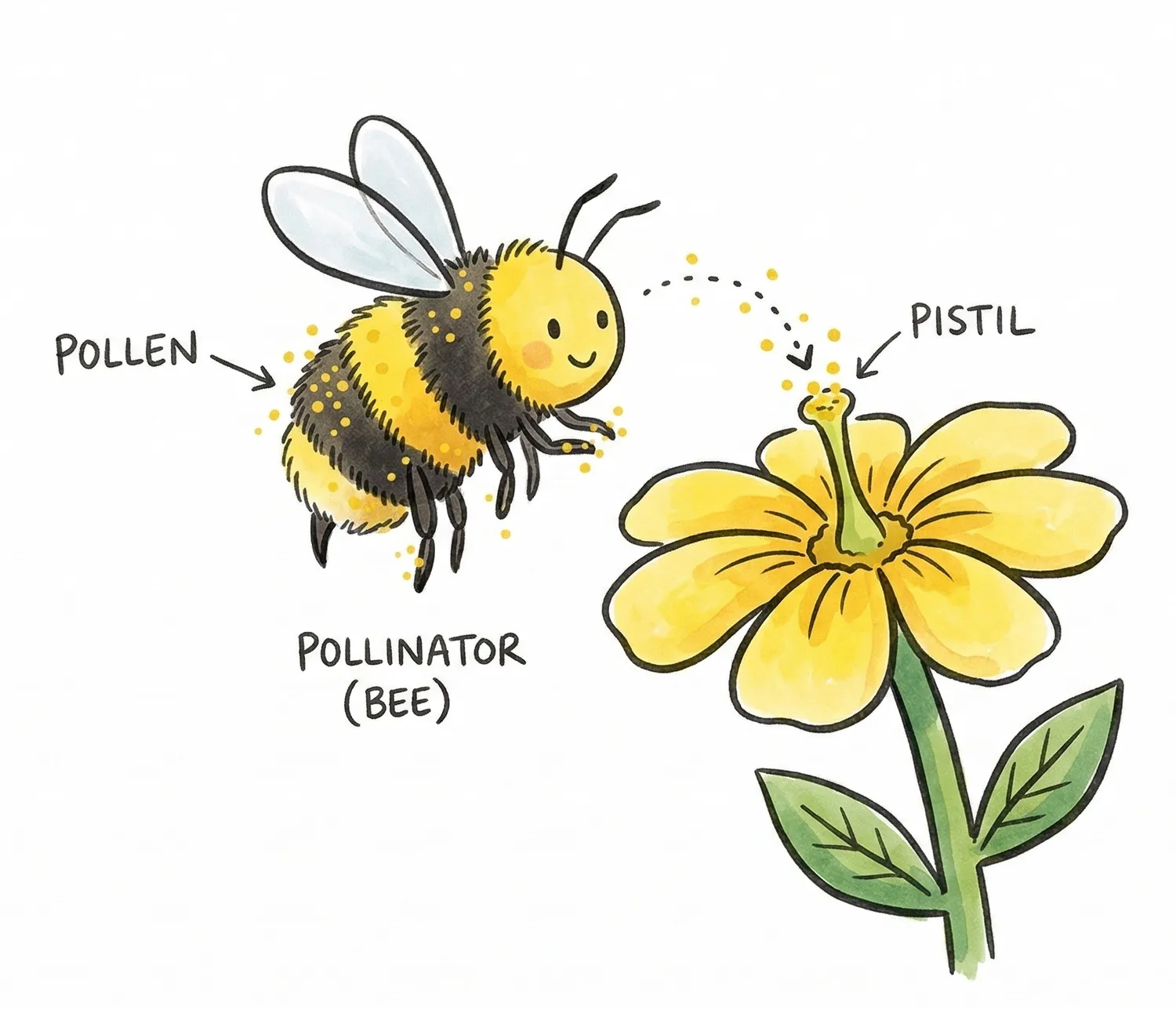
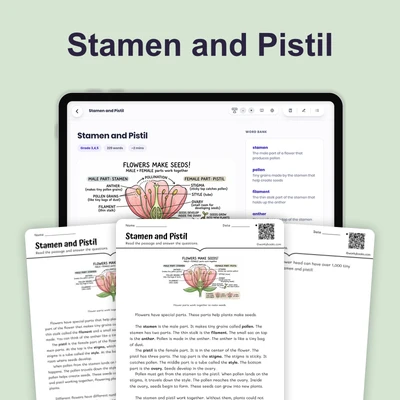
Flowers are the parts of plants that help make seeds. Inside a flower, there is a special powder called pollen. Pollen is a fine dust that contains the male cells needed for reproduction. For seeds to form, pollen must reach the pistil, which is the female part in the center of the flower. This process is called pollination.
Plants need help moving pollen from one flower to another. Pollinators are animals that carry pollen between flowers. Bees, butterflies, hummingbirds, and bats are common pollinators. When these animals visit flowers to drink nectar, pollen sticks to their bodies. They carry this pollen to the next flower they visit. Wind can also be a pollinator by blowing pollen through the air from one flower to another.
After pollination happens, the flower produces seeds. These seeds can fall to the ground and grow into new plants. Some plants can also reproduce without making seeds. Strawberry plants send out runners, which are stems that grow along the ground and create new plants. Other plants can grow from cuttings when you place a piece of stem in soil or water.
Interesting Fact: A single bee can visit up to 5,000 flowers in just one day, helping many plants reproduce!
What is reproduction?
Making new living thingsGrowing bigger flowersDrinking water from soilCollecting nectar from bees
What is pollen?
A type of seedA fine powder with male cellsThe center of a flowerA kind of bee
Which part receives pollen in a flower?
The petalsThe stemThe pistilThe roots
How do bees help plants reproduce?
They eat the seedsThey carry pollen between flowersThey water the plantsThey make new soil
What happens after pollination occurs?
The flower dies immediatelyThe plant stops growingThe flower produces seedsMore bees arrive
How can strawberry plants reproduce without seeds?
By sending out runnersBy making more flowersBy growing tallerBy attracting more bees
Wind can help move pollen between flowers.
TrueFalse
What does pollinator mean?
An animal that eats plantsAn animal that carries pollenA plant that makes seedsA type of flower
Perfect For:
๐ฉโ๐ซ Teachers
โข Reading comprehension practice
โข Auto-graded assessments
โข Literacy skill development
๐จโ๐ฉโ๐งโ๐ฆ Parents
โข Reading practice at home
โข Comprehension improvement
โข Educational reading time
๐ Homeschoolers
โข Reading curriculum support
โข Independent reading practice
โข Progress monitoring
Reading Features:
๐
Reading Passage
Engaging fiction or nonfiction text
โ
Comprehension Quiz
Auto-graded questions
๐
Instant Feedback
Immediate results and scoring
๐
Printable Version
Download for offline reading
๐
Read Aloud
Voice-over with word highlighting
Reviews & Ratings
No reviews yet. Be the first to share your experience!
Related Content
What Are Bones Made Of
This engaging 250-word reading passage introduces Grade 4 students to the structure and function of bones, aligned with ...
NGSS 4-LS1-1LS1.A
How Bones Protect Organs
This engaging 250-word reading passage helps Grade 4 students understand how bones protect organs, aligned with NGSS sta...
NGSS 4-LS1-1LS1.A
How Joints Connect Bones
This 250-word reading passage teaches fourth-grade students about joints and their role in the human skeletal system. Al...
NGSS 4-LS1-1LS1.A
Layers of the Skin
This engaging 250-word reading passage introduces fourth-grade students to the three layers of skin and their functions....
NGSS 4-LS1-1LS1.A
Parts of Plant Stems
This engaging 250-word reading passage introduces fourth-grade students to the internal structure and function of plant ...
NGSS 4-LS1-1LS1.A
Parts of a Flower
This comprehensive 250-word reading passage introduces fourth-grade students to the essential parts of a flower and thei...
NGSS 4-LS1-1LS1.A
How Leaves Make Food
This engaging Grade 4 science reading passage explains how leaves make food through photosynthesis. Students discover th...
NGSS 4-LS1-1LS1.A
How Animal Hearts Work
This 250-word audio-integrated reading passage introduces fourth-grade students to the essential function of the heart a...
NGSS 4-LS1-1LS1.A
Animal Skeleton Structure
This 250-word reading passage introduces fourth grade students to animal skeleton structure, aligned with NGSS 4-LS1-1 a...
NGSS 4-LS1-1LS1.A
How Animal Lungs Work
This 250-word reading passage introduces fourth-grade students to how animal lungs work, aligned with NGSS standard 4-LS...
NGSS 4-LS1-1LS1.A
Parts of a Leaf
This 250-word reading passage introduces Grade 4 students to the internal structure of leaves, aligned with NGSS standar...
NGSS 4-LS1-1LS1.A
Stamen and Pistil
This 250-word reading passage introduces fourth-grade students to the stamen and pistil, the key reproductive structures...
NGSS 4-LS1-1LS1.A
How Internal Structures Help Plants Survive
This 250-word informational reading passage is designed for Grade 4 students and aligns with NGSS standard 4-LS1-1 (LS1....
NGSS 4-LS1-1LS1.A
How Stems Support Plants
This engaging 250-word reading passage helps Grade 4 students understand how stems support plants and contribute to thei...
NGSS 4-LS1-1LS1.A
How External Structures Help Plants Survive
This 250-word reading passage introduces fourth-grade students to how external plant structures help plants survive, gro...
NGSS 4-LS1-1LS1.A
How Internal Structures Keep Animals Alive
This engaging 250-word reading passage introduces fourth-grade students to the essential internal structures that keep a...
NGSS 4-LS1-1LS1.A
Animal External Structures
This engaging 250-word reading passage introduces fourth-grade students to the concept of animal external structures ali...
NGSS 4-LS1-1LS1.A
What Are Exoskeletons
This engaging 250-word reading passage introduces fourth-grade students to the concept of exoskeletons, aligning with NG...
NGSS 4-LS1-1LS1.A
How Skin Protects Animals
This engaging 250-word reading passage introduces fourth-grade students to the protective functions of skin, the largest...