This learning resource is available in interactive and printable formats. The interactive worksheet can be played online and assigned to students. The Printable PDF version can be downloaded and printed for completion by hand.
This engaging 250-word reading passage introduces fourth-grade students to the concept of animal external structures aligned with NGSS standard 4-LS1-1 and Disciplinary Core Ideas LS1.A. Students explore how animals have structures on the outside of their bodies that help them survive, including body coverings like skin, fur, feathers, and scales, as well as limbs and specialized parts such as claws, beaks, and tails. The passage explains how each external structure serves specific functions for protection, movement, eating, or sensing the environment. Real-world examples help students understand that different animals have different external structures depending on where they live and how they survive. The audio-integrated lesson includes a simplified differentiated version for struggling readers, Spanish translations of both passages, a comprehensive glossary, an 8-question multiple-choice quiz testing recall and application, three scaffolded writing prompts, and two graphic organizers focusing on structure-function relationships and comparing different animals. This complete educational resource builds foundational understanding of how form relates to function in living organisms, preparing students for hands-on investigations and deeper discussions about animal adaptations and survival strategies.
CONTENT PREVIEW
Expand content preview
Animal external structures for survival.
Animals have body parts on the outside of their bodies called external structures. External structures are the parts you can see from the outside, like fur, feathers, or claws. These structures help animals survive in their environments by protecting them, helping them move, finding food, and sensing what is around them.
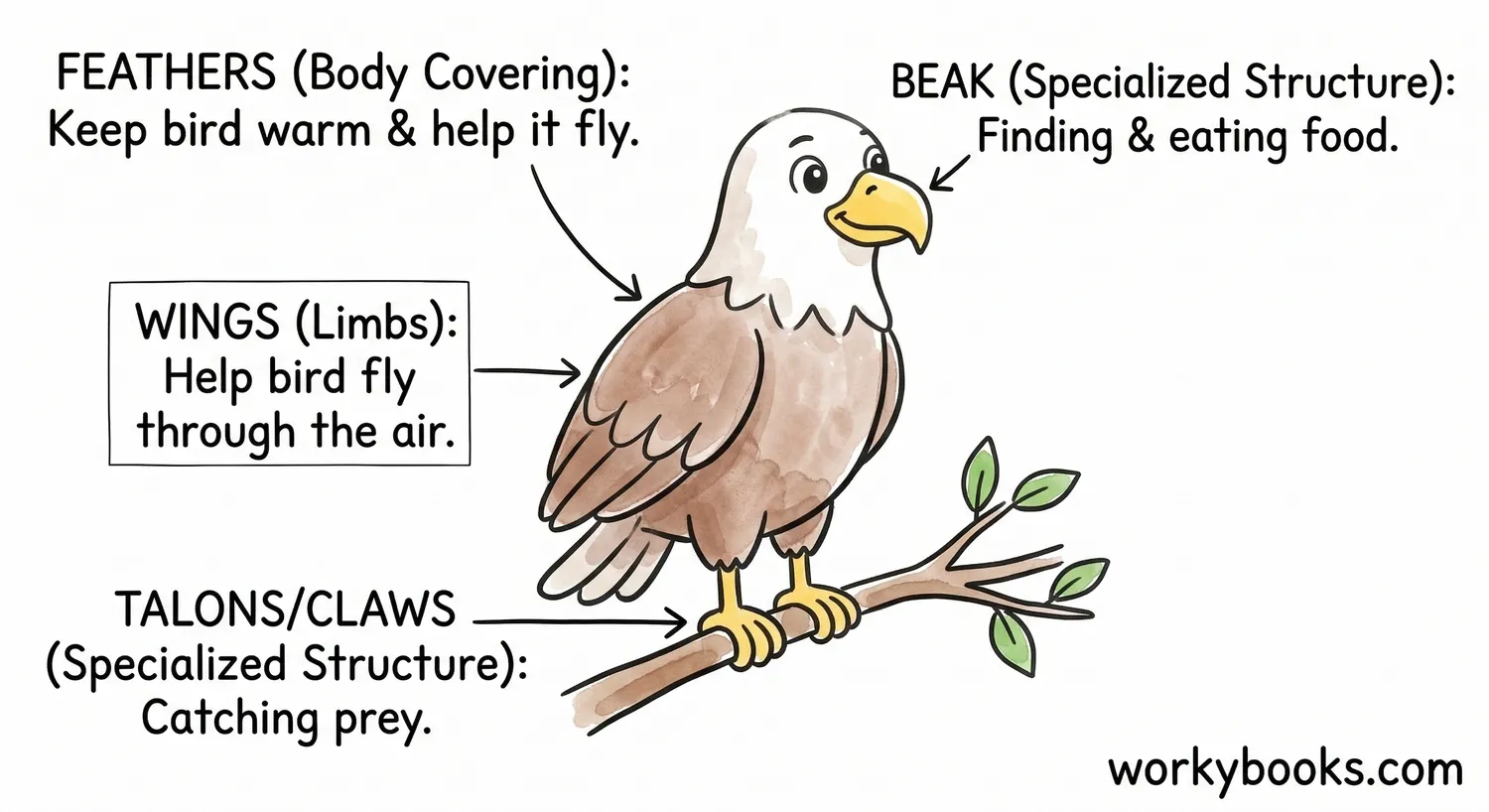
One type of external structure is body coverings. Body coverings are the outer layers that protect an animal's body. Birds have feathers that keep them warm and help them fly. Fish have scales that protect their bodies in water. Mammals like dogs and cats have fur that keeps them warm. Reptiles like snakes have tough skin or scales for protection.
Animals also have limbs, which are body parts used for movement. Limbs include legs, wings, and fins. A bird's wings help it fly through the air. A fish's fins help it swim through water. A deer's legs help it run quickly from danger. Each type of limb is shaped for how that animal needs to move.
Many animals have specialized structures for specific jobs. Specialized structures are body parts designed for particular tasks. Eagles have sharp claws called talons for catching prey. Woodpeckers have strong, pointed beaks for drilling into trees to find insects. Cats have whiskers that help them sense objects in the dark. A beaver's flat tail helps it swim and balance.
Different animals have different external structures because they live in different places and survive in different ways. A polar bear has thick fur and small ears to stay warm in cold places. A desert lizard has scales and can store water in its body. External structures match what each animal needs to survive.
Interesting Fact: A giraffe's tongue can be up to 20 inches long and is dark purple to protect it from sunburn while reaching for leaves high in trees!
What are external structures?
Body parts inside an animalBody parts on the outsideFood that animals eatPlaces where animals live
What body covering do birds have?
ScalesFurFeathersTough skin
What are limbs used for?
Protection from predatorsMovementEating foodStaying warm
Why does a polar bear have thick fur?
To help it swim fasterTo stay warm in cold placesTo catch more preyTo blend in with trees
How does a woodpecker's beak help it survive?
It drills into trees for insectsIt helps the bird swimIt keeps the bird warmIt scares away predators
What would happen if a fish lost its fins?
It could fly betterIt could not swim wellIt would grow furIt would become warmer
External structures help animals survive in their environments.
TrueFalse
What does specialized mean in this passage?
Very large in sizeDesigned for a specific taskFound on all animalsUsed only for protection
Perfect For:
๐ฉโ๐ซ Teachers
โข Reading comprehension practice
โข Auto-graded assessments
โข Literacy skill development
๐จโ๐ฉโ๐งโ๐ฆ Parents
โข Reading practice at home
โข Comprehension improvement
โข Educational reading time
๐ Homeschoolers
โข Reading curriculum support
โข Independent reading practice
โข Progress monitoring
Reading Features:
๐
Reading Passage
Engaging fiction or nonfiction text
โ
Comprehension Quiz
Auto-graded questions
๐
Instant Feedback
Immediate results and scoring
๐
Printable Version
Download for offline reading
๐
Read Aloud
Voice-over with word highlighting
Reviews & Ratings
No reviews yet. Be the first to share your experience!
Related Content
What Are Bones Made Of
This engaging 250-word reading passage introduces Grade 4 students to the structure and function of bones, aligned with ...
NGSS 4-LS1-1LS1.A
How Bones Protect Organs
This engaging 250-word reading passage helps Grade 4 students understand how bones protect organs, aligned with NGSS sta...
NGSS 4-LS1-1LS1.A
How Joints Connect Bones
This 250-word reading passage teaches fourth-grade students about joints and their role in the human skeletal system. Al...
NGSS 4-LS1-1LS1.A
Layers of the Skin
This engaging 250-word reading passage introduces fourth-grade students to the three layers of skin and their functions....
NGSS 4-LS1-1LS1.A
Parts of Plant Stems
This engaging 250-word reading passage introduces fourth-grade students to the internal structure and function of plant ...
NGSS 4-LS1-1LS1.A
Parts of a Flower
This comprehensive 250-word reading passage introduces fourth-grade students to the essential parts of a flower and thei...
NGSS 4-LS1-1LS1.A
How Leaves Make Food
This engaging Grade 4 science reading passage explains how leaves make food through photosynthesis. Students discover th...
NGSS 4-LS1-1LS1.A
How Animal Hearts Work
This 250-word audio-integrated reading passage introduces fourth-grade students to the essential function of the heart a...
NGSS 4-LS1-1LS1.A
Animal Skeleton Structure
This 250-word reading passage introduces fourth grade students to animal skeleton structure, aligned with NGSS 4-LS1-1 a...
NGSS 4-LS1-1LS1.A
How Animal Lungs Work
This 250-word reading passage introduces fourth-grade students to how animal lungs work, aligned with NGSS standard 4-LS...
NGSS 4-LS1-1LS1.A
Parts of a Leaf
This 250-word reading passage introduces Grade 4 students to the internal structure of leaves, aligned with NGSS standar...
NGSS 4-LS1-1LS1.A
Stamen and Pistil
This 250-word reading passage introduces fourth-grade students to the stamen and pistil, the key reproductive structures...
NGSS 4-LS1-1LS1.A
How Internal Structures Help Plants Survive
This 250-word informational reading passage is designed for Grade 4 students and aligns with NGSS standard 4-LS1-1 (LS1....
NGSS 4-LS1-1LS1.A
How Stems Support Plants
This engaging 250-word reading passage helps Grade 4 students understand how stems support plants and contribute to thei...
NGSS 4-LS1-1LS1.A
How Plants Reproduce
This 250-word reading passage introduces fourth-grade students to plant reproduction aligned with NGSS 4-LS1-1 and the D...
NGSS 4-LS1-1LS1.A
How External Structures Help Plants Survive
This 250-word reading passage introduces fourth-grade students to how external plant structures help plants survive, gro...
NGSS 4-LS1-1LS1.A
How Internal Structures Keep Animals Alive
This engaging 250-word reading passage introduces fourth-grade students to the essential internal structures that keep a...
NGSS 4-LS1-1LS1.A
What Are Exoskeletons
This engaging 250-word reading passage introduces fourth-grade students to the concept of exoskeletons, aligning with NG...
NGSS 4-LS1-1LS1.A
How Skin Protects Animals
This engaging 250-word reading passage introduces fourth-grade students to the protective functions of skin, the largest...