This learning resource is available in interactive and printable formats. The interactive worksheet can be played online and assigned to students. The Printable PDF version can be downloaded and printed for completion by hand.
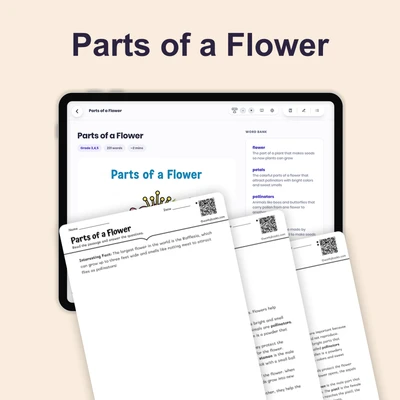
This 250-word reading passage introduces fourth-grade students to the stamen and pistil, the key reproductive structures of flowering plants. Aligned with NGSS standard 4-LS1-1 and Disciplinary Core Idea LS1.A, the passage explains how the stamen produces pollen and the pistil receives pollen to form seeds. Students learn about the anther, filament, stigma, style, and ovary in age-appropriate language. The passage includes bold vocabulary terms, a relatable analogy, and an interesting fact about flowers. Audio-integrated features support diverse learners. Activities include multiple-choice questions testing recall and comprehension, writing prompts requiring explanation and application, and graphic organizers for structure-function relationships and sequencing pollination. A simplified differentiated version and Spanish translations of both passages ensure accessibility for all students. This comprehensive resource builds foundational understanding of plant reproduction through engaging, standards-aligned content.
CONTENT PREVIEW
Expand content preview
Flower parts work together to make seeds.
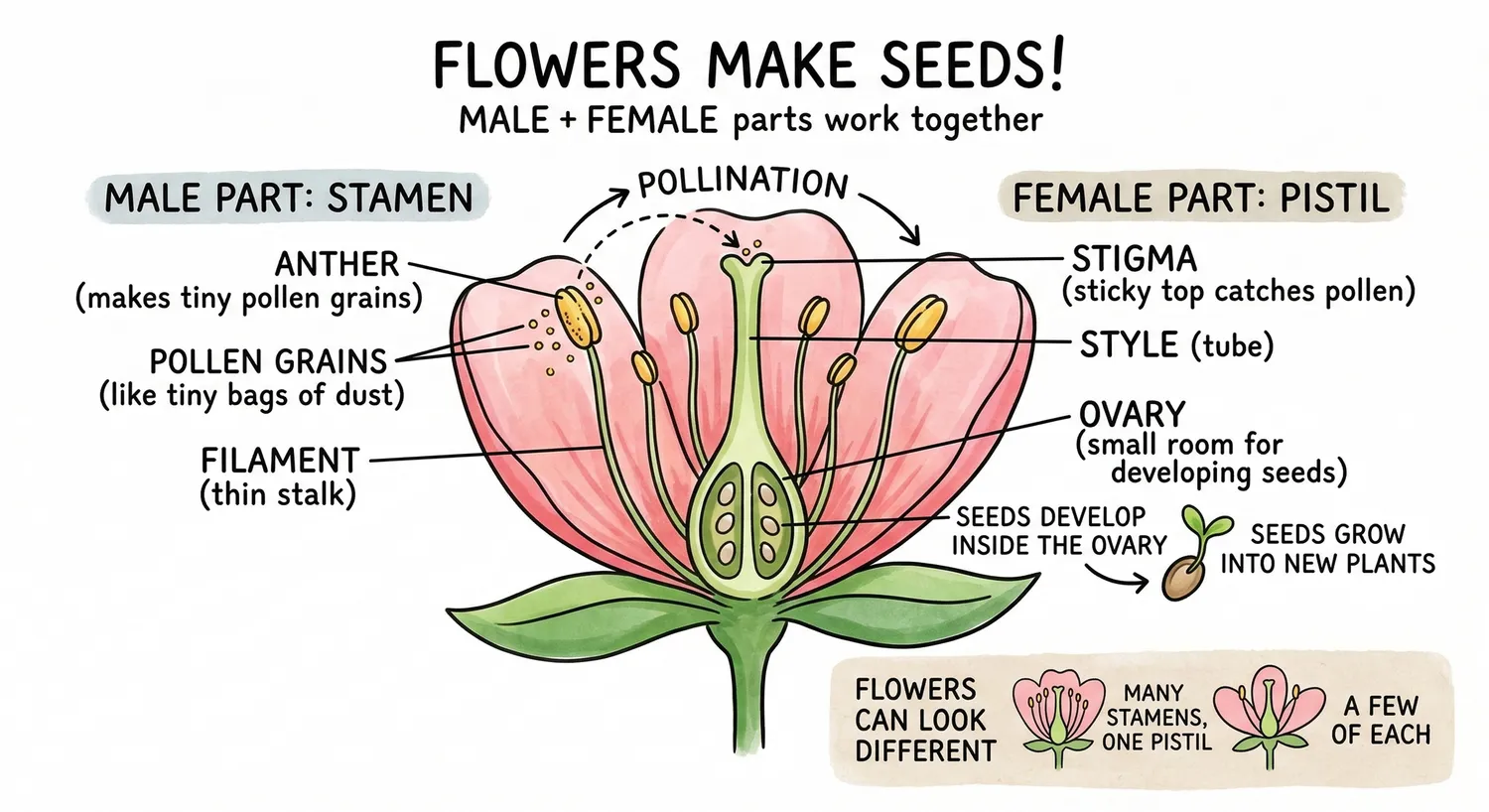
Flowers have special parts that help plants make seeds. The stamen is the male part of the flower that makes tiny grains called pollen. The stamen has two parts: a thin stalk called the filament and a small sac on top called the anther where pollen is made. You can think of the anther like a tiny bag holding dust.
The pistil is the female part of the flower found in the center. The pistil has three main parts. At the top is the stigma, which is sticky and catches pollen. Below the stigma is a tube called the style. At the bottom is the ovary, which is like a small room where seeds develop.
When pollen from the stamen lands on the stigma of the pistil, something amazing happens. The pollen travels down the style to reach the ovary. Inside the ovary, the pollen helps create seeds. These seeds can grow into new plants. Without the stamen and pistil working together, flowering plants could not reproduce and make new plants.
Different flowers have different numbers of stamens and pistils. Some flowers have many stamens surrounding one pistil. Other flowers have just a few of each part.
Interesting Fact: A single sunflower head can contain over 1,000 tiny flowers, and each one has its own stamen and pistil!
What does the stamen produce?
PollenSeedsWaterLeaves
Where are seeds developed in a flower?
In the antherIn the ovaryIn the filamentIn the stigma
What is the sticky part of pistil?
StyleOvaryStigmaFilament
Why do stamen and pistil work together?
To make flowers colorfulTo help plants make seedsTo attract butterfliesTo create flower petals
Where does pollen travel after stigma?
Through the style to ovaryBack to the antherOut of the flowerTo the filament
What happens when pollen reaches the ovary?
The flower diesMore pollen is madeSeeds begin to formThe flower changes color
The pistil is the male flower part.
TrueFalse
What is the anther?
Where pollen is madeWhere seeds developThe sticky part of pistilThe tube in pistil
Perfect For:
๐ฉโ๐ซ Teachers
โข Reading comprehension practice
โข Auto-graded assessments
โข Literacy skill development
๐จโ๐ฉโ๐งโ๐ฆ Parents
โข Reading practice at home
โข Comprehension improvement
โข Educational reading time
๐ Homeschoolers
โข Reading curriculum support
โข Independent reading practice
โข Progress monitoring
Reading Features:
๐
Reading Passage
Engaging fiction or nonfiction text
โ
Comprehension Quiz
Auto-graded questions
๐
Instant Feedback
Immediate results and scoring
๐
Printable Version
Download for offline reading
๐
Read Aloud
Voice-over with word highlighting
Reviews & Ratings
No reviews yet. Be the first to share your experience!
Related Content
What Are Bones Made Of
This engaging 250-word reading passage introduces Grade 4 students to the structure and function of bones, aligned with ...
NGSS 4-LS1-1LS1.A
How Bones Protect Organs
This engaging 250-word reading passage helps Grade 4 students understand how bones protect organs, aligned with NGSS sta...
NGSS 4-LS1-1LS1.A
How Joints Connect Bones
This 250-word reading passage teaches fourth-grade students about joints and their role in the human skeletal system. Al...
NGSS 4-LS1-1LS1.A
Layers of the Skin
This engaging 250-word reading passage introduces fourth-grade students to the three layers of skin and their functions....
NGSS 4-LS1-1LS1.A
Parts of Plant Stems
This engaging 250-word reading passage introduces fourth-grade students to the internal structure and function of plant ...
NGSS 4-LS1-1LS1.A
Parts of a Flower
This comprehensive 250-word reading passage introduces fourth-grade students to the essential parts of a flower and thei...
NGSS 4-LS1-1LS1.A
How Leaves Make Food
This engaging Grade 4 science reading passage explains how leaves make food through photosynthesis. Students discover th...
NGSS 4-LS1-1LS1.A
How Animal Hearts Work
This 250-word audio-integrated reading passage introduces fourth-grade students to the essential function of the heart a...
NGSS 4-LS1-1LS1.A
Animal Skeleton Structure
This 250-word reading passage introduces fourth grade students to animal skeleton structure, aligned with NGSS 4-LS1-1 a...
NGSS 4-LS1-1LS1.A
How Animal Lungs Work
This 250-word reading passage introduces fourth-grade students to how animal lungs work, aligned with NGSS standard 4-LS...
NGSS 4-LS1-1LS1.A
Parts of a Leaf
This 250-word reading passage introduces Grade 4 students to the internal structure of leaves, aligned with NGSS standar...
NGSS 4-LS1-1LS1.A
How Internal Structures Help Plants Survive
This 250-word informational reading passage is designed for Grade 4 students and aligns with NGSS standard 4-LS1-1 (LS1....
NGSS 4-LS1-1LS1.A
How Stems Support Plants
This engaging 250-word reading passage helps Grade 4 students understand how stems support plants and contribute to thei...
NGSS 4-LS1-1LS1.A
How Plants Reproduce
This 250-word reading passage introduces fourth-grade students to plant reproduction aligned with NGSS 4-LS1-1 and the D...
NGSS 4-LS1-1LS1.A
How External Structures Help Plants Survive
This 250-word reading passage introduces fourth-grade students to how external plant structures help plants survive, gro...
NGSS 4-LS1-1LS1.A
How Internal Structures Keep Animals Alive
This engaging 250-word reading passage introduces fourth-grade students to the essential internal structures that keep a...
NGSS 4-LS1-1LS1.A
Animal External Structures
This engaging 250-word reading passage introduces fourth-grade students to the concept of animal external structures ali...
NGSS 4-LS1-1LS1.A
What Are Exoskeletons
This engaging 250-word reading passage introduces fourth-grade students to the concept of exoskeletons, aligning with NG...
NGSS 4-LS1-1LS1.A
How Skin Protects Animals
This engaging 250-word reading passage introduces fourth-grade students to the protective functions of skin, the largest...