This learning resource is available in interactive and printable formats. The interactive worksheet can be played online and assigned to students. The Printable PDF version can be downloaded and printed for completion by hand.
This 250-word reading passage introduces fourth-grade students to how animal lungs work, aligned with NGSS standard 4-LS1-1 and Disciplinary Core Ideas LS1.A. Students learn that lungs are internal organs that take in oxygen from the air and release carbon dioxide. The passage explains the breathing process: when animals breathe in, air fills the lungs and oxygen passes into the blood; when they breathe out, carbon dioxide leaves the body. Students discover why animals need oxygen—to turn food into energy—and learn that different animals have different-sized lungs depending on their body size and activity level. The passage uses simple, age-appropriate language and includes relatable examples to help students understand this essential life process. Audio integration supports diverse learners by providing text-to-speech functionality. Accompanying activities include multiple-choice questions testing recall and comprehension, writing prompts requiring explanation and application, and graphic organizers for visualizing the breathing process and comparing lung structures. The passage is also available in a simplified differentiated version and Spanish translation to support all learners. This resource builds foundational understanding of respiratory systems, preparing students for hands-on investigations and deeper exploration of how organisms obtain and use energy.
CONTENT PREVIEW
Expand content preview
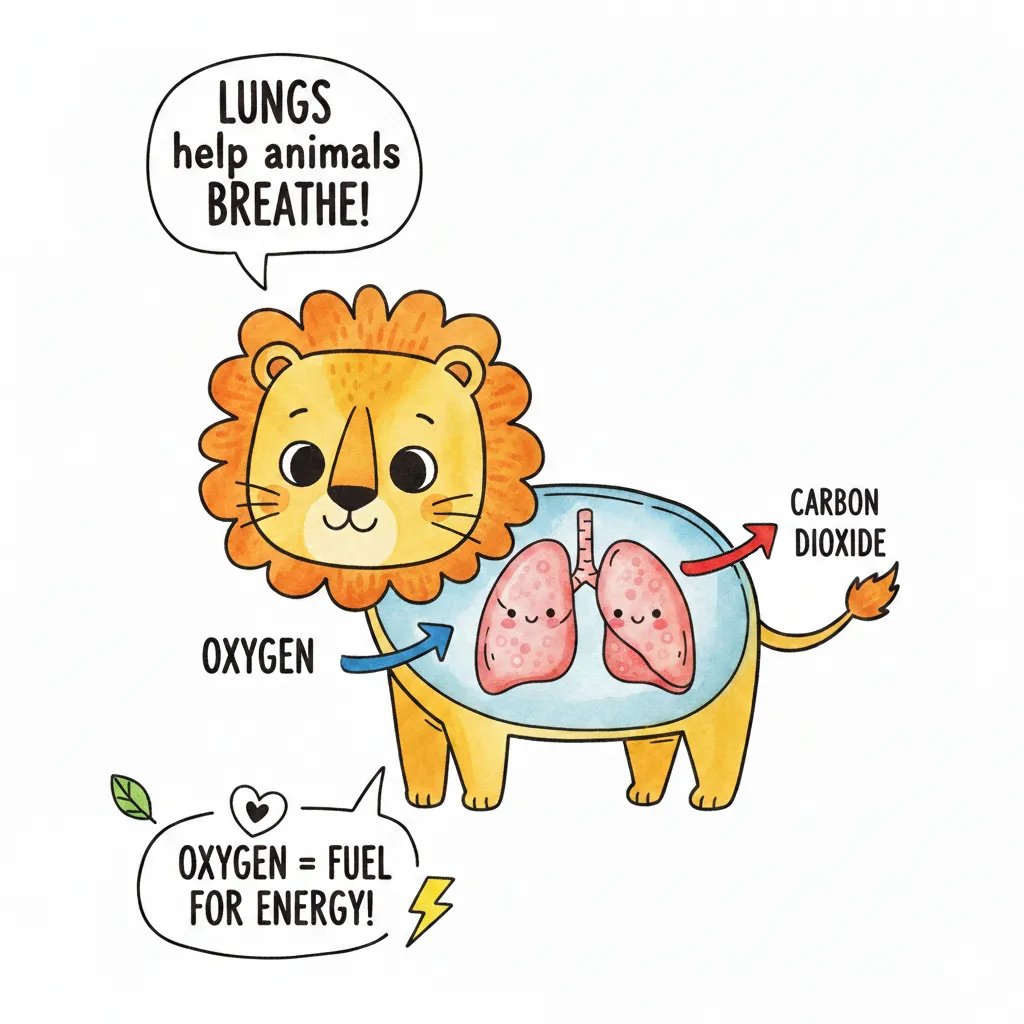
Lungs are special organs inside an animal's body that help it breathe. These internal organs (body parts located inside the body) do an important job—they take in oxygen from the air and release carbon dioxide, a waste gas the body doesn't need. Without lungs doing this job, animals could not survive.
When an animal breathes in, air travels into the lungs and fills them up, like blowing air into a balloon. Inside the lungs, oxygen passes from the air into the blood. The blood then carries oxygen to all parts of the body. When the animal breathes out, carbon dioxide leaves the lungs and exits the body. This process happens over and over, all day and all night.
Animals need oxygen for a very important reason. Oxygen helps turn the food they eat into energy that their bodies can use. Without oxygen, animals would have no energy to move, grow, or stay alive. Think of oxygen as fuel that keeps the body's engine running.
Different animals have different-sized lungs. A tiny mouse has small lungs, while a large elephant has huge lungs. Active animals, like cheetahs that run fast, need more oxygen and have larger, more powerful lungs than animals that move slowly.
Interesting Fact: A blue whale has the largest lungs of any animal on Earth—each lung can hold as much air as 1,300 human lungs combined!
What do lungs take in from air?
Carbon dioxideOxygenWater vaporNitrogen
What gas do lungs release?
OxygenHydrogenCarbon dioxideHelium
Where are lungs located in animals?
Outside the bodyInside the bodyOn the skinIn the tail
Why do animals need oxygen?
To make their bones strongTo turn food into energyTo help them sleep betterTo make their fur grow
Why does a cheetah need large lungs?
Because it eats a lotBecause it sleeps a lotBecause it runs fast and needs oxygenBecause it lives in hot places
What carries oxygen to body parts?
AirBloodWaterFood
Lungs work only during the day.
TrueFalse
What are internal organs?
Body parts on the outsideBody parts inside the bodyBody parts that don't workBody parts only in humans
Perfect For:
👩🏫 Teachers
• Reading comprehension practice
• Auto-graded assessments
• Literacy skill development
👨👩👧👦 Parents
• Reading practice at home
• Comprehension improvement
• Educational reading time
🏠 Homeschoolers
• Reading curriculum support
• Independent reading practice
• Progress monitoring
Reading Features:
📖
Reading Passage
Engaging fiction or nonfiction text
❓
Comprehension Quiz
Auto-graded questions
📊
Instant Feedback
Immediate results and scoring
📄
Printable Version
Download for offline reading
🔊
Read Aloud
Voice-over with word highlighting
Reviews & Ratings
No reviews yet. Be the first to share your experience!
Related Content
What Are Bones Made Of
This engaging 250-word reading passage introduces Grade 4 students to the structure and function of bones, aligned with ...
NGSS 4-LS1-1LS1.A
How Bones Protect Organs
This engaging 250-word reading passage helps Grade 4 students understand how bones protect organs, aligned with NGSS sta...
NGSS 4-LS1-1LS1.A
How Joints Connect Bones
This 250-word reading passage teaches fourth-grade students about joints and their role in the human skeletal system. Al...
NGSS 4-LS1-1LS1.A
Layers of the Skin
This engaging 250-word reading passage introduces fourth-grade students to the three layers of skin and their functions....
NGSS 4-LS1-1LS1.A
Parts of Plant Stems
This engaging 250-word reading passage introduces fourth-grade students to the internal structure and function of plant ...
NGSS 4-LS1-1LS1.A
Parts of a Flower
This comprehensive 250-word reading passage introduces fourth-grade students to the essential parts of a flower and thei...
NGSS 4-LS1-1LS1.A
How Leaves Make Food
This engaging Grade 4 science reading passage explains how leaves make food through photosynthesis. Students discover th...
NGSS 4-LS1-1LS1.A
How Animal Hearts Work
This 250-word audio-integrated reading passage introduces fourth-grade students to the essential function of the heart a...
NGSS 4-LS1-1LS1.A
Animal Skeleton Structure
This 250-word reading passage introduces fourth grade students to animal skeleton structure, aligned with NGSS 4-LS1-1 a...
NGSS 4-LS1-1LS1.A
Parts of a Leaf
This 250-word reading passage introduces Grade 4 students to the internal structure of leaves, aligned with NGSS standar...
NGSS 4-LS1-1LS1.A
Stamen and Pistil
This 250-word reading passage introduces fourth-grade students to the stamen and pistil, the key reproductive structures...
NGSS 4-LS1-1LS1.A
How Internal Structures Help Plants Survive
This 250-word informational reading passage is designed for Grade 4 students and aligns with NGSS standard 4-LS1-1 (LS1....
NGSS 4-LS1-1LS1.A
How Stems Support Plants
This engaging 250-word reading passage helps Grade 4 students understand how stems support plants and contribute to thei...
NGSS 4-LS1-1LS1.A
How Plants Reproduce
This 250-word reading passage introduces fourth-grade students to plant reproduction aligned with NGSS 4-LS1-1 and the D...
NGSS 4-LS1-1LS1.A
How External Structures Help Plants Survive
This 250-word reading passage introduces fourth-grade students to how external plant structures help plants survive, gro...
NGSS 4-LS1-1LS1.A
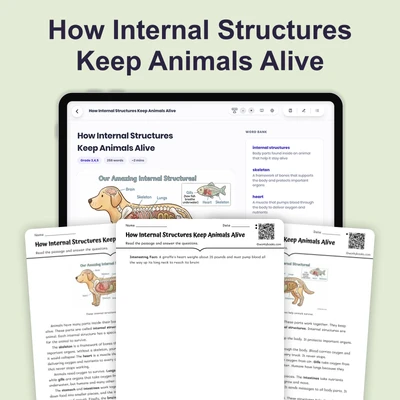
How Internal Structures Keep Animals Alive
This engaging 250-word reading passage introduces fourth-grade students to the essential internal structures that keep a...
NGSS 4-LS1-1LS1.A
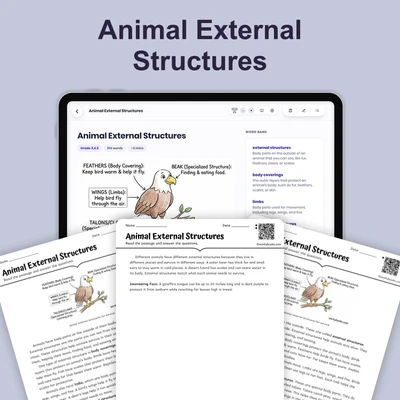
Animal External Structures
This engaging 250-word reading passage introduces fourth-grade students to the concept of animal external structures ali...
NGSS 4-LS1-1LS1.A
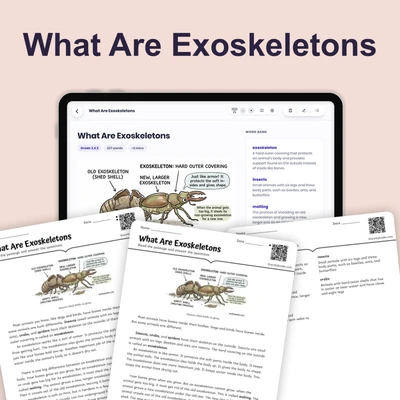
What Are Exoskeletons
This engaging 250-word reading passage introduces fourth-grade students to the concept of exoskeletons, aligning with NG...
NGSS 4-LS1-1LS1.A
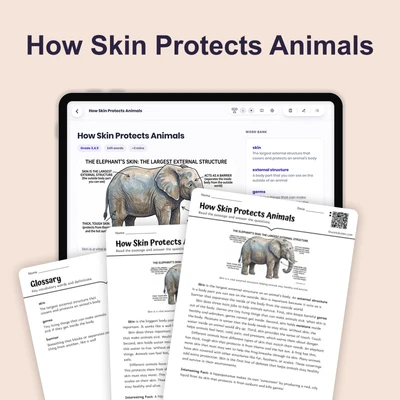
How Skin Protects Animals
This engaging 250-word reading passage introduces fourth-grade students to the protective functions of skin, the largest...