This learning resource is available in interactive and printable formats. The interactive worksheet can be played online and assigned to students. The Printable PDF version can be downloaded and printed for completion by hand.
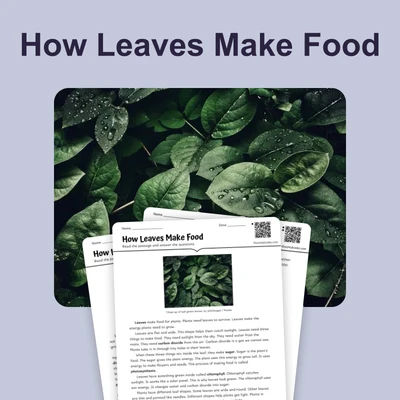
This 250-word reading passage introduces Grade 4 students to the internal structure of leaves, aligned with NGSS standard 4-LS1-1 and Disciplinary Core Idea LS1.A. Students discover how leaves contain specialized parts that work together to help plants survive. The passage explains the waxy coating (cuticle) that prevents water loss, tiny openings called stomata that allow gas exchange, and green cells containing chloroplasts that capture sunlight to make food. Through clear explanations and relatable examples, students build foundational understanding of plant structures and their functions. The passage includes bolded vocabulary terms with immediate definitions, making complex concepts accessible to fourth-grade readers. Audio integration supports diverse learners by providing multiple ways to access the content. Accompanying activities include multiple-choice questions testing recall and comprehension, writing prompts that encourage students to explain and apply their understanding, and graphic organizers that help students visualize the relationship between leaf structures and their functions. This comprehensive resource prepares students for hands-on investigations and deeper exploration of how plants meet their basic needs through specialized structures.
CONTENT PREVIEW
Expand content preview
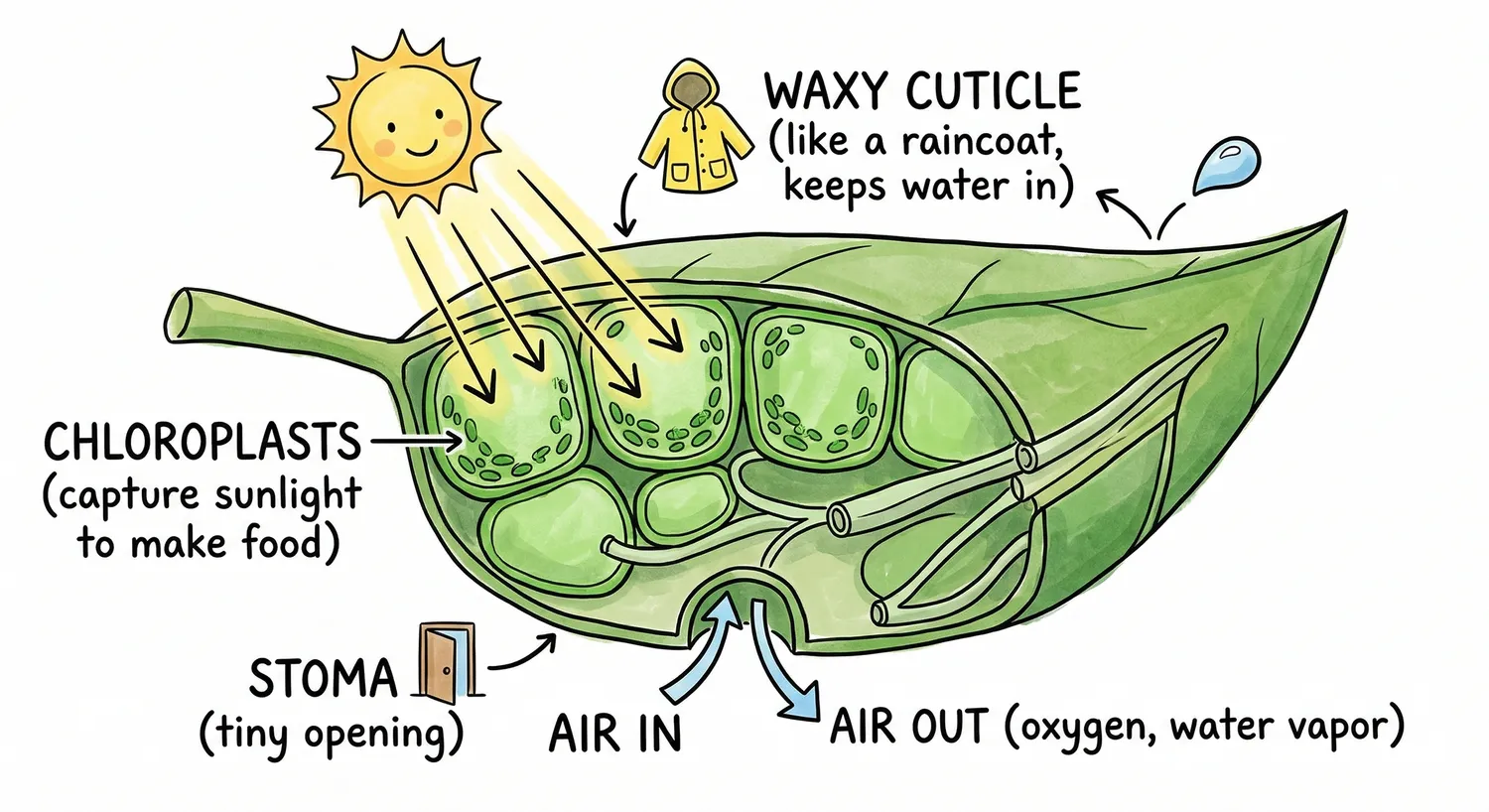
Anatomy of a leaf.
A leaf is a plant part that makes food for the plant. Inside and outside a leaf, there are special parts that each do an important job. Understanding these parts helps us see how plants stay alive and healthy.
The outside of a leaf has a waxy coating called the cuticle. This coating is like a raincoat for the leaf. It keeps water inside the plant so the leaf does not dry out. Without this coating, the plant would lose too much water and die.
On the bottom side of most leaves are tiny openings called stomata. These openings are so small you need a microscope to see them. Stomata let air move in and out of the leaf. Plants need air to make food and to release the oxygen we breathe. The stomata can open and close like tiny doors to control how much air and water vapor moves through them.
Inside the leaf are green cells that contain chloroplasts. Chloroplasts are tiny structures that capture sunlight. They use the sun's energy, along with air and water, to make food for the plant. This is why leaves are usually green—the chloroplasts give them their color. Each part of the leaf works together to help the plant survive and grow.
Interesting Fact: A single leaf can have thousands or even millions of stomata on its underside, and they open during the day to let air in and close at night to save water!
What does a leaf make for plants?
FoodRootsSeedsFlowers
What is the waxy coating called?
StomataCuticleChloroplastCell wall
Where are stomata located on a leaf?
On the top sideOn the stemOn the bottom sideInside the cells
Why do chloroplasts make leaves green?
They reflect green lightThey contain green pigmentThey absorb waterThey store food
How do stomata help control water?
They store extra waterThey make water for plantsThey open and close like doorsThey remove water from air
What do chloroplasts use to make food?
Sunlight, air, and waterOnly sunlightSoil and rocksSeeds and roots
Leaves can survive without a waxy coating.
TrueFalse
What are stomata?
Green structures that capture sunlightTiny openings that let air passWaxy coatings on leavesLarge cells that store food
Perfect For:
👩🏫 Teachers
• Reading comprehension practice
• Auto-graded assessments
• Literacy skill development
👨👩👧👦 Parents
• Reading practice at home
• Comprehension improvement
• Educational reading time
🏠 Homeschoolers
• Reading curriculum support
• Independent reading practice
• Progress monitoring
Reading Features:
📖
Reading Passage
Engaging fiction or nonfiction text
❓
Comprehension Quiz
Auto-graded questions
📊
Instant Feedback
Immediate results and scoring
📄
Printable Version
Download for offline reading
🔊
Read Aloud
Voice-over with word highlighting
Reviews & Ratings
No reviews yet. Be the first to share your experience!
Related Content
What Are Bones Made Of
This engaging 250-word reading passage introduces Grade 4 students to the structure and function of bones, aligned with ...
NGSS 4-LS1-1LS1.A
How Bones Protect Organs
This engaging 250-word reading passage helps Grade 4 students understand how bones protect organs, aligned with NGSS sta...
NGSS 4-LS1-1LS1.A
How Joints Connect Bones
This 250-word reading passage teaches fourth-grade students about joints and their role in the human skeletal system. Al...
NGSS 4-LS1-1LS1.A
Layers of the Skin
This engaging 250-word reading passage introduces fourth-grade students to the three layers of skin and their functions....
NGSS 4-LS1-1LS1.A
Parts of Plant Stems
This engaging 250-word reading passage introduces fourth-grade students to the internal structure and function of plant ...
NGSS 4-LS1-1LS1.A
Parts of a Flower
This comprehensive 250-word reading passage introduces fourth-grade students to the essential parts of a flower and thei...
NGSS 4-LS1-1LS1.A
How Leaves Make Food
This engaging Grade 4 science reading passage explains how leaves make food through photosynthesis. Students discover th...
NGSS 4-LS1-1LS1.A
How Animal Hearts Work
This 250-word audio-integrated reading passage introduces fourth-grade students to the essential function of the heart a...
NGSS 4-LS1-1LS1.A
Animal Skeleton Structure
This 250-word reading passage introduces fourth grade students to animal skeleton structure, aligned with NGSS 4-LS1-1 a...
NGSS 4-LS1-1LS1.A
How Animal Lungs Work
This 250-word reading passage introduces fourth-grade students to how animal lungs work, aligned with NGSS standard 4-LS...
NGSS 4-LS1-1LS1.A
Stamen and Pistil
This 250-word reading passage introduces fourth-grade students to the stamen and pistil, the key reproductive structures...
NGSS 4-LS1-1LS1.A
How Internal Structures Help Plants Survive
This 250-word informational reading passage is designed for Grade 4 students and aligns with NGSS standard 4-LS1-1 (LS1....
NGSS 4-LS1-1LS1.A
How Stems Support Plants
This engaging 250-word reading passage helps Grade 4 students understand how stems support plants and contribute to thei...
NGSS 4-LS1-1LS1.A
How Plants Reproduce
This 250-word reading passage introduces fourth-grade students to plant reproduction aligned with NGSS 4-LS1-1 and the D...
NGSS 4-LS1-1LS1.A
How External Structures Help Plants Survive
This 250-word reading passage introduces fourth-grade students to how external plant structures help plants survive, gro...
NGSS 4-LS1-1LS1.A
How Internal Structures Keep Animals Alive
This engaging 250-word reading passage introduces fourth-grade students to the essential internal structures that keep a...
NGSS 4-LS1-1LS1.A
Animal External Structures
This engaging 250-word reading passage introduces fourth-grade students to the concept of animal external structures ali...
NGSS 4-LS1-1LS1.A
What Are Exoskeletons
This engaging 250-word reading passage introduces fourth-grade students to the concept of exoskeletons, aligning with NG...
NGSS 4-LS1-1LS1.A
How Skin Protects Animals
This engaging 250-word reading passage introduces fourth-grade students to the protective functions of skin, the largest...