This learning resource is available in interactive and printable formats. The interactive worksheet can be played online and assigned to students. The Printable PDF version can be downloaded and printed for completion by hand.
This engaging 250-word reading passage introduces fourth-grade students to the concept of exoskeletons, aligning with NGSS standard 4-LS1-1 and the Disciplinary Core Idea LS1.A: Structure and Function. Students discover that some animals like insects, crabs, and spiders have their skeleton on the outside of their body instead of inside. The passage explains how exoskeletons are hard outer coverings that protect soft body parts, provide support, and prevent water loss. Unlike internal skeletons with bones that grow continuously, exoskeletons cannot grow with the animal. This leads to the fascinating process of molting, where animals must shed their old exoskeleton and grow a new, larger one. The passage compares exoskeletons to internal skeletons, helping students understand the diversity of animal structures. Audio integration supports diverse learners by providing multiple ways to access the content. The simplified differentiated version uses shorter sentences and familiar vocabulary while maintaining the same core science concepts. Both English and Spanish translations are included to support multilingual learners. Accompanying activities include comprehension questions, writing prompts, and graphic organizers that reinforce understanding of structure and function relationships in living organisms.
CONTENT PREVIEW
Expand content preview
Insects shed shells to grow.
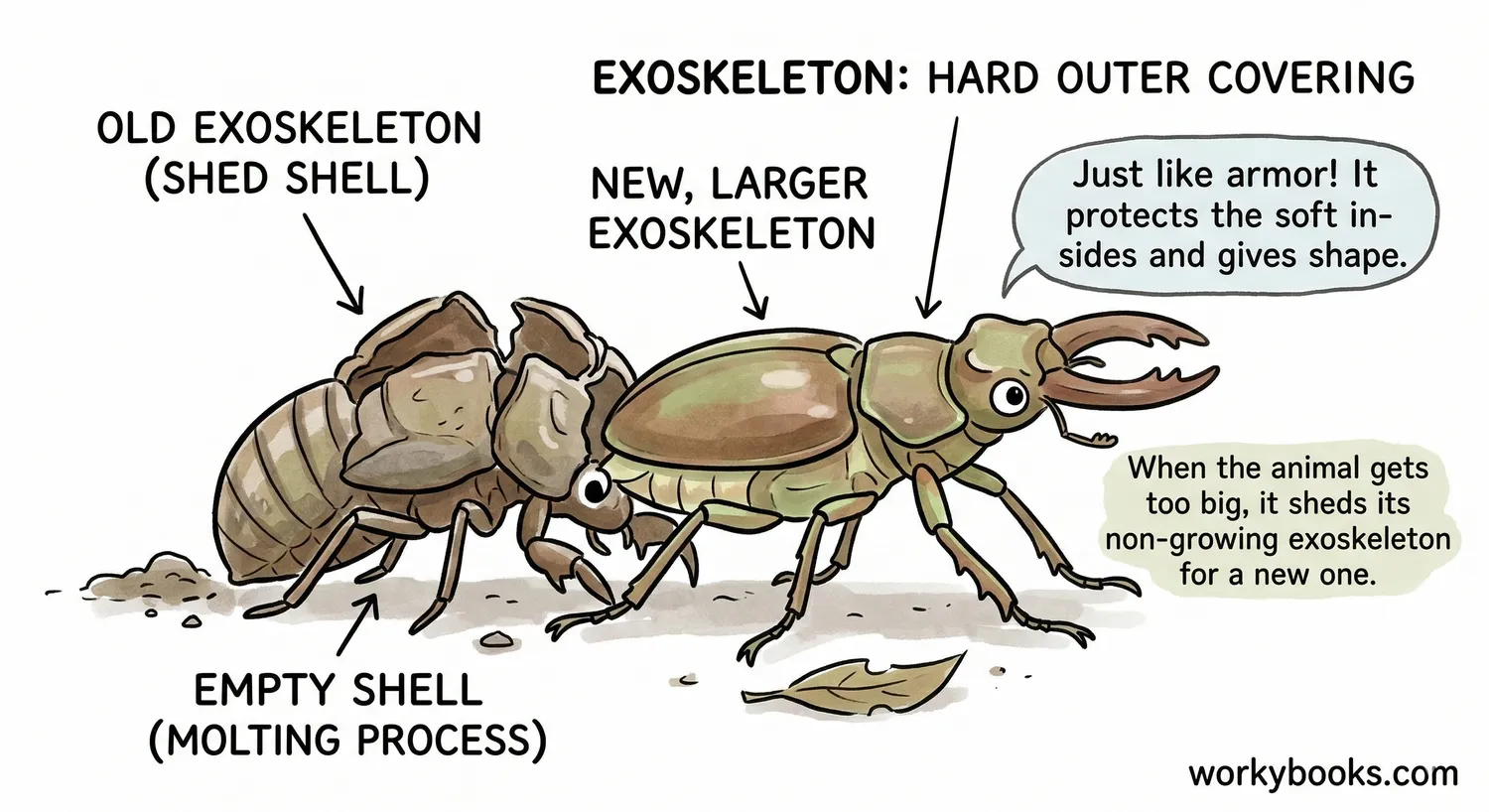
Most animals you know, like dogs and birds, have bones inside their bodies. But some animals are built differently. Insects (small animals with six legs like beetles and ants), crabs, and spiders have their skeleton on the outside of their body. This hard outer covering is called an exoskeleton.
An exoskeleton works like a suit of armor. It protects the soft body parts inside from getting hurt. The exoskeleton also gives the animal's body shape and support, just like your bones hold you up. Another important job of the exoskeleton is to keep water inside the animal's body so it doesn't dry out.
There is one big difference between an exoskeleton and the bones inside your body. Your bones grow as you grow. But an exoskeleton cannot grow. When an insect or crab gets too big for its exoskeleton, it must shed the old one. This process is called molting. The animal grows a new, larger exoskeleton underneath the old one. Then it crawls out of the old exoskeleton, leaving it behind like an empty shell. The new exoskeleton is soft at first, but it hardens in a few hours or days.
Interesting Fact: A cicada can live underground for 17 years, molting several times as it grows. When it finally comes above ground as an adult, you can often find its empty exoskeleton still clinging to a tree!
What is an exoskeleton?
Bones inside an animal's bodyA hard outer covering on animalsSoft skin that protects animalsA type of insect wing
Which animals have exoskeletons?
Dogs, cats, and birdsFish and sharksInsects, crabs, and spidersHorses and cows
What does an exoskeleton do?
It helps animals fly fasterIt protects and supports the bodyIt helps animals breathe underwaterIt makes animals grow bigger
Why do animals with exoskeletons molt?
Because they are sick or hurtTo change their body colorThe exoskeleton cannot grow with themTo find a new home
What happens after an animal molts?
The new exoskeleton is hard immediatelyThe animal stops growing foreverThe new exoskeleton hardens over timeThe animal loses its protection
How is an exoskeleton different from bones?
Exoskeletons are on the outsideExoskeletons are always softBones protect better than exoskeletonsBones are found in insects
An exoskeleton can grow as the animal grows.
TrueFalse
What does molting mean?
Growing new legs or wingsShedding an old exoskeletonEating a special type of foodMoving to a new location
Perfect For:
๐ฉโ๐ซ Teachers
โข Reading comprehension practice
โข Auto-graded assessments
โข Literacy skill development
๐จโ๐ฉโ๐งโ๐ฆ Parents
โข Reading practice at home
โข Comprehension improvement
โข Educational reading time
๐ Homeschoolers
โข Reading curriculum support
โข Independent reading practice
โข Progress monitoring
Reading Features:
๐
Reading Passage
Engaging fiction or nonfiction text
โ
Comprehension Quiz
Auto-graded questions
๐
Instant Feedback
Immediate results and scoring
๐
Printable Version
Download for offline reading
๐
Read Aloud
Voice-over with word highlighting
Reviews & Ratings
No reviews yet. Be the first to share your experience!
Related Content
What Are Bones Made Of
This engaging 250-word reading passage introduces Grade 4 students to the structure and function of bones, aligned with ...
NGSS 4-LS1-1LS1.A
How Bones Protect Organs
This engaging 250-word reading passage helps Grade 4 students understand how bones protect organs, aligned with NGSS sta...
NGSS 4-LS1-1LS1.A
How Joints Connect Bones
This 250-word reading passage teaches fourth-grade students about joints and their role in the human skeletal system. Al...
NGSS 4-LS1-1LS1.A
Layers of the Skin
This engaging 250-word reading passage introduces fourth-grade students to the three layers of skin and their functions....
NGSS 4-LS1-1LS1.A
Parts of Plant Stems
This engaging 250-word reading passage introduces fourth-grade students to the internal structure and function of plant ...
NGSS 4-LS1-1LS1.A
Parts of a Flower
This comprehensive 250-word reading passage introduces fourth-grade students to the essential parts of a flower and thei...
NGSS 4-LS1-1LS1.A
How Leaves Make Food
This engaging Grade 4 science reading passage explains how leaves make food through photosynthesis. Students discover th...
NGSS 4-LS1-1LS1.A
How Animal Hearts Work
This 250-word audio-integrated reading passage introduces fourth-grade students to the essential function of the heart a...
NGSS 4-LS1-1LS1.A
Animal Skeleton Structure
This 250-word reading passage introduces fourth grade students to animal skeleton structure, aligned with NGSS 4-LS1-1 a...
NGSS 4-LS1-1LS1.A
How Animal Lungs Work
This 250-word reading passage introduces fourth-grade students to how animal lungs work, aligned with NGSS standard 4-LS...
NGSS 4-LS1-1LS1.A
Parts of a Leaf
This 250-word reading passage introduces Grade 4 students to the internal structure of leaves, aligned with NGSS standar...
NGSS 4-LS1-1LS1.A
Stamen and Pistil
This 250-word reading passage introduces fourth-grade students to the stamen and pistil, the key reproductive structures...
NGSS 4-LS1-1LS1.A
How Internal Structures Help Plants Survive
This 250-word informational reading passage is designed for Grade 4 students and aligns with NGSS standard 4-LS1-1 (LS1....
NGSS 4-LS1-1LS1.A
How Stems Support Plants
This engaging 250-word reading passage helps Grade 4 students understand how stems support plants and contribute to thei...
NGSS 4-LS1-1LS1.A
How Plants Reproduce
This 250-word reading passage introduces fourth-grade students to plant reproduction aligned with NGSS 4-LS1-1 and the D...
NGSS 4-LS1-1LS1.A
How External Structures Help Plants Survive
This 250-word reading passage introduces fourth-grade students to how external plant structures help plants survive, gro...
NGSS 4-LS1-1LS1.A
How Internal Structures Keep Animals Alive
This engaging 250-word reading passage introduces fourth-grade students to the essential internal structures that keep a...
NGSS 4-LS1-1LS1.A
Animal External Structures
This engaging 250-word reading passage introduces fourth-grade students to the concept of animal external structures ali...
NGSS 4-LS1-1LS1.A
How Skin Protects Animals
This engaging 250-word reading passage introduces fourth-grade students to the protective functions of skin, the largest...