This learning resource is available in interactive and printable formats. The interactive worksheet can be played online and assigned to students. The Printable PDF version can be downloaded and printed for completion by hand.
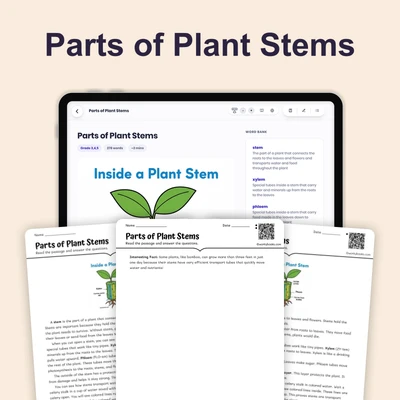
This engaging 250-word reading passage helps Grade 4 students understand how stems support plants and contribute to their survival. Aligned with NGSS 4-LS1-1 and the Disciplinary Core Idea LS1.A, the passage explains how stems hold plants upright, position leaves to receive sunlight, and create pathways between roots and leaves. Students explore different types of stems including thin flexible stems like daisies, thick woody stems like tree trunks, and climbing stems like vines. The passage uses age-appropriate language and real-world examples to build foundational understanding of plant structures and their functions. Audio-integrated features support diverse learners, while the simplified differentiated version ensures accessibility for all reading levels. Complementary activities include multiple-choice comprehension questions, writing prompts that encourage application of concepts, and graphic organizers that help students analyze stem structures and functions. This standards-aligned resource provides teachers with complete instructional materials for teaching plant anatomy and the relationship between structure and function in living organisms.
CONTENT PREVIEW
Expand content preview
Stems connect roots to leaves.
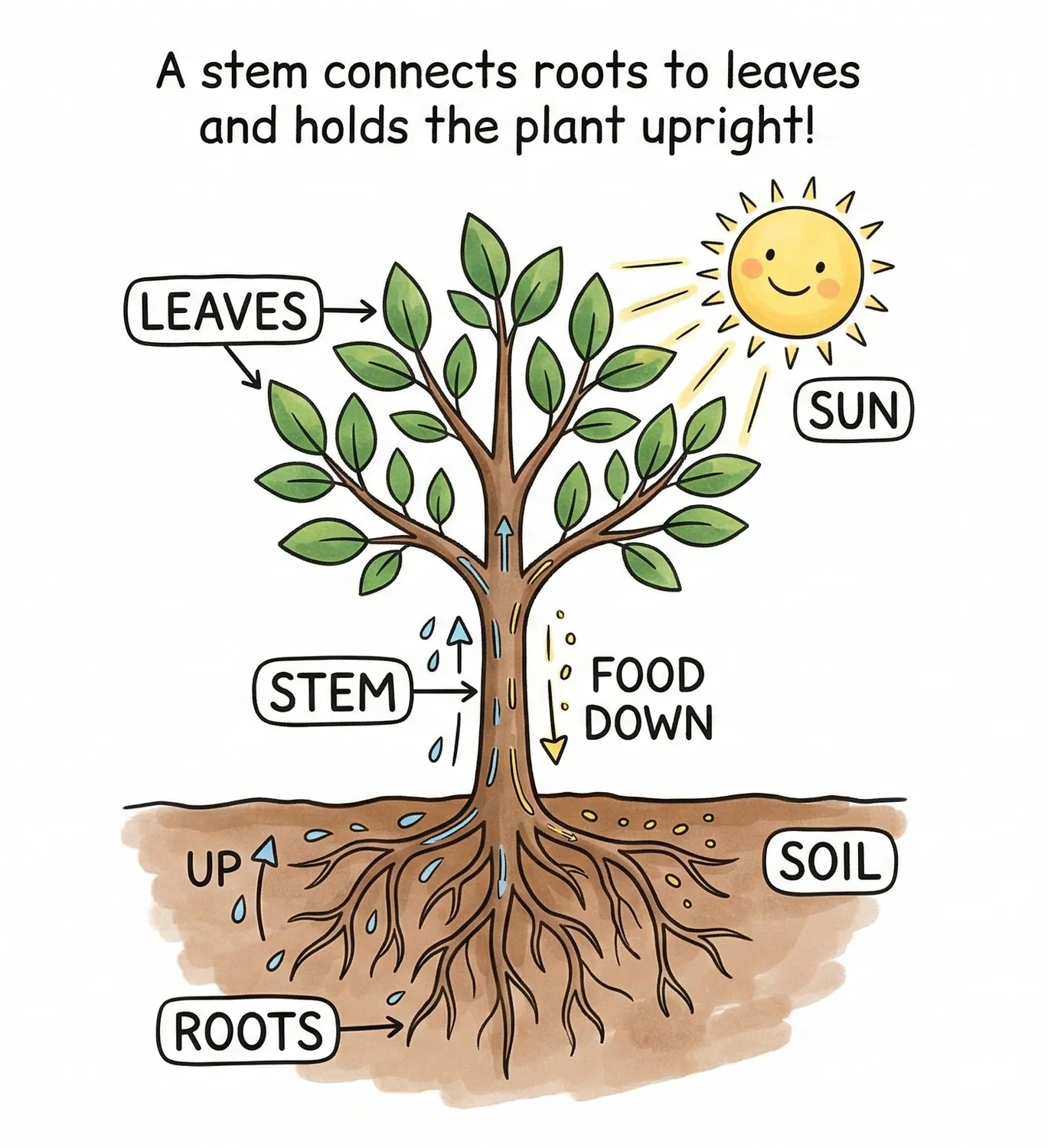
A stem is the part of a plant that connects the roots underground to the leaves above ground. Stems are important because they hold the plant upright and position the leaves where they can catch sunlight. Without stems, plants could not stand tall or spread their leaves to make food through photosynthesis.
Stems come in many different forms depending on the type of plant. A daisy has a thin, flexible stem that can bend in the wind without breaking. Flexible means able to bend easily. A tree has a thick, woody stem called a trunk that provides strong support so the tree can grow very tall. Woody means hard and rigid like wood. Some plants like ivy have climbing stems called vines that wrap around objects for support. Think of a stem like a straw in a drink box—it connects the liquid at the bottom to your mouth at the top.
The external structure of the stem—its thickness, strength, and flexibility—determines how tall a plant can grow and how it holds its shape. External structure means the outside form and features of something. Thick, woody stems allow trees to reach heights of over 100 feet, while thin stems keep smaller plants closer to the ground. Stems also create a pathway that moves water from the roots up to the leaves and carries food made in the leaves down to the rest of the plant.
Interesting Fact: The tallest tree in the world is a coast redwood named Hyperion that stands 380 feet tall—that's taller than the Statue of Liberty!
What does a stem connect?
Roots to leavesFlowers to seedsWater to soilSunlight to roots
What type of stem does a daisy have?
Thick and woodyThin and flexibleClimbing vineUnderground root
What is a tree's stem called?
A vineA branchA trunkA root
Why do plants need stems?
To make flowers bloomTo hold leaves toward sunlightTo create new seedsTo store water underground
How does external structure affect plant growth?
It changes leaf colorIt determines how tall plants growIt makes flowers biggerIt helps roots spread wider
What do stems transport inside plants?
Only water from roots to leavesOnly food from leaves to rootsWater up and food downSunlight to all parts
Stems help position leaves to catch sunlight.
TrueFalse
What does 'flexible' mean?
Very hard and strongAble to bend easilyGrowing undergroundMaking food from sunlight
Perfect For:
👩🏫 Teachers
• Reading comprehension practice
• Auto-graded assessments
• Literacy skill development
👨👩👧👦 Parents
• Reading practice at home
• Comprehension improvement
• Educational reading time
🏠 Homeschoolers
• Reading curriculum support
• Independent reading practice
• Progress monitoring
Reading Features:
📖
Reading Passage
Engaging fiction or nonfiction text
❓
Comprehension Quiz
Auto-graded questions
📊
Instant Feedback
Immediate results and scoring
📄
Printable Version
Download for offline reading
🔊
Read Aloud
Voice-over with word highlighting
Reviews & Ratings
No reviews yet. Be the first to share your experience!
Related Content
What Are Bones Made Of
This engaging 250-word reading passage introduces Grade 4 students to the structure and function of bones, aligned with ...
NGSS 4-LS1-1LS1.A
How Bones Protect Organs
This engaging 250-word reading passage helps Grade 4 students understand how bones protect organs, aligned with NGSS sta...
NGSS 4-LS1-1LS1.A
How Joints Connect Bones
This 250-word reading passage teaches fourth-grade students about joints and their role in the human skeletal system. Al...
NGSS 4-LS1-1LS1.A
Layers of the Skin
This engaging 250-word reading passage introduces fourth-grade students to the three layers of skin and their functions....
NGSS 4-LS1-1LS1.A
Parts of Plant Stems
This engaging 250-word reading passage introduces fourth-grade students to the internal structure and function of plant ...
NGSS 4-LS1-1LS1.A
Parts of a Flower
This comprehensive 250-word reading passage introduces fourth-grade students to the essential parts of a flower and thei...
NGSS 4-LS1-1LS1.A
How Leaves Make Food
This engaging Grade 4 science reading passage explains how leaves make food through photosynthesis. Students discover th...
NGSS 4-LS1-1LS1.A
How Animal Hearts Work
This 250-word audio-integrated reading passage introduces fourth-grade students to the essential function of the heart a...
NGSS 4-LS1-1LS1.A
Animal Skeleton Structure
This 250-word reading passage introduces fourth grade students to animal skeleton structure, aligned with NGSS 4-LS1-1 a...
NGSS 4-LS1-1LS1.A
How Animal Lungs Work
This 250-word reading passage introduces fourth-grade students to how animal lungs work, aligned with NGSS standard 4-LS...
NGSS 4-LS1-1LS1.A
Parts of a Leaf
This 250-word reading passage introduces Grade 4 students to the internal structure of leaves, aligned with NGSS standar...
NGSS 4-LS1-1LS1.A
Stamen and Pistil
This 250-word reading passage introduces fourth-grade students to the stamen and pistil, the key reproductive structures...
NGSS 4-LS1-1LS1.A
How Internal Structures Help Plants Survive
This 250-word informational reading passage is designed for Grade 4 students and aligns with NGSS standard 4-LS1-1 (LS1....
NGSS 4-LS1-1LS1.A
How Plants Reproduce
This 250-word reading passage introduces fourth-grade students to plant reproduction aligned with NGSS 4-LS1-1 and the D...
NGSS 4-LS1-1LS1.A
How External Structures Help Plants Survive
This 250-word reading passage introduces fourth-grade students to how external plant structures help plants survive, gro...
NGSS 4-LS1-1LS1.A
How Internal Structures Keep Animals Alive
This engaging 250-word reading passage introduces fourth-grade students to the essential internal structures that keep a...
NGSS 4-LS1-1LS1.A
Animal External Structures
This engaging 250-word reading passage introduces fourth-grade students to the concept of animal external structures ali...
NGSS 4-LS1-1LS1.A
What Are Exoskeletons
This engaging 250-word reading passage introduces fourth-grade students to the concept of exoskeletons, aligning with NG...
NGSS 4-LS1-1LS1.A
How Skin Protects Animals
This engaging 250-word reading passage introduces fourth-grade students to the protective functions of skin, the largest...