How the Crusades Changed Europe
Interactive passage with audio narration, comprehension questions, and printable PDF.
By completing this purchase you agree to our Terms of Use and Privacy Policy. Your subscription renews automatically until you cancel. You can cancel anytime from your account settings. All sales are final and non-refundable. Digital content is available for download in your account immediately upon purchase.
What's included
How the Crusades Changed Europe preview and details
About this printable How the Crusades Changed Europe reading passage (Grades 5-8)
Sample passage and quiz from How the Crusades Changed Europe
Reading passage and comprehension quiz preview
How the Crusades Changed Europe
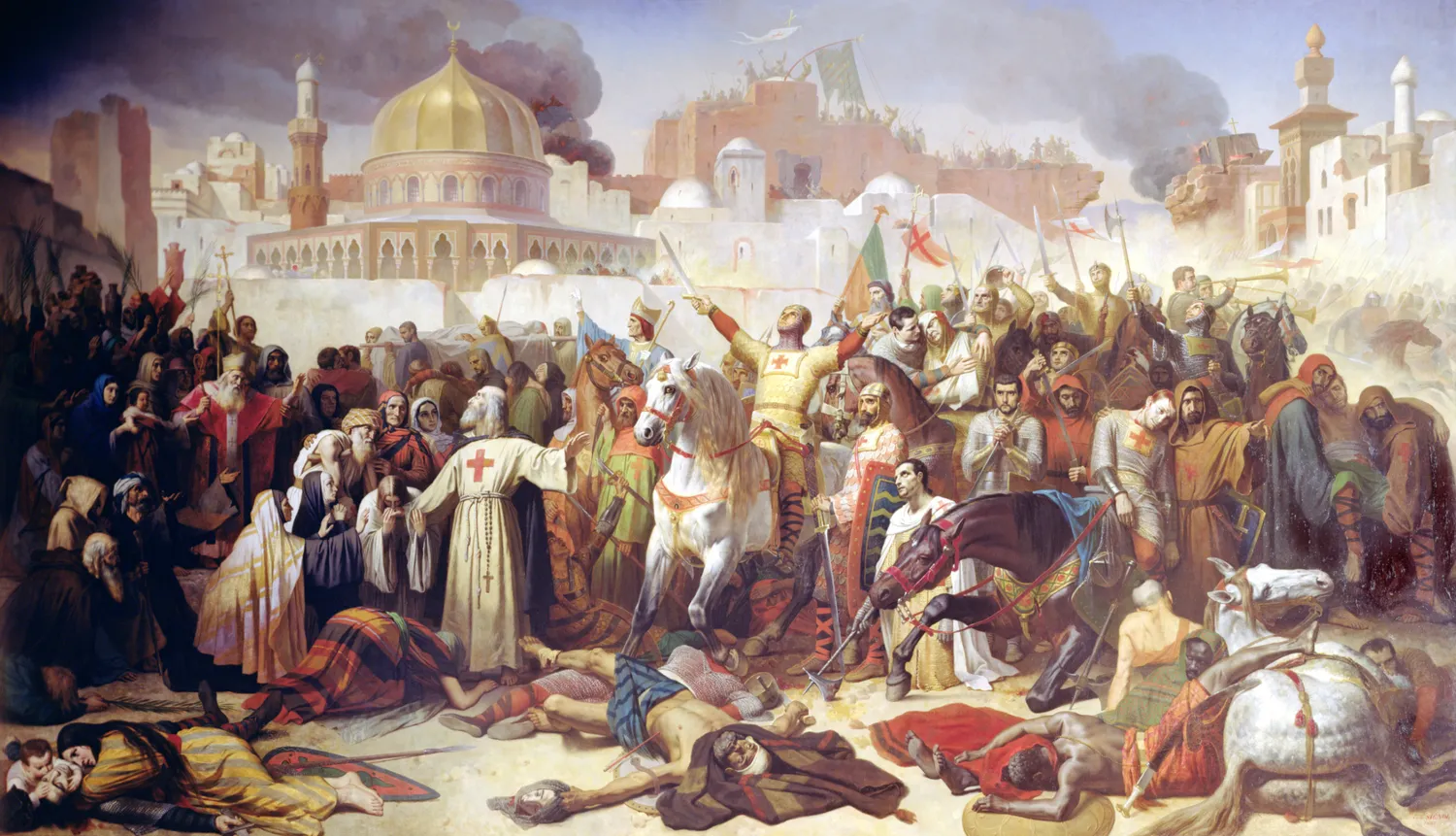
"Taking of Jerusalem by the Crusaders, 15th July 1099" by Émile Signol / Wikimedia Commons.
The Crusades were a series of military campaigns that began in 1096, when European Christians set out to capture Jerusalem and other holy sites from Muslim rulers. These wars, which lasted until the late 1200s, had long-lasting effects on Europe. While the Crusaders often failed to achieve their main religious goals, the Crusades brought significant changes to European societies.
One major effect of the Crusades was the increase in trade between Europe and the Middle East. Crusaders traveling through the Byzantine Empire and Islamic lands encountered new goods such as spices, silk, and glassware. Italian city-states like Venice and Genoa became wealthy by transporting Crusaders and trading with the East. Archaeological finds, such as imported ceramics in European ports, provide evidence of this new commercial activity. Over time, merchants established new trade routes, connecting Europe more closely to Asia and Africa.
The Crusades also exposed Europeans to new ideas and technologies from the Islamic world. European Crusaders observed advanced medical practices, mathematics, and architecture in cities like Damascus and Cairo. For example, the writings of Muslim scholars such as Avicenna influenced European medicine. Europeans brought back Arabic numerals and techniques such as distillation and paper-making. These exchanges led to important changes in European learning and culture.
Another major effect was the weakening of feudalism. Many nobles sold land or freed their serfs to raise money for the Crusades. With fewer people tied to the land, cities grew and a new middle class of merchants and artisans emerged. This shift is documented in town charters and records from the period. The power of kings increased as they united their lands, while the influence of local lords declined. Feudal society began to change, paving the way for the modern nation-state.
The Crusades also affected culture and daily life. Europeans adopted new foods, clothing styles, and art forms. Contact with other civilizations made some Europeans more curious and open to learning. However, the Crusades also led to violence and mistrust between Christians, Muslims, and Jews. Despite these conflicts, the Crusades helped end Europe's isolation and connected it with the wider world.
In conclusion, the Crusades had lasting effects on Europe by promoting trade, spreading new ideas and technology, and changing social structures. These changes helped shape the development of Europe in the centuries that followed.
The impact of the Crusades connects to larger themes in world history, such as cultural exchange, economic growth, and the rise of new political systems.
Interesting Fact: Knights returning from the Crusades sometimes brought back rare animals, like camels or peacocks, which amazed people in their home villages.
Comprehension quiz (8 questions)
1. When did the First Crusade start?
2. Which city-state grew rich from Crusader trade?
3. Who influenced European medicine during the Crusades?
4. Why did feudalism weaken after the Crusades?
5. What did Europeans adopt from the Islamic world?
6. Which group grew after the Crusades?
7. The Crusades lasted about 200 years.
8. What is feudalism?
Perfect for the way you teach
- Build comprehension skills
- Auto-graded quiz
- Differentiated reading
- Read together at home
- Improve fluency
- Quiet reading time
- Reading curriculum support
- Independent practice
- Track Lexile growth