This passage explores the rise of King Saul, the first king of ancient Israel, and his role in uniting the twelve tribes during a turbulent period. Students will learn how Saul was chosen, how he ruled, and the challenges he faced from both internal divisions and external threats such as the Philistines. The text provides evidence from biblical and archaeological sources, examines the cause and effect of transitioning from judges to monarchy, and connects the events to the broader context of ancient civilizations in the Middle East. This history reading passage includes a glossary, comprehension questions, writing prompts, graphic organizers, timeline, and Spanish translation. Audio read-aloud is provided. The resource aligns with California HSS 6.2 and Common Core RI.6-8.1, RI.6-8.3, and W.6-8.2 standards.
Written by Workybooks TeamPublished by Workybooks
Preview
Sample passage and quiz content
CONTENT PREVIEW
Expand content preview
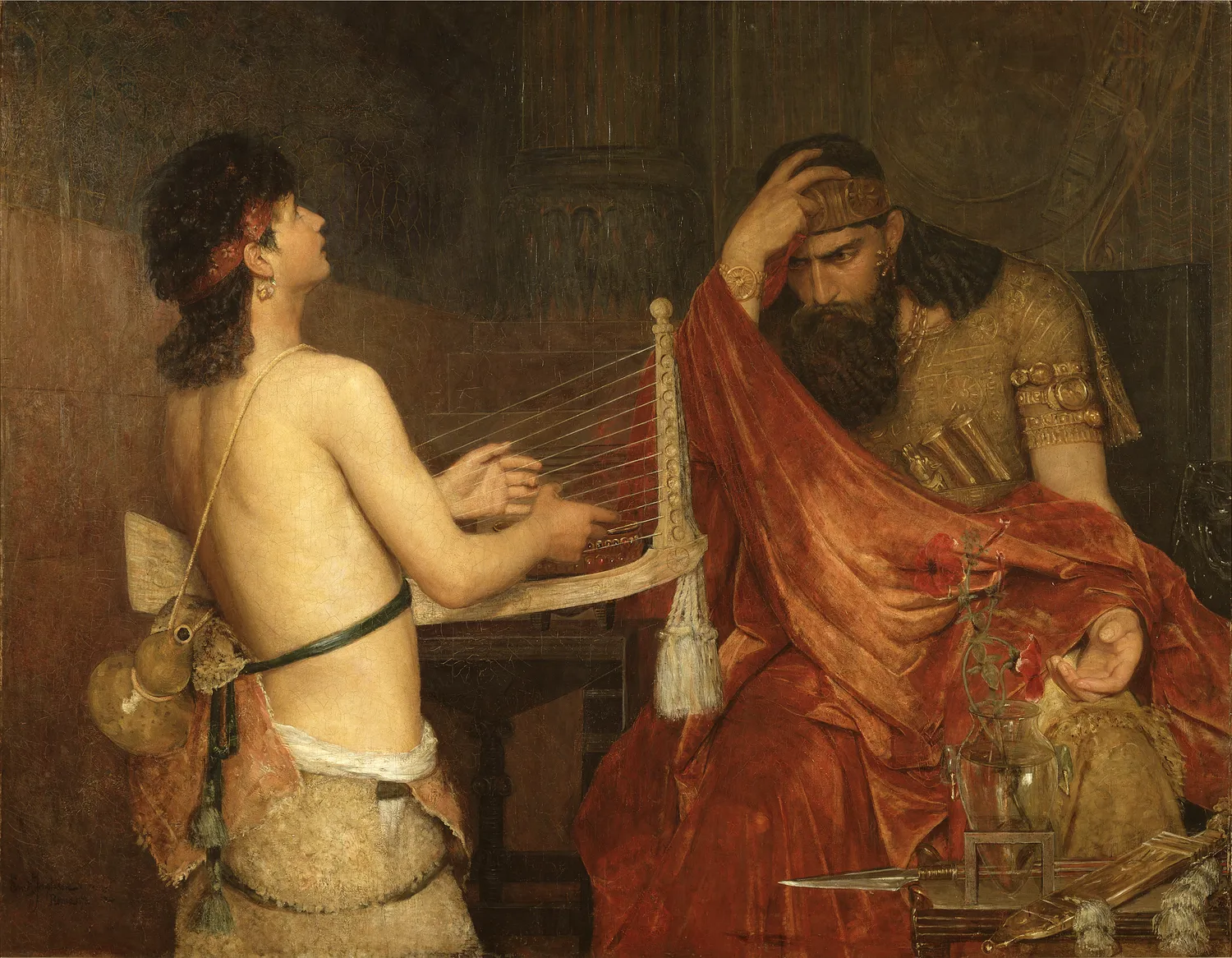
"David and Saul (Israel's First King)" by Ernst Josephson / Wikimedia Commons
King Saul became the first king of ancient Israel around 1020 BCE, during a period of great change and danger for the Israelite people. Before Saul's reign, Israel was a loose collection of twelve tribes, each governed by local leaders called judges. These tribes often struggled to work together, especially when faced with threats from neighboring groups like the Philistines.
The rise of Saul marked a major turning point for Israel. According to the Hebrew Bible, the people demanded a single leader who could unite them and provide strong leadership against their enemies. The prophet Samuel was chosen by God to select the new king. Saul, from the tribe of Benjamin, was described as tall and impressive. Archaeological discoveries, such as ancient pottery found in the region of Gibeah, where Saul’s capital was located, support the idea that this area became more important during Saul’s rule. Saul was anointed as king by Samuel, symbolizing his legitimacy and authority to rule.
Saul’s first major challenge was uniting the tribes, which often disagreed due to historical rivalries and different ways of life. He organized a standing army, a new step for the Israelites, and led successful battles against enemies like the Ammonites and Philistines. One famous example is found in the First Book of Samuel, where Saul rallies the tribes to rescue the city of Jabesh-Gilead. However, his reign was also marked by conflict, including growing tension with Samuel and the people, who accused Saul of disobeying God’s commands. Saul’s failure to fully destroy the Amalekites, for example, led to his rejection by Samuel as king, showing how religious expectations shaped the monarchy.
Saul’s rule ended in tragedy. After years of war with the Philistines, Saul and his sons died in battle at Mount Gilboa. The defeat was a disaster for Israel, but it paved the way for David, Saul’s former ally, to become the next king. Saul’s reign showed both the strengths and weaknesses of monarchy. On one hand, he brought unity and a stronger sense of national identity. On the other, his struggles revealed the challenges of balancing tribal traditions, religious laws, and the demands of leadership.
King Saul’s story connects to the broader history of ancient civilizations in the Middle East, where leaders often rose in response to external threats and internal divisions. Understanding his reign helps us see how societies organize themselves, respond to change, and remember their pasts.
Interesting Fact: According to ancient sources, Saul was chosen partly because of his great height, which made him stand out among the Israelites.
Who was Israel's first king?
SaulDavidSamuelSolomon
Which tribe did Saul come from?
BenjaminJudahDanLevi
Who anointed Saul as king?
SamuelDavidMosesJoshua
Why did the Israelites want a king?
To unite tribesTo build a templeTo farm landTo trade spices
What was one of Saul’s main challenges?
Uniting the tribesBuilding pyramidsFinding goldSailing the seas
What happened after Saul died?
David became kingSaul became king againEgypt invaded IsraelThe tribes split
Saul was chosen because of his height. (True/False)
TrueFalse
What does the word 'monarchy' mean?
Rule by a kingRule by a councilRule by merchantsRule by farmers
Who it's for
Perfect for the way you teach
Teachers
Build comprehension skills
Auto-graded quiz
Differentiated reading
Parents
Read together at home
Improve fluency
Quiet reading time
Homeschoolers
Reading curriculum support
Independent practice
Track Lexile growth
Topics
King Saulancient Israelfirst kingtwelve tribesmonarchySamuelPhilistinesancient civilizationshistory reading passage
Reviews & Ratings
No reviews yet. Be the first to share your experience!
More reading you might love
20 more
Farming in Ancient Mesopotamia
This engaging reading passage explores how the geography of Mesopotamia shaped its civilization through innovative irrig...
CA HSS 6.2RH.6-8.1RH.6-8.2RH.6-8.4
Mesopotamian Irrigation Systems
This reading passage explores the environmental challenges faced by ancient Mesopotamia, the 'land between the rivers.' ...
CA HSS 6.2RH.6-8.1RH.6-8.2TEKS 6.2A
Egypt's New Kingdom
This engaging history reading passage explores the rise of Ancient Egypt during the New Kingdom, when Egypt became a pow...
CA HSS 6.2RH.6-8.2WHST.6-8.2
Legacy of Ancient Civilizations
This history reading passage explores how geography played a crucial role in shaping the development, connection, and di...
CA HSS 6.2RI.6.1RI.6.3
Ancient Egyptian Afterlife
This engaging history reading passage explores ancient Egyptian beliefs about the afterlife and the construction of the ...
CA HSS 6.2RH.6-8.1RH.6-8.4
Comparing Ancient Religions and Beliefs
This passage explores the religious beliefs of ancient civilizations, focusing on the differences and similarities betwe...
CA HSS 6.2RH.6-8.1RH.6-8.4RH.6-8.9
Rosetta Stone Decoded
This engaging history reading passage explores the remarkable discovery of the Rosetta Stone and its impact on the study...
CA HSS 6.27.1CCSS.RI.6.1CCSS.RI.7.1
Ancient Taxes and Tribute
This reading passage explores the origins and practices of taxation in ancient civilizations, focusing on how early gove...
CA HSS 6.2CCSS.RI.6.1CCSS.RI.6.4CCSS.W.6.2
Ancient Coins and Barter
This passage explores the fascinating evolution from barter to the earliest coins in ancient civilizations, focusing on ...
CA HSS 6.2CCSS.ELA-LITERACY.RH.6-8.2CCSS.ELA-LITERACY.RH.6-8.4
Neolithic Tools
This passage explores the profound impact of new stone tools during the Neolithic period, focusing on how these innovati...
CA HSS 6.2CCSS RH.6-8.1CCSS RH.6-8.4
Social structures in Ancient World
This passage explores the organization and significance of family life in ancient societies, focusing on how extended fa...
CA HSS 6.2CCSS RH.6-8.1CCSS RH.6-8.4CCSS RH.6-8.7
Egyptian Social Classes
This engaging reading passage explores the social pyramid of Ancient Egyptian society, delving into how the roles and re...
CA HSS 6.2RI.6.1RI.6.2RI.6.4
King Solomon and the First Temple
This engaging history reading passage explores King Solomon and the construction of the First Temple in ancient Jerusale...
CA HSS 6.2CCSS.RI.6.1CCSS.RI.6.2CCSS.RI.7.1
King David of Israel
This engaging history passage explores the life and legacy of King David, focusing on his rise as a warrior king and his...
CA HSS 6.2CCSS.RI.6.1CCSS.RI.6.3CCSS.W.6.2
Mesopotamian Math and Astronomy
This engaging passage explores the scientific achievements of ancient Mesopotamia, the region between the Tigris and Eup...
CA HSS 6.2RH.6-8.2
City-States of the Ancient World
This history reading passage explores the development and significance of city-states in ancient civilizations, focusing...
CA HSS 6.2CCSS.RI.6.3CCSS.RI.6.4
Ancient Mathematics
This passage explores the essential role of mathematics in ancient civilizations, including Mesopotamia, Egypt, Greece, ...
CA HSS 6.2CCSS RH.6-8.1CCSS RH.6-8.4
Ancient Science and Medicine
This comprehensive reading passage explores the development of science and medicine in ancient civilizations, including ...
CA HSS 6.2CCSS RH.6-8.2CCSS RH.6-8.4CCSS RH.6-8.7
Ancient Writing Systems
This engaging history reading passage explores the origins and evolution of ancient writing systems, including cuneiform...
CA HSS 6.2CCSS RH.6-8.2CCSS RH.6-8.4CCSS RH.6-8.9
The Bronze Age Begins
This passage explores the transformative era of the Bronze Age, focusing on how the discovery and use of bronze revoluti...