Treaty of Verdun Divides an Empire
Interactive passage with audio narration, comprehension questions, and printable PDF.
By completing this purchase you agree to our Terms of Use and Privacy Policy. Your subscription renews automatically until you cancel. You can cancel anytime from your account settings. All sales are final and non-refundable. Digital content is available for download in your account immediately upon purchase.
What's included
Treaty of Verdun Divides an Empire preview and details
About this printable Treaty of Verdun Divides an Empire reading passage (Grades 5-8)
Sample passage and quiz from Treaty of Verdun Divides an Empire
Reading passage and comprehension quiz preview
Treaty of Verdun Divides an Empire
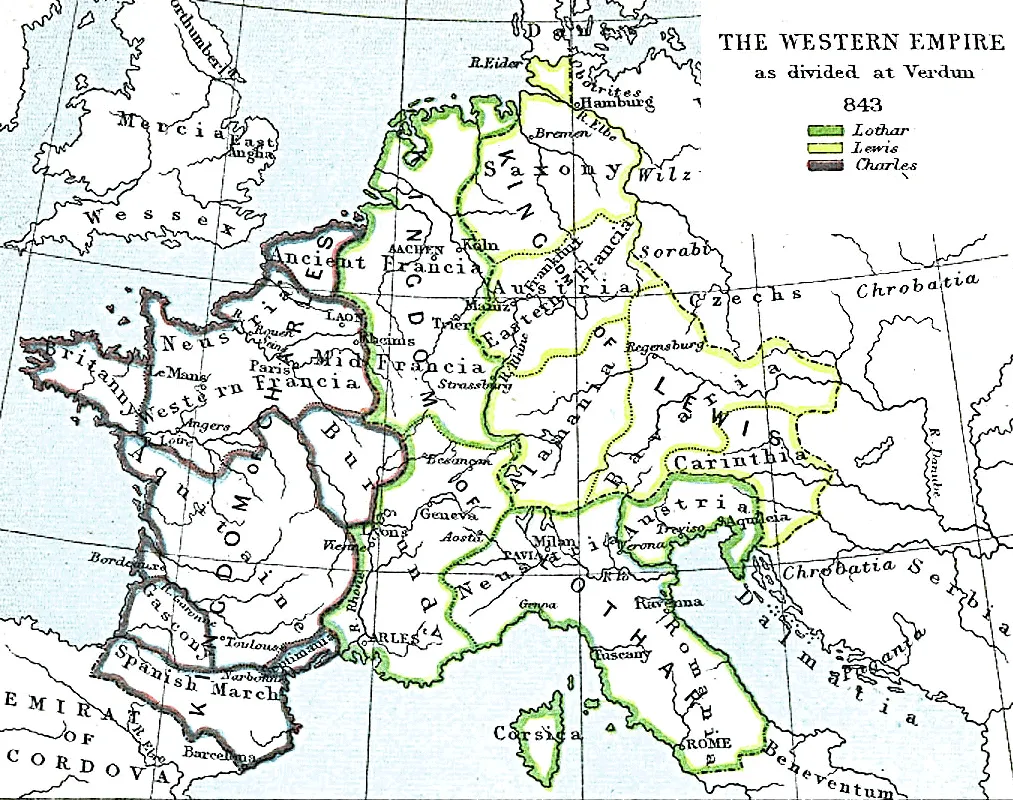
"Western empire verdun 843" / Wikimedia Commons (Public domain).
The Treaty of Verdun in 843 CE marked a turning point in European history, when the vast Frankish Empire built by Charlemagne was divided among his grandsons. This event did not only end the era of a unified empire in Western Europe, but it also set the stage for the development of modern European countries such as France and Germany.
Charlemagne, crowned Emperor of the Romans in 800 CE, ruled over a huge territory that included much of Western and Central Europe. He worked to unite his empire using Christianity, laws, and the feudal system. After Charlemagne’s death in 814 CE, his only surviving son, Louis the Pious, became emperor. Louis faced many challenges, including revolts from his own sons who each wanted a share of the empire. Political instability increased as the empire struggled to control its vast lands and diverse peoples.
When Louis the Pious died in 840 CE, his three surviving sons—Lothair, Charles the Bald, and Louis the German—began fighting for control. Their disputes led to civil war and widespread destruction. The conflict ended with the Treaty of Verdun in 843 CE, a formal agreement supported by church leaders and nobles. According to a contemporary chronicler, "the brothers, weary of war, divided the realm with solemn oaths." Archaeological evidence from the city of Verdun, including fragments of royal seals and surviving legal documents, confirm the importance of the treaty and the gathering of nobles there.
The treaty split the empire into three parts. Lothair received the central region, called the Middle Kingdom, stretching from the North Sea to Italy, including important cities like Aachen and Rome. Charles the Bald took the western lands, known as West Francia (which would later become France), while Louis the German ruled the eastern lands, or East Francia (which would become Germany). Each kingdom developed its own identity, language, and leaders over time. The division also weakened central authority, making it harder to defend against external threats such as Viking raids. Local lords gained more power, leading to the rise of medieval feudalism and a new social hierarchy.
The Treaty of Verdun is significant because it marked the end of Charlemagne’s vision of a united empire. It created new borders that still influence Europe today. The agreement was both a cause and an effect of the empire’s decline: family conflicts and geographic challenges made unity impossible, while the division itself led to greater independence for regions and rulers. Over centuries, these kingdoms would evolve into modern European states, showing both change and continuity in history.
This story connects to broader themes in world history, such as the rise and fall of empires, the importance of political agreements, and how geography shapes societies.
Interesting Fact: The Treaty of Verdun is one of the earliest examples in Europe where a written agreement, rather than war alone, decided the fate of an empire.
Comprehension quiz (8 questions)
1. When was the Treaty of Verdun signed?
2. Who was Charlemagne’s only surviving son?
3. Which region did Charles the Bald rule?
4. Why was the empire hard to control?
5. How did the treaty impact local lords?
6. What was a result of the division?
7. The Treaty of Verdun was a written agreement.
8. What is the meaning of 'feudal system'?
Perfect for the way you teach
- Build comprehension skills
- Auto-graded quiz
- Differentiated reading
- Read together at home
- Improve fluency
- Quiet reading time
- Reading curriculum support
- Independent practice
- Track Lexile growth