Wampum Belts
Interactive passage with audio narration, comprehension questions, and printable PDF.
By completing this purchase you agree to our Terms of Use and Privacy Policy. Your subscription renews automatically until you cancel. You can cancel anytime from your account settings. All sales are final and non-refundable. Digital content is available for download in your account immediately upon purchase.
What's included
Wampum Belts preview and details
About this printable Wampum Belts reading passage (Grades 5-8)
Sample passage and quiz from Wampum Belts
Reading passage and comprehension quiz preview
Wampum Belts
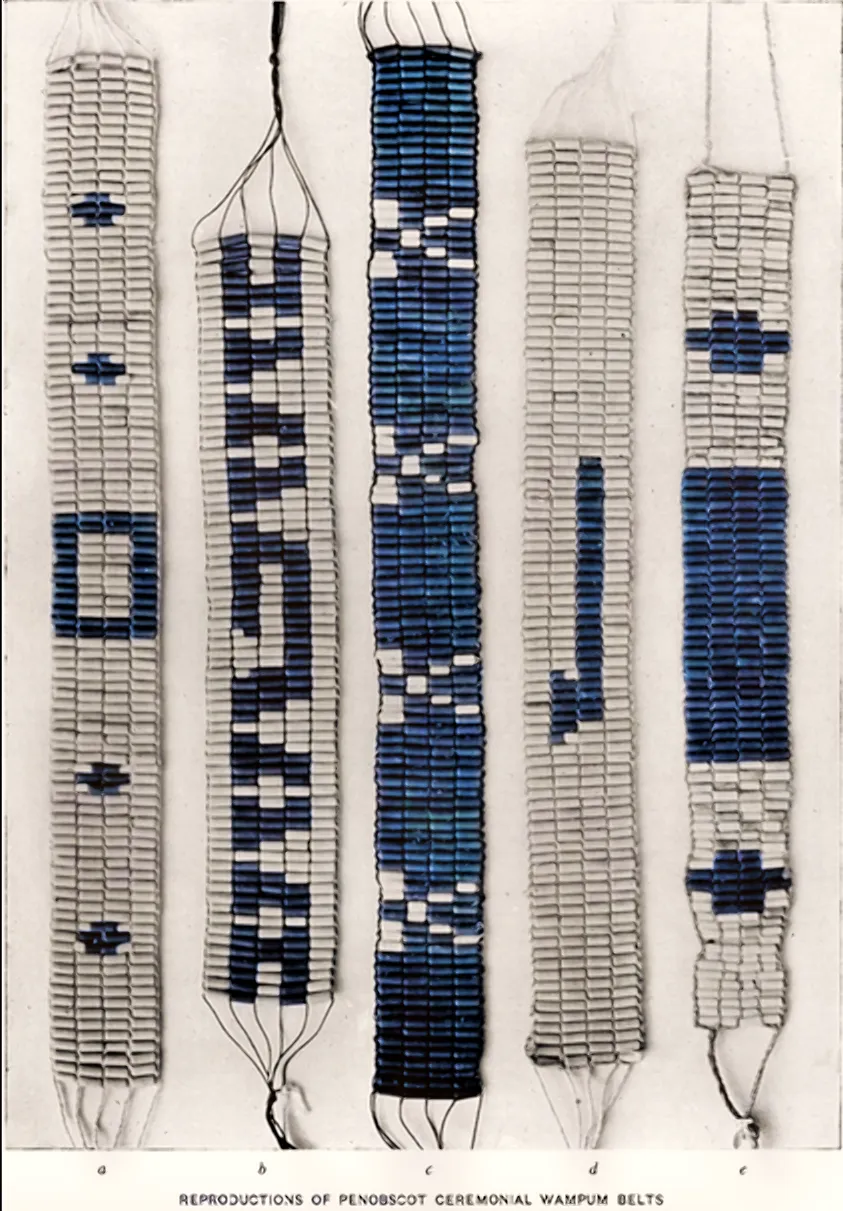
"Wabanaki Wampum Belts" by Frank Speck / Wikimedia Commons
Wampum belts are carefully crafted objects made from small shell beads, traditionally created by Native American peoples of the Eastern Woodlands, including the Haudenosaunee (Iroquois) Confederacy. These belts were not simply decorative items; they played a crucial role in recording treaties, agreements, and important events. The use of wampum belts as a form of record-keeping demonstrates the complex social and political systems of these communities.
The Haudenosaunee, who lived in what is now New York State and parts of Canada, valued wampum for both its beauty and its function. Wampum belts were made by stringing together beads carved from white and purple shells, usually from quahog clams and whelks found along the Atlantic coast. The creation of each belt required skilled labor and significant time, making them highly valuable. Each design on a wampum belt represented a specific message or agreement, acting as a mnemonic device—a tool to help people remember the details of spoken agreements or oral history. For example, during treaty negotiations in the 17th and 18th centuries, wampum belts were exchanged as physical proof of promises made between Native nations and European settlers. The Two Row Wampum, created around 1613, was used to symbolize a peaceful relationship between the Haudenosaunee and Dutch colonists, with two parallel rows of beads representing separate but equal paths.
One of the most famous wampum belts is the Hiawatha Belt, which symbolizes the formation of the Haudenosaunee Confederacy, an alliance of five nations—the Mohawk, Oneida, Onondaga, Cayuga, and Seneca—around the late 1500s or early 1600s. The Hiawatha Belt features a pattern of white and purple beads that represent the five nations joined together, with a central tree symbolizing the Onondaga, where the council fire burned. The meaning of each belt was maintained through oral tradition and explained by designated wampum keepers, who were respected for their knowledge and memory.
Over time, the role of wampum belts changed due to contact with Europeans. While they continued to record important agreements, wampum also became a medium of exchange and was sometimes used as currency in colonial trade. However, as written documents became more common, the use of wampum for treaties declined. Despite these changes, many belts still exist in museums and Native communities, serving as primary sources for historians and as symbols of Indigenous resilience and sovereignty.
Wampum belts are significant because they provide insight into the governance, diplomacy, and cultural values of Eastern Woodland societies. Their continued preservation and interpretation connect present-day Native Americans to their ancestors and highlight the importance of non-written records in world history.
As we study wampum belts, we see how inventions can shape societies, preserve memories, and influence relationships between peoples across time and place.
Interesting Fact: The Hiawatha Belt is still used today during important Haudenosaunee ceremonies to remind people of the Confederacy's founding principles.
Comprehension quiz (8 questions)
1. Who created wampum belts?
2. What material are wampum belts made from?
3. Which belt symbolizes the Haudenosaunee Confederacy?
4. Why were wampum belts valuable?
5. How did wampum belts help with treaties?
6. What changed the use of wampum over time?
7. Wampum belts were always used as money. True or false?
8. What is a mnemonic device?
Perfect for the way you teach
- Build comprehension skills
- Auto-graded quiz
- Differentiated reading
- Read together at home
- Improve fluency
- Quiet reading time
- Reading curriculum support
- Independent practice
- Track Lexile growth