This learning resource is available in interactive and printable formats. The interactive worksheet can be played online and assigned to students. The Printable PDF version can be downloaded and printed for completion by hand.
This educational content features an audio-integrated reading passage titled 'Hurricane Structure' designed for Grade 6 students. It delves into the key components of a hurricane – the eye, eyewall, and rainbands – using simple language and defining important terms. The passage explores how these powerful storms form and move, connecting to the NGSS standard MS-ESS2-5: Collect data to provide evidence for how the motions and complex interactions of air masses result in changes in weather conditions. Engaging activities, including multiple-choice questions, a glossary, and short answer questions, reinforce learning about hurricane characteristics and their impact on weather, making complex scientific concepts accessible and understandable.
CONTENT PREVIEW
Expand content preview
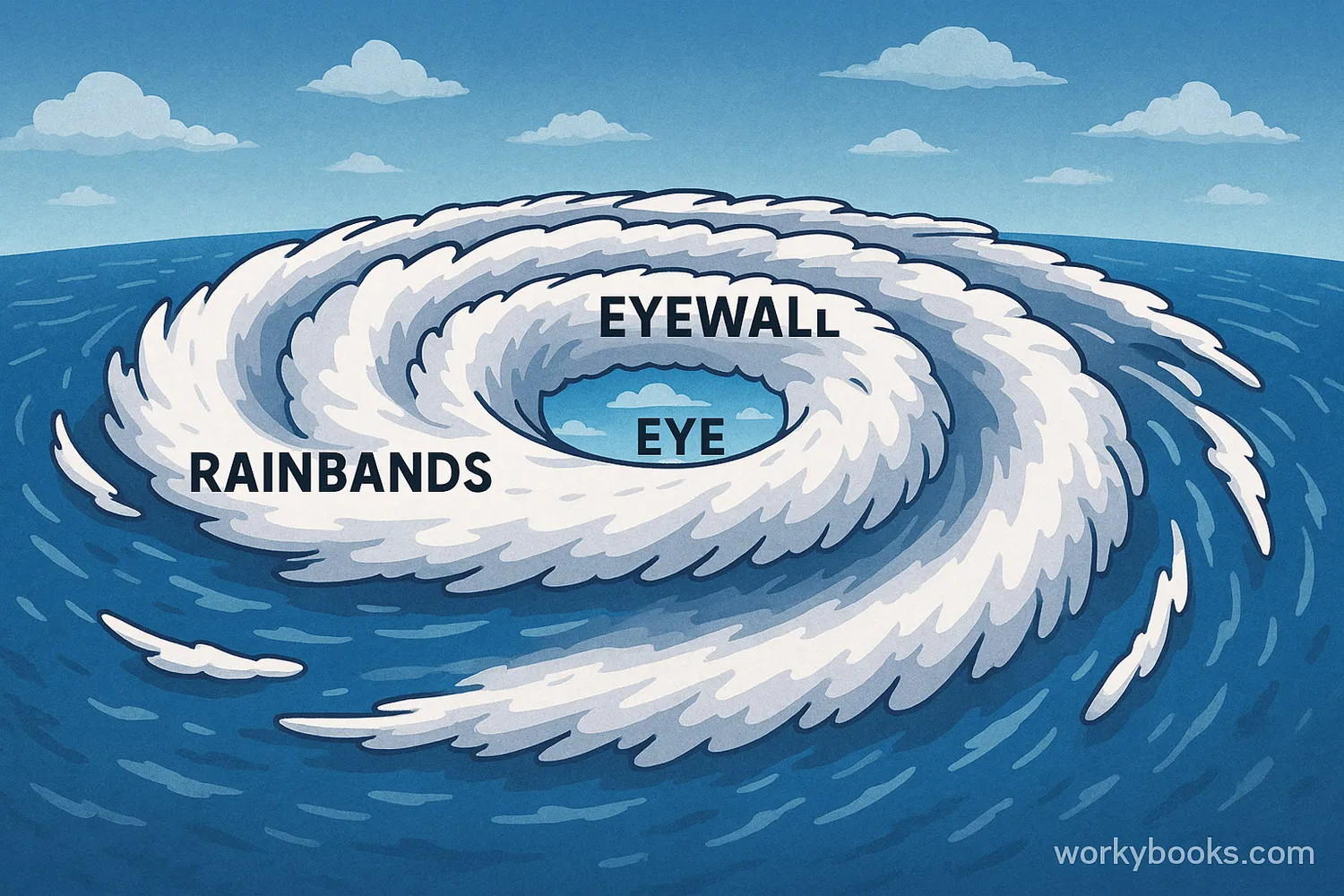
Diagram of a hurricane’s eye, eyewall, and rainbands over the ocean.
Imagine a colossal spinning top, hundreds of miles wide, fueled by warm ocean water. This is a hurricane, one of Earth's most powerful weather systems. Understanding its parts helps us understand its immense power and how it changes our weather. These massive tropical cyclones, also known as typhoons or cyclones depending on where they form, are not just big storms; they have a very specific and organized structure.
At the very center of a hurricane is the eye. It's a surprisingly calm and clear area, often with blue skies or scattered clouds. If you were in the eye, you might even see the sun! The winds here are light, and the rain stops. But don't let this calm fool you; it's surrounded by the most dangerous part of the storm.
Encircling the eye is the eyewall. This is where the hurricane's strongest winds and heaviest rainfall are found. The eyewall is a towering ring of thunderstorms that swirls violently around the eye. Air rushes upwards in the eyewall, creating intense conditions. It's the engine of the hurricane, where the energy from the warm ocean is converted into the storm's destructive power. The faster the winds in the eyewall, the stronger the hurricane.
Beyond the eyewall are the rainbands. These are curved bands of thunderstorms and rain that spiral out from the eyewall, like the arms of a pinwheel. While not as intense as the eyewall, rainbands can still bring heavy rain, strong winds, and even tornadoes. As the hurricane moves, these rainbands cause significant changes in local weather conditions, impacting areas far from the storm's center. Understanding these parts helps scientists track hurricanes and predict their path and intensity, crucial for protecting coastal communities.
Interesting Fact: Hurricanes often get their names from a list maintained by the World Meteorological Organization, and the names are recycled every six years, unless a storm is so deadly or costly that its name is retired.
Which part of a hurricane is calm?
The eyeThe eyewallThe rainbandsOuter edges
What are hurricanes also known as?
BlizzardsTropical cyclonesTornadosMonsoons
The eyewall contains the heaviest rainfall and strongest winds.
TrueFalse
What fuels a hurricane?
Cold airWarm ocean waterDry landHigh mountains
Why is the eye of a hurricane described as 'calm'?
No storms ever happenLight winds, no rainStrongest winds occurAlways sunny, clear
What part of the hurricane is considered its 'engine'?
The eyeThe eyewallThe rainbandsOuter fringes
How do rainbands affect areas far from the hurricane's center?
No impactOnly strong windsHeavy rain, winds, tornadoesClear skies
Why is understanding hurricane structure important for scientists?
To name stormsTo track and predictTo change weatherTo stop hurricanes
If you are in an area experiencing heavy rain and strong winds from a hurricane, but not the absolute strongest, which part of the hurricane are you most likely in?
The eyeThe eyewallA rainbandOutside storm
Which term describes a massive spinning top fueled by warm ocean water?
EyewallRainbandTropical cycloneEye
Perfect For:
👩🏫 Teachers
• Reading comprehension practice
• Auto-graded assessments
• Literacy skill development
👨👩👧👦 Parents
• Reading practice at home
• Comprehension improvement
• Educational reading time
🏠 Homeschoolers
• Reading curriculum support
• Independent reading practice
• Progress monitoring
Reading Features:
📖
Reading Passage
Engaging fiction or nonfiction text
❓
Comprehension Quiz
Auto-graded questions
📊
Instant Feedback
Immediate results and scoring
📄
Printable Version
Download for offline reading
🔊
Read Aloud
Voice-over with word highlighting
Reviews & Ratings
No reviews yet. Be the first to share your experience!
Related Content
Climate and weather activity
This worksheet is perfect for understanding the differences between climate and weather. Students will read the phrases ...
Climate and Weather — Distinguishing Characterstics
This worksheet highlights the differences between climate and weather. The chart format makes comparing and contrasting ...
Comparing Weather and Climate Texts
This reading comprehension worksheet has 5th graders read two informational texts about Weather and Climate. Students th...
RI.5.9
Tools and Technology in Earth Science
This middle school science reading passage explores the wide range of tools and technologies used in Earth science, from...
MS-ESS2-2MS-ESS3-2MS-ETS1-1MS-PS4-3
What Is Space Weather and How Does It Affect the Earth?
This NGSS-aligned science passage for middle school explains what space weather is and how it affects Earth. Students le...
MS-ESS2-2
What Is Earth Science?
This engaging middle school science passage introduces students to the field of Earth science, aligning with NGSS standa...
MS-ESS1MS-ESS2MS-ESS3SEP
Extreme Weather and Climate Change
This Grade 6-8 science passage, aligned to NGSS standards, explores the impact of climate change on extreme weather even...
What Is The Difference Between Climate Model And Weather Model?
This reading passage delves into the fundamental differences between weather models and climate models, explaining their...
Scientific Inquiry in Earth Science
This passage explores scientific inquiry in Earth science for grades 6-8, aligned with NGSS standards MS-ESS1-4, MS-ESS2...
MS-ESS1-4MS-ESS2-1MS-ESS3-5SEP
Earth's Major Climate Zones Explained
This engaging science passage for grades 6-8 explains Earth's major climate zones, including tropical, temperate, and po...
Climate Through Earth's History
This engaging passage for grades 6-8 explores how Earth's climate has naturally changed over millions of years, highligh...
MS-ESS1-4MS-ESS2-6
Earth: Our Home in Space
This engaging Grade 4-5 science passage, aligned to NGSS, introduces students to Earth's special place in the solar syst...
Weather vs. Climate
This comprehensive passage for grades 6-8 explores the difference between weather and climate, aligning with NGSS standa...
MS-ESS2-6
How is Climate Different from Weather?
This passage distinguishes climate from weather for young readers. It defines climate as the usual weather patterns over...
RI.3.1RI.4.14.ESS2.D
Air Masses and Weather
This audio-integrated passage, "Air Masses and Weather," is designed for 6th-grade students to understand how the moveme...
Antarctica Climate
This engaging science passage for grades 6-8 explores Antarctica, the coldest climate zone on Earth. Students will learn...
Climate Zones Word Sort
This word sort activity helps students understand different climate zones through real-world locations. Students classif...
How Climate Change Affects Weather
This middle school science passage explores how and why weather patterns are changing globally. Students will learn abou...
MS-ESS3-5
Polar Bears and Climate
This informational text on polar bears is a great way to practice reading comprehension. Students will read the passage ...
RI.4.1W.4.72-LS4-1RF.4.4
Escape Velocity and Space Travel
This middle school science passage introduces students to the concept of escape velocity—the minimum speed required to b...