This learning resource is available in interactive and printable formats. The interactive worksheet can be played online and assigned to students. The Printable PDF version can be downloaded and printed for completion by hand.
This engaging reading passage explores the positive effects of the Industrial Revolution in the United States, highlighting how new inventions and factory systems changed daily life during the Progressive Era. Students will learn about the growth of cities, the rise of new jobs, and inventions like the telephone and electric light. The passage uses clear, simple language and provides a strong cause-and-effect structure for young readers. Activities include a timeline, glossary, multiple-choice quiz, and writing prompts. The passage is aligned with C3 Framework and ELA Common Core standards, and also includes a Spanish translation and read aloud audio. This resource helps students make connections between history and the modern world, while building foundational literacy skills and historical understanding.
CONTENT PREVIEW
Expand content preview
The Industrial Revolution brought many positive changes.
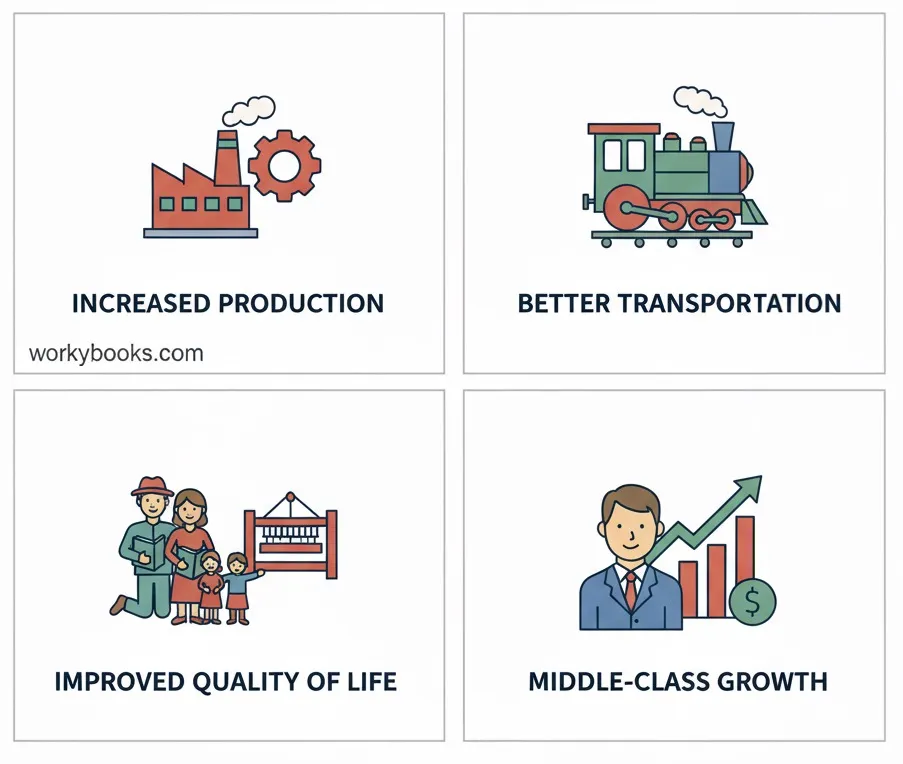
The Industrial Revolution changed life in the United States in many important ways. Factories began to appear in cities and towns. Before this time, most goods were made by hand. Only rich people could buy things like fine clothes or furniture. With the rise of factories, these goods became much cheaper. Soon, more people could afford items that made life easier and more comfortable.
One of the biggest changes was in how goods were made. New machines helped workers produce more products faster than ever before. This made it possible for factories to make large numbers of shoes, clothes, or tools in a short amount of time. Factory workers could also earn money to support their families. The need for workers created many new jobs in cities. This led to more people moving from farms to towns and cities for work.
Another important benefit was that goods could travel farther and faster. Trains and steamships carried products from factories to stores across the country. This made it easier for people in different places to buy the same things. It also helped farmers sell their crops to more people. The railroad and telegraph also improved communication and travel. People could send messages quickly and learn new information from far away places.
The Industrial Revolution also encouraged innovation. Inventors created new machines and tools to solve everyday problems. For example, the sewing machine made it faster to make clothes. The telephone made it possible to talk to people in other cities. These inventions improved life for many Americans by saving time and effort.
As more people gained jobs and could afford factory-made goods, the standard of living improved. Families could buy better food, warm clothes, and even enjoy new inventions like electric lights. Over time, people began to live longer and healthier lives. Children were able to go to school instead of working all day. Streets and homes became cleaner and safer.
However, there were also challenges. Factories could be dangerous, and workers sometimes had to work long hours. But many people believed that progress and unity could solve these problems. Reformers worked hard to make factories safer and to protect workers’ rights during the Progressive Era.
The Industrial Revolution is a key example of how progress and innovation can improve life for many people. Today, the changes started during this time still affect the way we live, work, and connect with others.
Interesting Fact: During the late 1800s, more than half of the people in the United States lived in cities for the first time ever.
What did factories make cheaper?
Goods like clothes and furnitureLand and farmsBooks only for schoolsGold and silver
What helped move goods faster?
Trains and steamshipsBicycles and wagonsHorses and boatsAirplanes and cars
Who worked to make factories safer?
ReformersFarmersChildrenInventors
Why did people move to cities?
To find factory jobsTo look for goldTo escape from schoolTo build new farms
How did the telephone help people?
They could talk to far away peopleIt made clothes fasterIt built new homesIt helped plant crops
What was a main result of new machines?
More goods made fasterFewer jobs for workersMore people moved to farmsPrices became higher
Factory jobs were always safe. True or false?
TrueFalse
What does 'innovation' mean?
A new idea or inventionA type of trainA group of workersA kind of factory
Perfect For:
👩🏫 Teachers
• Reading comprehension practice
• Auto-graded assessments
• Literacy skill development
👨👩👧👦 Parents
• Reading practice at home
• Comprehension improvement
• Educational reading time
🏠 Homeschoolers
• Reading curriculum support
• Independent reading practice
• Progress monitoring
Reading Features:
📖
Reading Passage
Engaging fiction or nonfiction text
❓
Comprehension Quiz
Auto-graded questions
📊
Instant Feedback
Immediate results and scoring
📄
Printable Version
Download for offline reading
🔊
Read Aloud
Voice-over with word highlighting
Reviews & Ratings
No reviews yet. Be the first to share your experience!
Related Content
Colonial Trade with England and Africa
This history reading passage explores colonial trade between the American colonies, England, and Africa, focusing on the...
D2.HIS.2.3-5D2.HIS.14.3-5RI.4.3RI.4.4
John Adams: Second President
This engaging U.S. history reading passage introduces students to John Adams, the second President of the United States....
D2.HIS.2.3-5D2.HIS.14.3-5RI.4.3RI.4.4
Building Washington D.C., Our Capital
This history reading passage explores the building of Washington D.C., the capital of the United States. Students will l...
D2.HIS.1-3.3-5D2.HIS.14.3-5RI.4.3RI.4.4
Dolley Madison Saves Washington's Portrait
This engaging history reading passage tells the inspiring story of Dolley Madison and her brave actions during the War o...
D2.HIS.2.3-5D2.HIS.14.3-5RI.4.3RI.4.4
Boomtowns Spring Up Out West
This engaging passage explores the exciting rise of boomtowns in the American West during the 1800s, focusing on the Gol...
D2.HIS.2.3-5D2.HIS.14.3-5RI.4.3RI.4.4
African Americans Fight for the Union
This engaging U.S. history reading passage explores the important role African Americans played in helping the Union dur...
D2.HIS.2.3-5D2.HIS.14.3-5RI.4.3RI.4.4
Franklin D. Roosevelt and the New Deal
This engaging history reading passage explores the life and leadership of Franklin D. Roosevelt and his creation of the ...
D2.HIS.2.3-5D2.HIS.14.3-5RI.4.3RI.4.4
Rationing and Life on the Home Front
This history reading passage explores rationing and life on the home front during World War II, focusing on how American...
D2.HIS.2.3-5D2.HIS.14.3-5RI.4.3RI.4.4
D-Day and the End of World War II
This engaging reading passage explores the key events of D-Day and how it helped bring World War II to a close. Students...
D2.HIS.2.3-5D2.HIS.14.3-5RI.4.3RI.4.4
Martin Luther King Jr. and "I Have a Dream"
This engaging history reading passage introduces students to the life and legacy of Martin Luther King Jr., focusing on ...
D2.HIS.2.3-5D2.HIS.14.3-5RI.4.1RI.4.3.
Ruby Bridges and the Little Rock Nine
This engaging history reading passage explores the stories of Ruby Bridges and the Little Rock Nine, two important group...
D2.HIS.2.3-5D2.HIS.14.3-5RI.4.3RI.4.4
Cesar Chavez and Farm Workers' Rights
This engaging history reading passage explores the life and impact of Cesar Chavez, a key leader in the fight for farm w...
D2.HIS.2.3-5D2.HIS.14.3-5RI.4.3RI.4.4
When Mexico Took Over California
This engaging U.S. history reading passage explores the period when Mexico took over California during the era of Westwa...
D2.HIS.2.3-5D2.HIS.3.3-5D2.HIS.14.3-5RI.4.3
Californios Culture
This history reading passage explores the story of the Californios—Spanish and Mexican settlers who shaped California be...
D2.HIS.2.3-5D2.HIS.3.3-5D2.HIS.14.3-5RI.4.3
The 31st State: California Joins the Union
This engaging U.S. history reading passage explores California's journey to becoming the 31st state in 1850. Students le...
D2.HIS.3.3-5D2.HIS.14.3-5RI.4.3RI.4.4
Routes to the Gold Fields
This engaging history reading passage explores the three main routes people took to reach the California gold fields dur...
D2.HIS.2.3-5D2.HIS.14.3-5RI.4.3RI.4.4
The Golden Spike: Connecting California to the Nation
This engaging U.S. history reading passage teaches students about the Golden Spike and how the first transcontinental ra...
D2.HIS.1.3-5D2.HIS.2.3-5D2.HIS.14.3-5RI.4.3
California Women Win the Vote in 1911
This engaging history reading passage explores how women in California fought and won the right to vote in 1911. Aligned...
D2.HIS.2.3-5D2.HIS.14.3-5RI.4.3RI.4.4
The 1965 Immigration Act
Discover the story of the 1965 Immigration Act with this engaging U.S. history reading passage. Perfect for building rea...
D2.HIS.4.3-5D2.HIS.14.3-5RI.5.3RI.5.4
Protecting California's Environment
This engaging U.S. history reading passage explores the story of how California has worked to protect its unique environ...