Levels of Organization
Interactive passage with audio narration, comprehension questions, and printable PDF.
By completing this purchase you agree to our Terms of Use and Privacy Policy. Your subscription renews automatically until you cancel. You can cancel anytime from your account settings. All sales are final and non-refundable. Digital content is available for download in your account immediately upon purchase.
What's included
Levels of Organization preview and details
About this printable Levels of Organization science reading passage, NGSS-aligned (Grades 5-8)
Sample passage and quiz from Levels of Organization
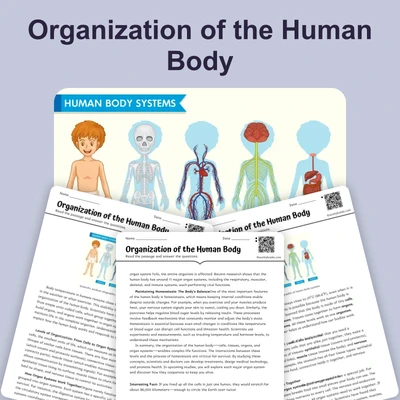
Reading passage and comprehension quiz preview
Levels of Organization
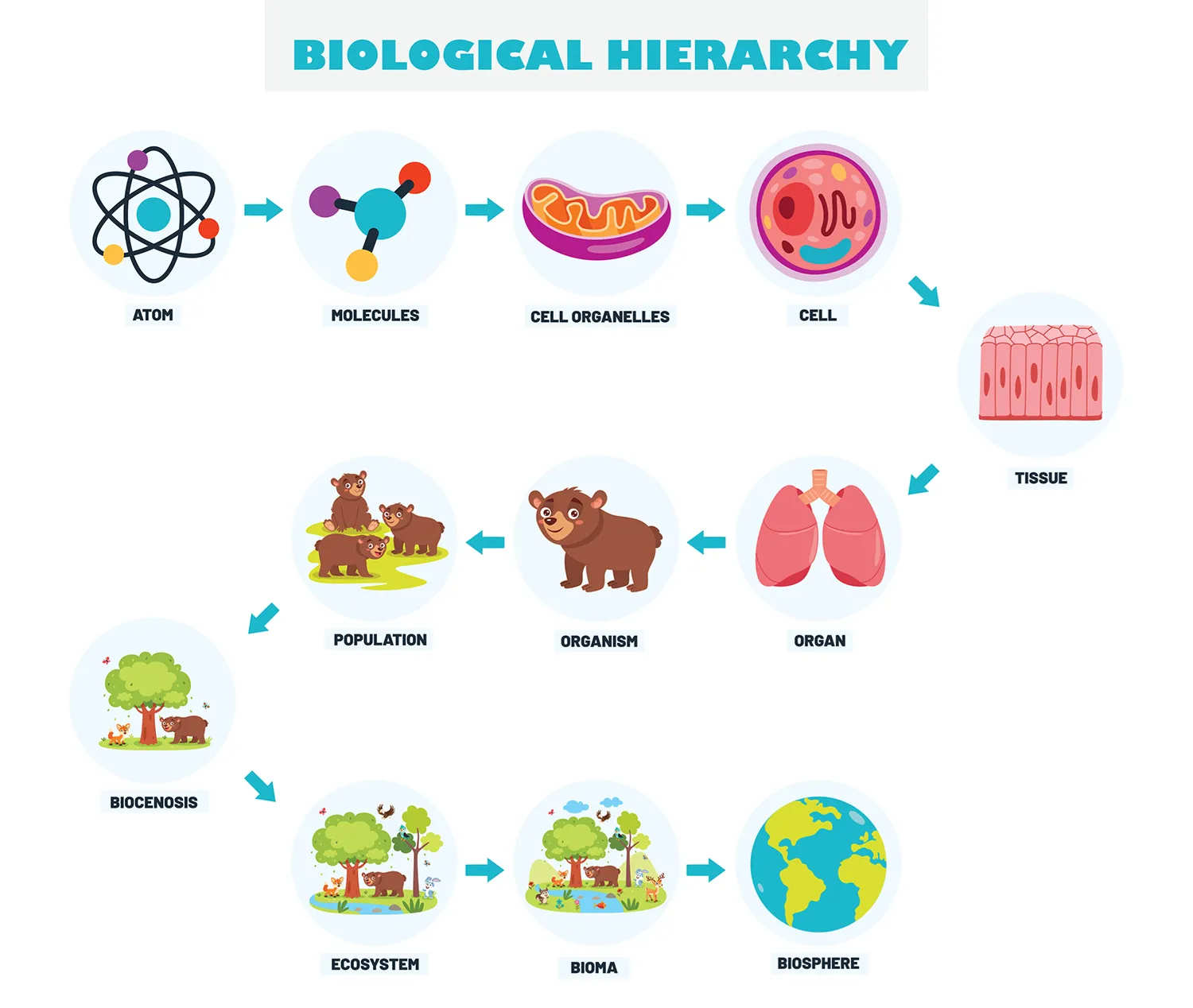
The study of living things reveals a remarkable pattern: all complex organisms are organized in distinct levels, each with its own important role. This hierarchy—from cells to organisms—explains how life functions efficiently. Understanding these levels of organization helps scientists answer questions about growth, health, and disease in all forms of life.
From Cells to Tissues: The Building Blocks
At the most basic level, all living things are made of cells. A cell is the smallest unit that can carry out all the processes needed for life. In the human body, there are over 200 different types of cells, such as muscle cells and nerve cells. When similar cells group together to perform a specific job, they form a tissue. For example, muscle tissue is made of many muscle cells working together to create movement, while nerve tissue carries electrical signals throughout the body. This organization allows for specialization, which means each cell type can be more efficient at its job.
Organs and Organ Systems: Working Together
Multiple tissues combine to make an organ. Each organ has a specific function and structure. For instance, the heart is an organ built from muscle tissue, nerve tissue, and blood tissue. Its main job is to pump blood throughout the body. Another example is the lung, which is made of several types of tissue that work together to exchange oxygen and carbon dioxide. In plants, a leaf acts as an organ that captures sunlight for photosynthesis. Organs rarely work alone; they are part of organ systems. An organ system is a group of organs that collaborate to perform a major function. For example, the digestive system includes the stomach, intestines, and liver, all working together to break down food and absorb nutrients. The circulatory system, including the heart and blood vessels, transports nutrients and oxygen to cells and removes waste.
Complexity and Survival: The Complete Organism
All organ systems together form an entire organism, whether it is a human, animal, or plant. This high level of organization allows living things to survive in changing environments. Each system depends on the others; for example, muscles need oxygen from the circulatory system, and the brain relies on signals from the nervous system. Scientists have measured that about 37 trillion cells make up the average human body, working in harmony to maintain life. If one level—such as a tissue or organ—fails to function, the whole organism may be affected. Understanding these connections helps medical researchers find treatments for diseases, design prosthetic organs, and even create artificial tissues in the lab.
In summary, the levels of organization—cells, tissues, organs, organ systems, and organisms—demonstrate how complex life is built from simple parts. This organization is a unifying principle in biology and helps explain how life adapts, survives, and evolves. As technology advances, our knowledge of these levels continues to grow, leading to new discoveries in health and environmental science.
Interesting Fact: The largest single cell in the world is the ostrich egg, which can weigh up to 1.4 kilograms and is visible to the naked eye!
Comprehension quiz (10 questions)
1. What is the smallest unit that can carry out all the processes needed for life?
2. What do similar cells grouped together form?
3. Which of the following is an example of an organ?
4. What is the main function of the heart as described in the passage?
5. In the context of the passage, what does 'specialization' mean?
6. What is the role of the circulatory system?
7. Why is it important for organs to work together in organ systems?
8. If a tissue or organ fails, what might happen to the organism?
9. True or False: All organs in an organ system perform the same job.
10. True or False: The ostrich egg is the largest known single cell.
Perfect for the way you teach
- Build comprehension skills
- Auto-graded quiz
- Differentiated reading
- Read together at home
- Improve fluency
- Quiet reading time
- Reading curriculum support
- Independent practice
- Track Lexile growth