Muscular System
Interactive passage with audio narration, comprehension questions, and printable PDF.
By completing this purchase you agree to our Terms of Use and Privacy Policy. Your subscription renews automatically until you cancel. You can cancel anytime from your account settings. All sales are final and non-refundable. Digital content is available for download in your account immediately upon purchase.
What's included
Muscular System preview and details
About this printable Muscular System science reading passage, NGSS-aligned (Grades 5-8)
Sample passage and quiz from Muscular System
Reading passage and comprehension quiz preview
Muscular System
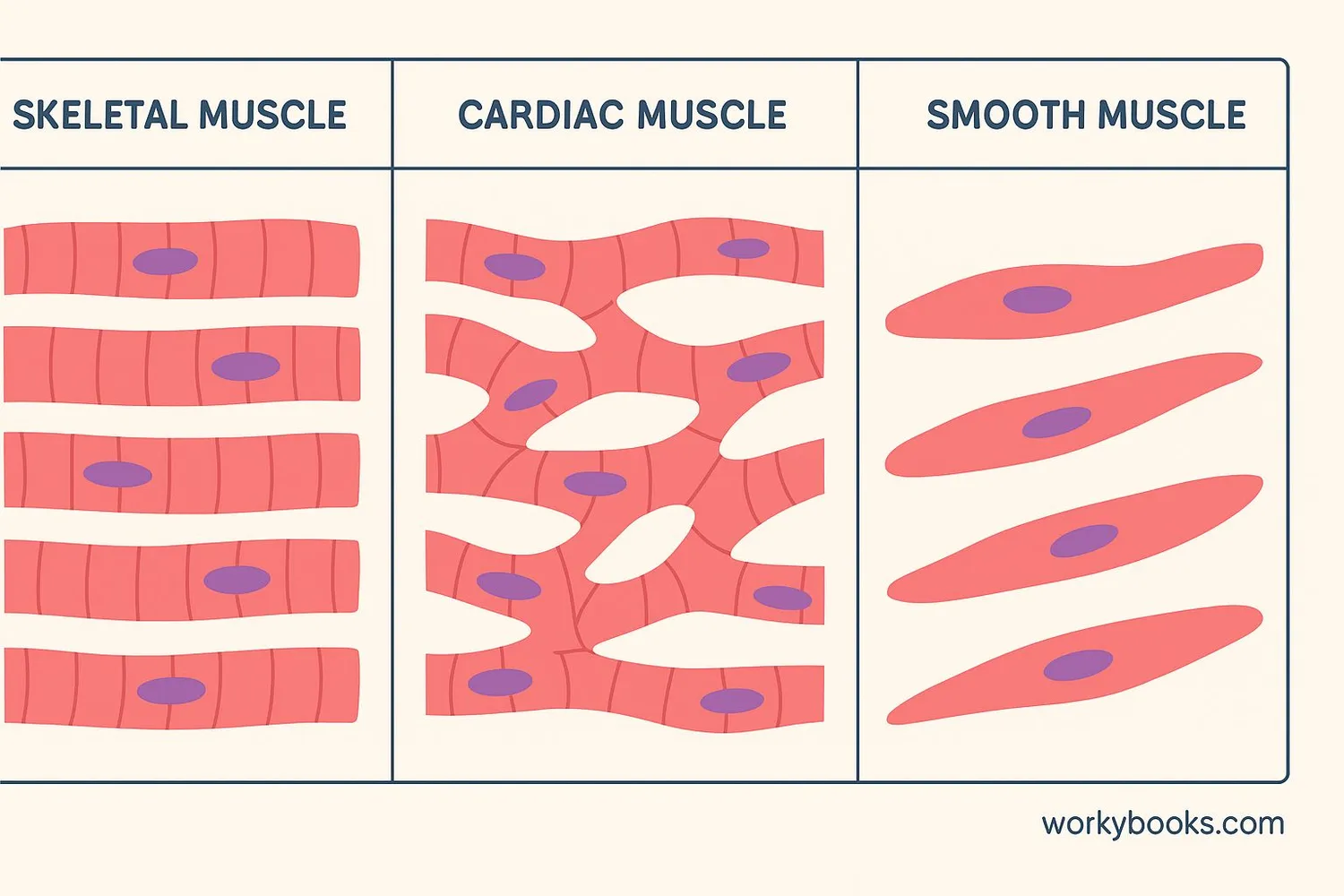
The muscular system is a vital network in the human body that allows for movement, posture, and even heat production. When you run, jump, or simply smile, your muscles are at work. Scientists have discovered that there are over 600 individual muscles in the human body, each with a specific role. Understanding how these muscles function helps explain how the body performs complex actions and responds to challenges.
Types of Muscles and How They Work
The human body contains three main types of muscles: skeletal, smooth, and cardiac. Skeletal muscles are attached to bones with strong, flexible tissues known as tendons. These muscles are called voluntary because you control them. For example, when you bend your arm, your biceps contract while your triceps relax. This is known as working in antagonistic pairs. Smooth muscles are found in the walls of organs like your stomach and blood vessels. They are involuntary, meaning they work automatically without conscious effort. Cardiac muscle is found only in the heart and is also involuntary. It has special properties that allow it to beat continuously without tiring.
Muscle and Bone Interaction: Producing Movement
Muscles cannot push; they only contract or relax to pull on bones. This process is called contraction. When a muscle contracts, it gets shorter and pulls on the bone, causing movement at a joint. For example, the biceps and triceps in your upper arm form an antagonistic pair. When you lift a book, the biceps contract and the triceps relax; to lower the book, the triceps contract and the biceps relax. This coordination with the skeletal system allows for precise and powerful movements. Tendons act as strong cables, connecting muscles to bones and transmitting the force generated by contraction.
Muscle Health, Heat, and Common Issues
Healthy muscles require regular exercise and proper nutrition, especially foods rich in protein. When muscles contract, they also produce heat—up to 85% of the body’s heat is generated this way. This is why you feel warmer after exercise. However, muscles can sometimes be injured. A strain happens when a muscle is stretched too far, while a cramp is a sudden, involuntary contraction. Scientists study muscle performance to understand conditions like muscular dystrophy and to improve athletic training. Research shows that regular activity increases muscle strength, flexibility, and resistance to fatigue.
In summary, the muscular system is an integrated network that interacts with bones, nerves, and the circulatory system to produce movement and maintain health. Its ability to contract, relax, and generate heat is essential for daily life and survival. Ongoing scientific research helps us understand how to keep our muscles strong, flexible, and functioning throughout life.
Interesting Fact: The strongest muscle, based on its size, is the masseter in your jaw. It can create a bite force of up to 200 pounds (90 kilograms)!
Comprehension quiz (10 questions)
1. Which type of muscle is only found in the heart?
2. What do antagonistic muscle pairs do?
3. Where are smooth muscles found in the body?
4. What is the main function of tendons?
5. In the passage, what does 'involuntary' mean?
6. Which of the following is an example of a voluntary muscle?
7. Why do muscles produce heat when they contract?
8. If a person cannot control a muscle, what type is it most likely to be?
9. True or False: All muscles in the human body are attached to bones.
10. True or False: Exercise and protein are important for keeping muscles healthy.
Perfect for the way you teach
- Build comprehension skills
- Auto-graded quiz
- Differentiated reading
- Read together at home
- Improve fluency
- Quiet reading time
- Reading curriculum support
- Independent practice
- Track Lexile growth