Circulatory System
Interactive passage with audio narration, comprehension questions, and printable PDF.
By completing this purchase you agree to our Terms of Use and Privacy Policy. Your subscription renews automatically until you cancel. You can cancel anytime from your account settings. All sales are final and non-refundable. Digital content is available for download in your account immediately upon purchase.
What's included
Circulatory System preview and details
About this printable Circulatory System science reading passage, NGSS-aligned (Grades 5-8)
Sample passage and quiz from Circulatory System
Reading passage and comprehension quiz preview
Circulatory System
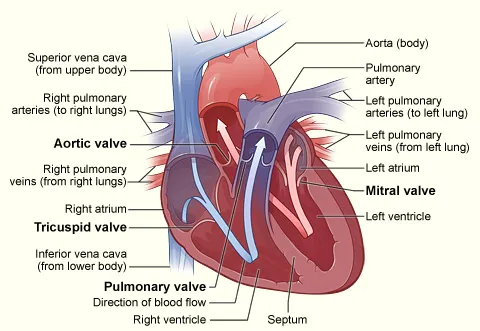
"Heart valves NIH" by National Heart Lung and Blood Institute (NIH) / Wikimedia Commons (Public domain).
The circulatory system is essential for life in all animals, including humans. It moves blood through the body, delivering oxygen and nutrients and removing waste. When you exercise, your heart beats faster and your pulse increases because your muscles need more oxygen. Scientists have studied how blood moves and why the heart is necessary for survival.
How the Heart and Blood Vessels Work
The heart is a muscular organ with four chambers: two atria (which receive blood) and two ventricles (which pump blood out). The heart contracts and relaxes in a regular pattern called the cardiac cycle. The heartbeat is regulated by electrical signals, which ensure the heart pumps at the right speed. Blood leaves the heart through arteries, which have thick, strong walls to handle high pressure. It returns to the heart through veins, which have valves to prevent backflow. Tiny capillaries connect arteries and veins, allowing oxygen and nutrients to pass into tissues and waste to move out. Capillaries are so small that red blood cells move through them in single file.
Blood Components and Circuits
Blood is made of several parts: plasma (a yellowish liquid), red blood cells (which carry oxygen), white blood cells (which fight infection), and platelets (which help form clots). About 55% of blood is plasma, 44% is red blood cells, and the rest is white cells and platelets. The circulatory system includes two main circuits. The pulmonary circuit moves blood from the heart to the lungs and back, picking up oxygen and releasing carbon dioxide. The systemic circuit carries blood from the heart to the rest of the body and back, delivering oxygen and nutrients to cells. Blood pressure is the force of blood against artery walls, and pulse is the rhythmic beating of arteries as blood is pumped.
Maintaining Heart Health
Heart health depends on many factors. Regular exercise strengthens the heart muscle, while a balanced diet supports healthy blood vessels. Avoiding smoking is important because chemicals in cigarettes damage arteries and reduce oxygen in the blood. Scientists use blood pressure and pulse measurements to monitor heart health. Medical researchers have found that people with healthy habits have a lower risk of heart disease. The circulatory system demonstrates how body systems interact, showing the relationship between structure and function in living organisms.
Keeping the circulatory system healthy is vital for life. As our knowledge of biology has grown, new treatments and technologies have improved how we diagnose and care for heart and blood vessel problems. Understanding the circulatory system helps us make choices that support long-term health and connect to the broader scientific idea that structure determines function.
Interesting Fact: The human heart pumps about 70 milliliters of blood with each beat—moving approximately 7,000 liters of blood every day!
Comprehension quiz (10 questions)
1. What is the main function of the circulatory system?
2. Which chambers of the heart pump blood out to the body and lungs?
3. What is plasma?
4. What is the primary role of red blood cells?
5. How do arteries and veins differ?
6. What is the function of capillaries?
7. What happens if the valves in veins do not work properly?
8. Which of the following helps maintain heart health?
9. True or False: The pulmonary circuit carries blood between the heart and the rest of the body.
10. True or False: Capillaries are the smallest blood vessels in the body.
Perfect for the way you teach
- Build comprehension skills
- Auto-graded quiz
- Differentiated reading
- Read together at home
- Improve fluency
- Quiet reading time
- Reading curriculum support
- Independent practice
- Track Lexile growth