This learning resource is available in interactive and printable formats. The interactive worksheet can be played online and assigned to students. The Printable PDF version can be downloaded and printed for completion by hand.
This engaging, audio-integrated reading passage, "Lucy the Australopithecus: Walking Upright," introduces students to a pivotal figure in human evolution. Students will learn about Lucy, a famous fossil, and the scientific ideas behind bipedalism – the ability to walk on two legs. The passage, designed for Grade 6, explores anatomical similarities and differences in modern and fossil organisms, directly addressing NGSS standard MS-LS4-2. It defines key terms like Australopithecus and hominins, and provides a foundation for understanding how scientists infer evolutionary relationships from fossil evidence. Activities include multiple-choice questions, a glossary, and short answer questions.
CONTENT PREVIEW
Expand content preview
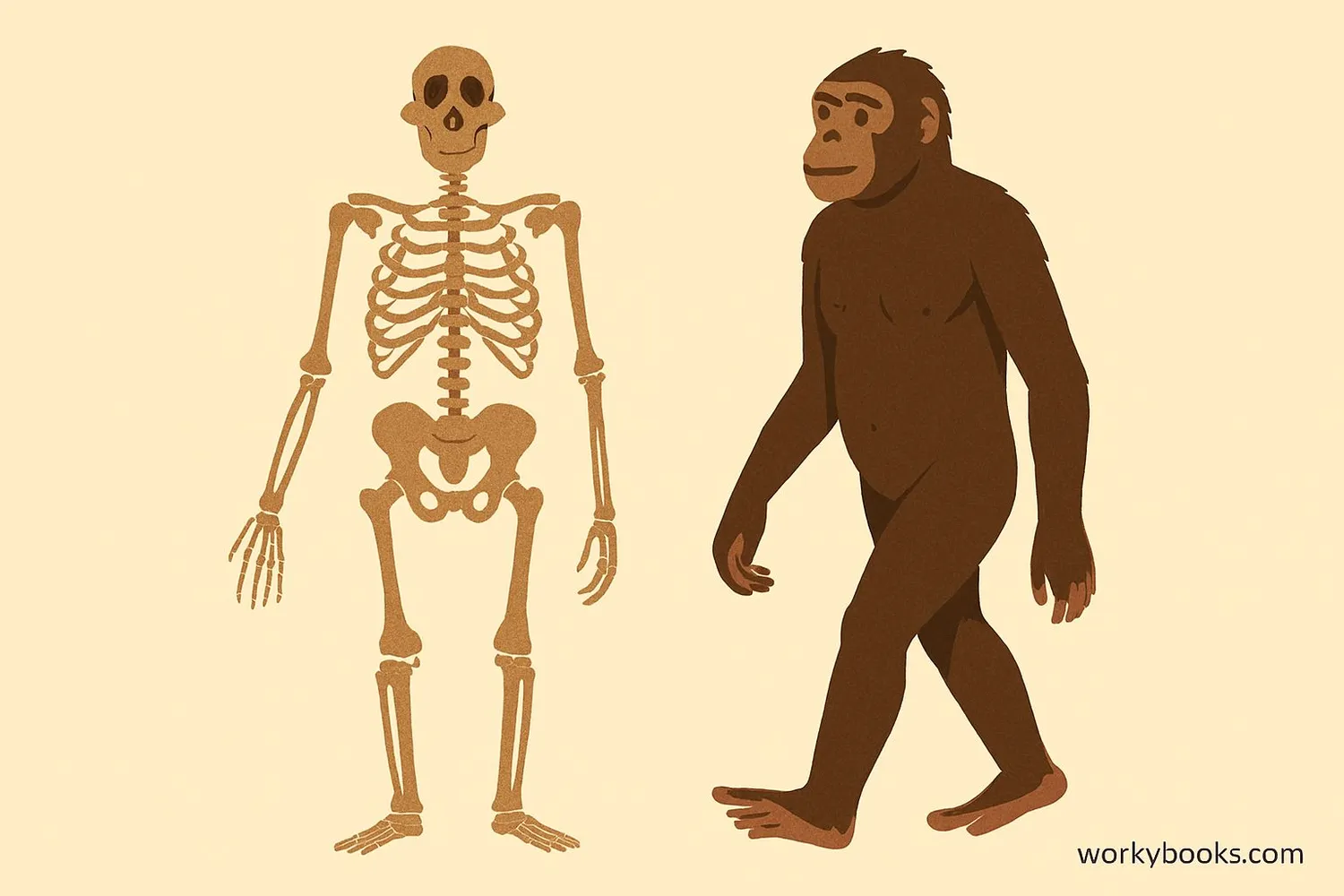
The Lucy fossil and reconstruction
Imagine a world millions of years ago, long before humans as we know them existed. In this ancient landscape, a small creature, no taller than a modern 7-year-old, walked on two legs. This creature was Lucy, a famous Australopithecus. Her discovery changed how we understand our own family tree and the amazing journey of human evolution.
Lucy’s story began in 1974 when scientists found her fossilized remains in Ethiopia. She isn't a complete skeleton, but enough bones were found to give us incredible clues. Scientists named her Lucy after the Beatles song 'Lucy in the Sky with Diamonds.' She lived about 3.2 million years ago.
One of the most exciting things about Lucy is what her bones tell us about bipedalism – the ability to walk upright on two legs. While other apes mostly knuckle-walk or spend time in trees, Lucy’s pelvis and leg bones clearly show she walked like us. Her knee joint locked, her hip bones flared out, and her big toe wasn't opposable like a thumb. These anatomical similarities to modern humans are strong evidence of this crucial ability.
Walking upright had huge advantages. It freed up her hands to carry food, use simple tools, or care for young. It also allowed her to see over tall grasses, helping her spot predators or find distant food sources. This unique way of moving helped her ancestors survive and thrive in changing environments, making Lucy an important link in understanding our early hominin relatives.
Studying fossils like Lucy helps scientists piece together the puzzle of life on Earth. By comparing her bones to other fossil organisms and to modern humans, we can infer evolutionary relationships. We learn how different species are connected and how traits, like walking upright, developed over millions of years. Lucy shows us that walking on two legs came before the development of large brains, challenging earlier ideas about human evolution.
Interesting Fact: Lucy’s scientific name is Australopithecus afarensis, which means "southern ape from Afar," referring to the region in Ethiopia where she was found.
What year were Lucy's remains discovered?
1974198019652000
How long ago did Lucy live?
1 million years3.2 million years500,000 years10 million years
True or False: Lucy's discovery provided evidence for bipedalism.
TrueFalse
What does 'bipedalism' mean?
Walking on four legsLiving in treesWalking on two legsEating only plants
Which of these was NOT an advantage of bipedalism for Lucy?
Carrying foodSpotting predatorsClimbing trees fasterUsing simple tools
What did Lucy's bones reveal about walking upright?
Opposable big toeKnuckle-walking abilityLocked knee jointSmall hip bones
What is an 'Australopithecus' based on the passage?
Type of dinosaurAncient plant speciesEarly human ancestorModern ape species
How do scientists learn about evolutionary relationships?
Studying modern animalsReading ancient storiesComparing modern and fossil bonesObserving animal behavior
Why is Lucy considered a crucial link in human evolution?
She was the first animalHer fossils show early upright walkingShe had a very large brainShe used complex tools
What did Lucy's discovery challenge about evolution?
That apes existedUpright walking came after large brainsFossils are not usefulHumans evolved from fish
Perfect For:
👩🏫 Teachers
• Reading comprehension practice
• Auto-graded assessments
• Literacy skill development
👨👩👧👦 Parents
• Reading practice at home
• Comprehension improvement
• Educational reading time
🏠 Homeschoolers
• Reading curriculum support
• Independent reading practice
• Progress monitoring
Reading Features:
📖
Reading Passage
Engaging fiction or nonfiction text
❓
Comprehension Quiz
Auto-graded questions
📊
Instant Feedback
Immediate results and scoring
📄
Printable Version
Download for offline reading
🔊
Read Aloud
Voice-over with word highlighting
Reviews & Ratings
No reviews yet. Be the first to share your experience!
Related Content
Understanding Biological Evolution and Diversity
This passage addresses the NGSS standard 3-LS4-2 focusing on biological evolution and the unity and diversity of life. T...
RI.3.3RI.4.3RI.5.33-LS4-2
Theory of Evolution
This middle school science passage explains the theory of evolution and the concept of common ancestry, aligning with NG...
MS-LS4-1MS-LS4-2
Evidence for Evolution: Comparative Anatomy
This middle school science reading passage explores the evidence for evolution through comparative anatomy, aligning wit...
MS-LS4-2MS-LS4-3
The Nature of Life Science
This passage, aligned with NGSS MS-LS1-1, introduces students in grades 6-8 to the foundational concepts of life science...
MS-LS1-1
Human Evolution
This middle school science passage explains the scientific evidence for human evolution, aligning with NGSS standards MS...
MS-LS4-1MS-LS4-2
Science Vocabulary
This worksheet on domain-specific words will help students learn some science vocabulary. Students will be asked to matc...
L.3.6L.3.4.A
The Giant Isopod: Biological Evolution
This NGSS passage examines how giant isopods evolved for deep-sea survival, including slow metabolism for food scarcity,...
MS-LS4-4RI.6.3RI.7.3RI.8.8
Evidence for Evolution: The Fossil Record
This middle school science passage explains the importance of fossils as preserved evidence of ancient life and their ro...
MS-LS4-1
Simple Machines Science Report
This science writing task requires students to clearly explain how three simple machines work using precise domain-speci...
W.5.4
Fossil Evidence of Human Evolution
This engaging, audio-integrated reading passage, 'Fossil Evidence of Human Evolution,' introduces Grade 6 students to th...
The Science of Hibernation
This educational module, featuring an audio-integrated reading passage titled 'The Science of Hibernation,' is designed ...
What is an amphibian
This audio-integrated reading passage, "The Life of Amphibians," is designed for 4th-grade students to explore the fasci...
The Levels of Australopithecus
This educational content offers an engaging, audio-integrated reading passage titled 'The Levels of Biological Classific...
The Nature of Science
This passage explores the nature of science for middle school students, aligning with NGSS standards MS-ETS1-4, MS-PS1-1...
MS-ETS1-4MS-PS1-1MS-LS1-1
The Pumpkin Life Cycle
This informational worksheet explores the pumpkin lifecycle, guiding students through procedural steps in a scientific t...
RI.2.3RI.2.10
What Is Earth Science?
This engaging middle school science passage introduces students to the field of Earth science, aligning with NGSS standa...
MS-ESS1MS-ESS2MS-ESS3SEP
Citizen Science and Ecological Monitoring
This engaging passage for grades 6-8 introduces the concept of citizen science and its critical role in ecological monit...
MS-LS2-1
Tools and Technology in Earth Science
This middle school science reading passage explores the wide range of tools and technologies used in Earth science, from...
MS-ESS2-2MS-ESS3-2MS-ETS1-1MS-PS4-3
The Life Cycle of an Angiosperm
This educational content package delves into the intriguing world of angiosperms and their complex life cycles, perfectl...
History of Life on Earth
This comprehensive middle school science reading passage provides an engaging overview of the history of life on Earth, ...