Madagascar's Unique and Endangered Lemurs
Interactive passage with audio narration, comprehension questions, and printable PDF.
What's included
Madagascar's Unique and Endangered Lemurs preview and details
About this printable Madagascar's Unique and Endangered Lemurs science reading passage, NGSS-aligned (Grade 6)
Sample passage and quiz from Madagascar's Unique and Endangered Lemurs
Reading passage and comprehension quiz preview
Madagascar's Unique and Endangered Lemurs
Imagine an island where almost every animal is found nowhere else on Earth. This is Madagascar, a large island nation off the southeast coast of Africa. It’s a place bursting with incredible biodiversity, meaning a huge variety of life. Among its most famous residents are the lemurs.
Lemurs are primates, just like monkeys, apes, and humans. However, lemurs belong to an older group of primates called prosimians. Millions of years ago, the ancestors of modern lemurs likely floated to Madagascar from Africa on rafts of vegetation. Once they arrived, they evolved in isolation, meaning they were cut off from other populations. Over vast stretches of time, these isolated populations adapted to different environments and food sources on the island, leading to the amazing diversity of lemurs we see today.
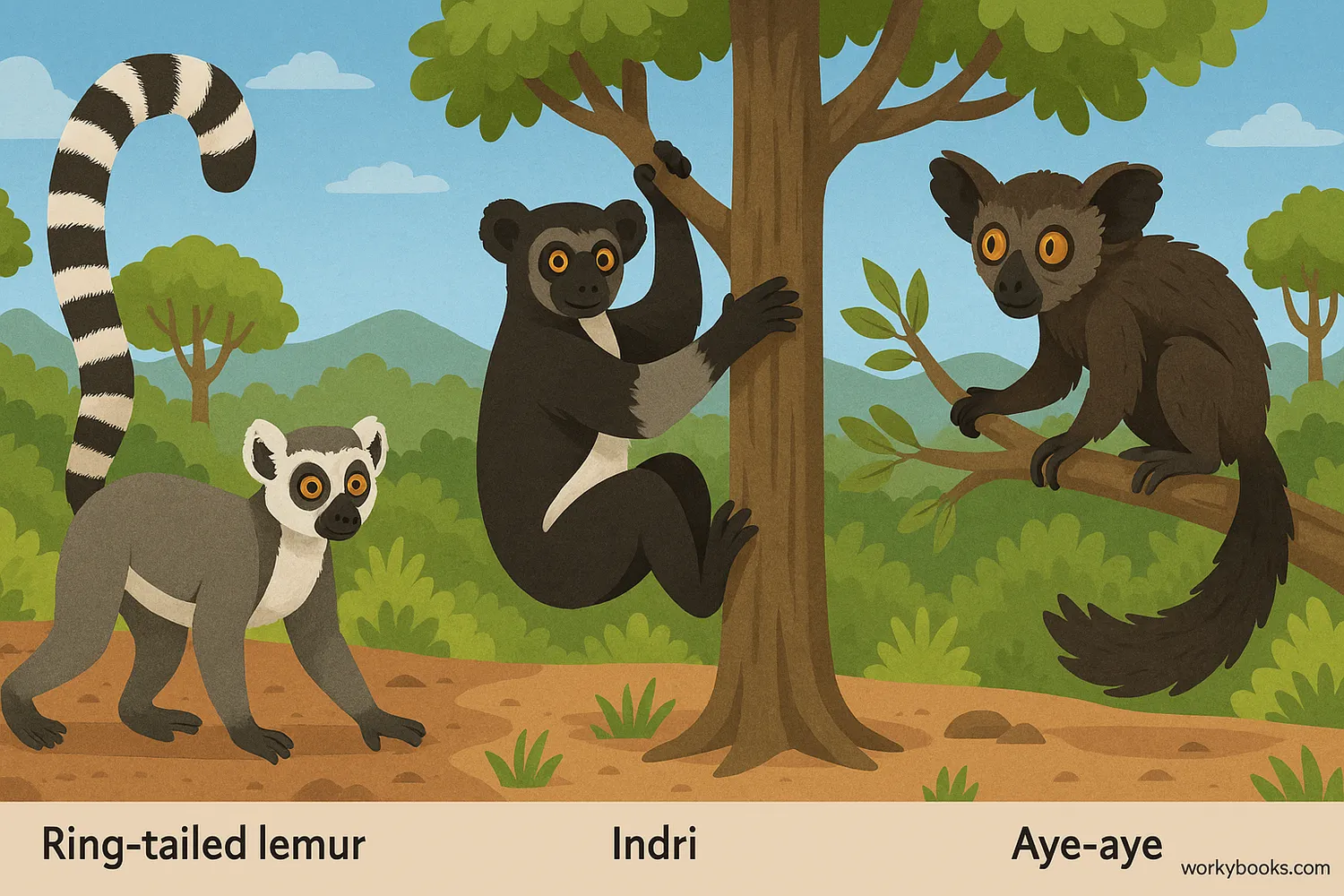
There are over 100 different species of lemurs, each with unique adaptations. For example, the ring-tailed lemur is famous for its long, striped tail, which it uses for balance and communication. The indri is the largest lemur and has powerful legs for leaping through trees. The aye-aye, with its long, skinny middle finger, has evolved to tap on wood and extract insect larvae, a behavior known as foraging. These differences in their bodies and behaviors show how they have changed over time to survive in their specific parts of the Madagascan ecosystem.
Sadly, many lemur species are endangered. This means they are at risk of disappearing forever. The biggest threat they face is habitat loss, mainly due to deforestation. People cut down trees for farming, charcoal production, and logging, destroying the forests where lemurs live. Climate change also plays a role, altering the habitats they rely on. Conservation efforts are crucial to protect these unique animals and their homes. These efforts include creating national parks, educating local communities, and replanting trees.
Understanding the evolutionary relationships among lemurs and other primates helps scientists appreciate their unique place in the animal kingdom and the importance of their survival. By protecting lemurs, we help preserve Madagascar's extraordinary biodiversity for future generations.
Interesting Fact: Some lemurs, like the sifaka, have a unique way of moving on the ground, often described as 'dancing,' as they hop sideways on their hind legs.
Comprehension quiz (10 questions)
1. Which continent is Madagascar located near?
2. What is the main reason lemurs are endangered?
3. Based on the passage, what does 'biodiversity' mean?
4. Why did lemurs evolve into so many species on Madagascar?
5. How do conservation efforts help lemurs?
6. What can you infer about the importance of Madagascar's forests?
7. Which of these is NOT an adaptation mentioned for a specific lemur?
8. The aye-aye's long middle finger is used for foraging.
9. If a new species of lemur was discovered, what would scientists likely look for to understand its evolutionary relationship?
10. Imagine Madagascar loses all its lemurs. What impact would this have on the island's biodiversity?
Perfect for the way you teach
- Build comprehension skills
- Auto-graded quiz
- Differentiated reading
- Read together at home
- Improve fluency
- Quiet reading time
- Reading curriculum support
- Independent practice
- Track Lexile growth