Martin Luther King Jr Early Life
Interactive passage with audio narration, comprehension questions, and printable PDF.
By completing this purchase you agree to our Terms of Use and Privacy Policy. Your subscription renews automatically until you cancel. You can cancel anytime from your account settings. All sales are final and non-refundable. Digital content is available for download in your account immediately upon purchase.
What's included
Martin Luther King Jr Early Life preview and details
About this printable Martin Luther King Jr Early Life reading passage (Grades 6-8)
Sample passage and quiz from Martin Luther King Jr Early Life
Reading passage and comprehension quiz preview
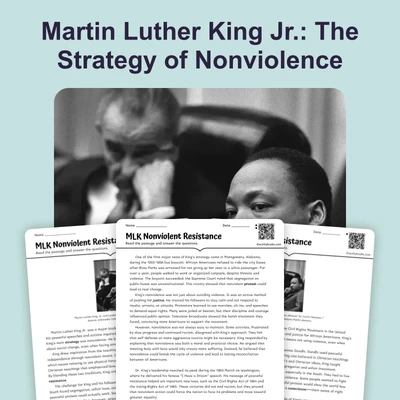
Martin Luther King Jr Early Life

"Martin Luther King, Jr. National Historical Park, Georgia by NPS / Wikimedia Commons
Martin Luther King Jr. was born in 1929 in Atlanta, Georgia, a city deeply divided by segregation. From an early age, he experienced the harsh realities of racial separation in schools, public places, and transportation. These childhood encounters with discrimination were not only troubling but also shaped his understanding of injustice. However, King’s family environment provided both comfort and strength, helping him develop a sense of resilience in the face of adversity.
King’s father, Martin Luther King Sr., was a respected Baptist minister and an influential leader in Atlanta’s Black community. The King family’s religious tradition emphasized principles of equality, justice, and service to others. Through regular church attendance and participation in family discussions, Martin learned the importance of moral responsibility. This upbringing encouraged him to question unfair laws and seek solutions through peaceful means.
Education played a crucial role in King’s formation as a future leader. King started school at a young age, skipping both the ninth and twelfth grades due to his academic excellence. He attended the prestigious Morehouse College at just 15 years old, following in the footsteps of his father and grandfather. At Morehouse, he engaged in thoughtful discussions about race, justice, and the power of nonviolence. The college’s president, Dr. Benjamin Mays, became an important mentor who inspired King to see education as a path to change.
Despite his supportive home and school life, King faced significant challenges outside these spaces. Atlanta’s strict Jim Crow laws enforced separation between Black and white citizens, limiting opportunities for Black children. Even so, King’s family and church taught him to respond to hatred with love, and to meet obstacles with determination. These early lessons in faith, education, and perseverance became the foundation for his later activism.
When King witnessed acts of discrimination, he learned to analyze the causes of inequality and imagine solutions. He saw that nonviolent protest and negotiation could be effective tools for change. This problem-solving approach, rooted in his early experiences, helped shape his philosophy as a leader in the Civil Rights Movement.
King’s early life in Atlanta was marked by both struggle and support. The combination of personal experience with segregation, a nurturing family, and strong educational influences prepared him to confront injustice. By the time King graduated from college, he had developed a deep sense of purpose and a commitment to fighting for civil rights in America.
Interesting Fact: Martin Luther King Jr. was so academically advanced that he entered Morehouse College at just 15 years old, much younger than most students.
Comprehension quiz (8 questions)
1. Where was Martin Luther King Jr. born?
2. Who was King’s important mentor at college?
3. What law kept Black and white people separate?
4. How did King’s family help him?
5. Why was King’s education important?
6. What effect did segregation have on King?
7. King always believed in violent protest. True or false?
8. What does 'resilience' mean?
Perfect for the way you teach
- Build comprehension skills
- Auto-graded quiz
- Differentiated reading
- Read together at home
- Improve fluency
- Quiet reading time
- Reading curriculum support
- Independent practice
- Track Lexile growth