Civil War Causes
Interactive passage with audio narration, comprehension questions, and printable PDF.
By completing this purchase you agree to our Terms of Use and Privacy Policy. Your subscription renews automatically until you cancel. You can cancel anytime from your account settings. All sales are final and non-refundable. Digital content is available for download in your account immediately upon purchase.
What's included
Civil War Causes preview and details
About this printable Civil War Causes reading passage (Grades 6-8)
Sample passage and quiz from Civil War Causes
Reading passage and comprehension quiz preview
Civil War Causes: States' Rights or Slavery?
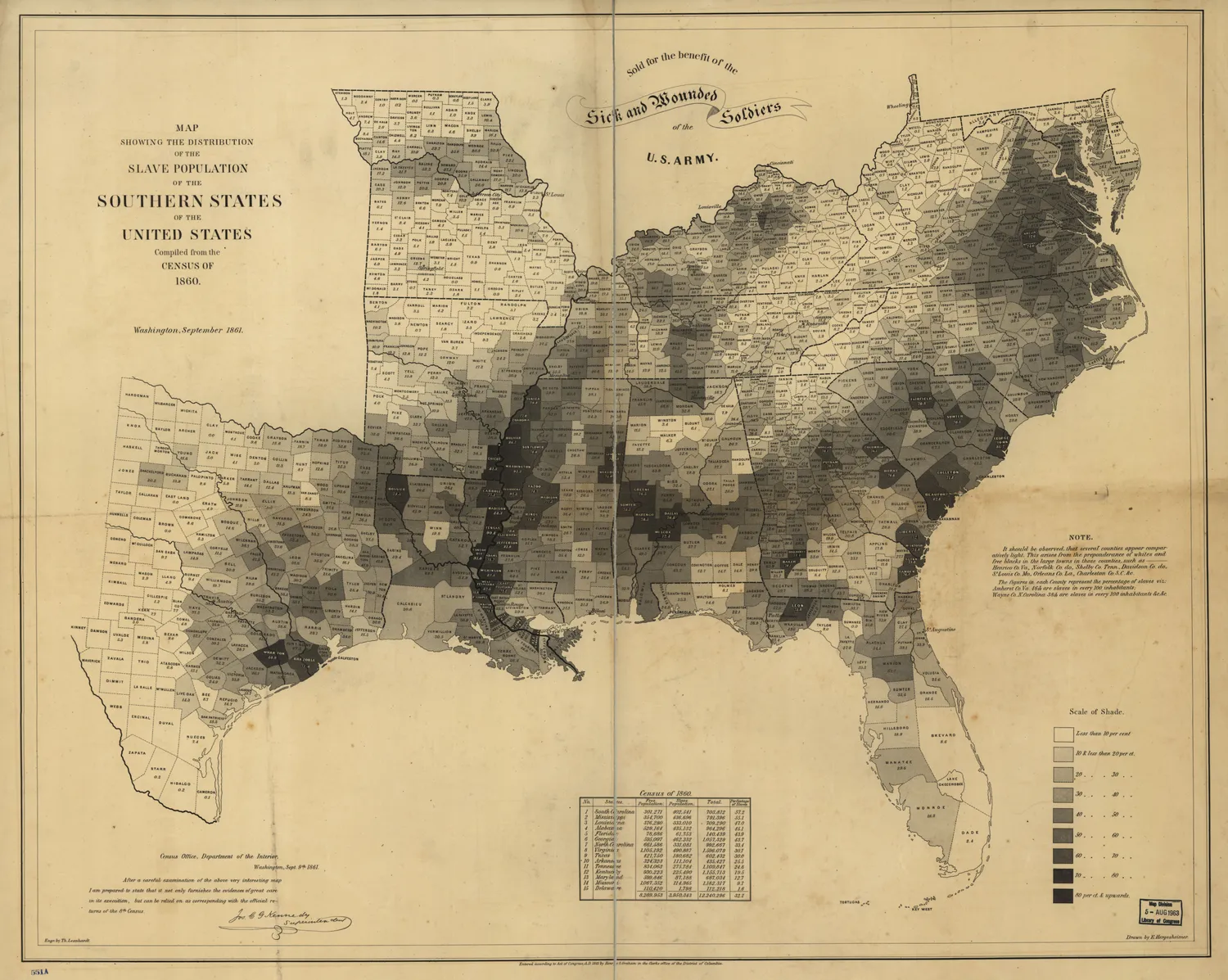
"Map showing the distribution of the slave population of the southern states of the United States. Compiled from the census of 1860 LOC ody0314" by Hergesheimer, E. (Edwin); Adolph Von Steinwehr; Hergesheimer, E. / Wikimedia Commons (Public domain).
The causes of the American Civil War remain debated by historians, but two major factors are often highlighted: states' rights and slavery. In the first half of the 1800s, the United States became increasingly divided between the North and the South. These regions held deeply different economic interests and social systems. The North favored industrial development and, over time, increasingly opposed slavery. The South, however, depended heavily on enslaved labor for its agricultural economy, especially in growing cotton and tobacco.
The issue of sovereignty—the right of each state to govern itself—was at the heart of many arguments. Southern leaders claimed that the federal government had no authority to interfere with their way of life, including the institution of slavery. They believed the U.S. Constitution protected their rights as independent states. As John C. Calhoun, a prominent Southern senator, wrote in 1837: "The peculiar institution [of slavery] is a positive good." Calhoun's words show how some Southerners justified slavery as essential, not only to their economy but to their society.
Meanwhile, many Northerners considered slavery morally wrong and wanted to prevent its expansion into new western territories. This led to fierce debates in Congress and the country. Compromises, such as the Missouri Compromise of 1820 and the Compromise of 1850, attempted to balance the interests of free and slave states. However, these agreements only provided temporary solutions. As the nation expanded westward, each new territory raised the question: Should slavery be allowed here?
Contradictions appeared even within the idea of states' rights. For example, Southern leaders wanted strong state power when it protected slavery but demanded federal enforcement of the Fugitive Slave Act, which required Northern states to return escaped enslaved people. This revealed a complex relationship between states and the federal government, with each side using the principle of states' rights when it benefited their cause.
The debate over slavery and states' rights grew more intense in the 1850s. The publication of "Uncle Tom's Cabin" and the violent conflict in Kansas, known as "Bleeding Kansas," increased tensions. Some Southerners felt threatened by growing Northern opposition and worried that their political power was slipping away. In 1860, Abraham Lincoln was elected president without winning any Southern states. Southern leaders saw this as proof that the federal government would act against their interests. In response, eleven Southern states decided to secede, or break away, from the Union.
While both sectionalism—loyalty to one’s own region—and disputes over states' rights shaped the conflict, the evidence shows that the expansion and preservation of slavery was the central issue. Most declarations of secession written by Southern states directly mention slavery as their main reason for leaving the Union. The Northern point of view, however, often focused on preserving the nation and stopping the spread of slavery, rather than abolishing it everywhere at first.
In summary, the Civil War was caused by a combination of factors. Arguments over states' rights provided a framework, but the survival of slavery was the most important cause, as demonstrated by speeches, laws, and official documents from the era. Understanding these complexities helps us see why the Civil War was such a significant and tragic turning point in American history.
Interesting Fact: The Emancipation Proclamation, issued by President Lincoln in 1863, did not end slavery everywhere but only in states rebelling against the Union.
Comprehension quiz (8 questions)
1. What was the main Southern crop?
2. Who won the 1860 presidential election?
3. How many Southern states seceded?
4. Why did many Northerners oppose slavery?
5. What was the main goal of the North?
6. What does 'secede' mean?
7. The Missouri Compromise ended slavery. True or false?
8. What is sectionalism?
Common Core standards for Civil War Causes
Explain events, procedures, ideas, or concepts in a historical, scientific, or technical text, including what happened and why, based on specific information in the text.
Determine the meaning of general academic and domain-specific words or phrases in a text relevant to a grade 4 topic or subject area.
Write informative/explanatory texts to examine a topic and convey ideas and information clearly.
Perfect for the way you teach
- Build comprehension skills
- Auto-graded quiz
- Differentiated reading
- Read together at home
- Improve fluency
- Quiet reading time
- Reading curriculum support
- Independent practice
- Track Lexile growth