The Women's Rights Movement Begins
Interactive passage with audio narration, comprehension questions, and printable PDF.
By completing this purchase you agree to our Terms of Use and Privacy Policy. Your subscription renews automatically until you cancel. You can cancel anytime from your account settings. All sales are final and non-refundable. Digital content is available for download in your account immediately upon purchase.
What's included
The Women's Rights Movement Begins preview and details
About this printable The Women's Rights Movement Begins reading passage (Grades 6-8)
Sample passage and quiz from The Women's Rights Movement Begins
Reading passage and comprehension quiz preview
Women's Rights Movement Begins
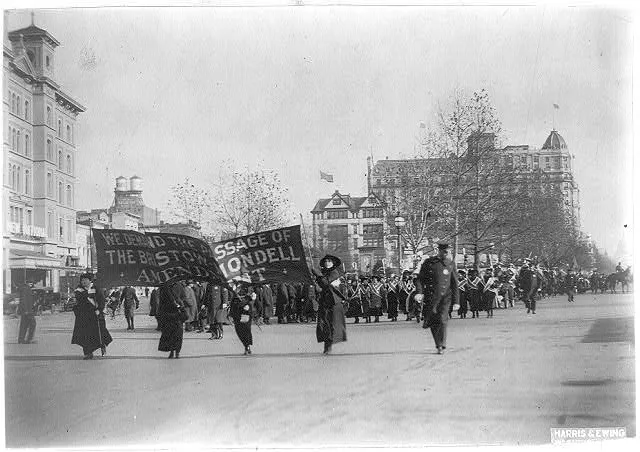
Source: Library of Congress - Harris & Ewing
The women's rights movement in the United States began in the early 1800s when women started to organize and demand equal treatment under the law. At that time, American women had very few rights. They could not vote, own property after marriage, or participate fully in public life. Many women recognized these restrictions as unjust and began to advocate for change. This activism marked the early stages of a long struggle for equality and justice.
One of the main problems was the lack of political suffrage, or the right to vote. Laws and customs kept women from having a voice in making decisions that affected their lives. Additionally, women were often denied access to higher education and important professional opportunities. These issues inspired women to create a movement, or organized effort, to seek legal and social reforms.
Leaders like Elizabeth Cady Stanton and Lucretia Mott helped organize the Seneca Falls Convention in 1848, which was the first major gathering focused on women's rights in the United States. At this convention, activists drafted the Declaration of Sentiments, a document that outlined the many ways women were treated unequally and demanded changes. The Declaration listed grievances about laws that denied women property rights, limited their participation in government, and prevented them from gaining an equal status in society.
Despite their efforts, early activists faced significant opposition from many in society, including lawmakers and even some women who believed that traditional gender roles should not be challenged. Newspapers sometimes mocked the movement, and change came slowly. However, these challenges did not stop women from continuing their work. Their persistence laid the foundation for future advances in women's rights.
Over time, the women's rights movement gained more supporters and began to achieve reforms. Some states passed laws allowing women to own property and attend colleges. The movement also connected with other reform causes, such as the abolition of slavery and temperance, increasing its influence. Eventually, these efforts led to the passage of the 19th Amendment in 1920, which guaranteed women the right to vote.
The struggle for women's rights was complex and required cooperation, courage, and determination. Early activists used petitions, speeches, and public demonstrations to raise awareness and push for change. Although the road to equality was difficult, the movement's leaders inspired generations to continue fighting for justice and equal rights for all people.
Interesting Fact: The Seneca Falls Convention in 1848 was attended by about 300 people, but only a third of those who signed the Declaration of Sentiments were women; many supporters were men.
Comprehension quiz (8 questions)
1. When did the women's rights movement begin?
2. Who organized the Seneca Falls Convention?
3. What was a major problem for women?
4. Why was the Declaration of Sentiments important?
5. How did society react to early activists?
6. What was one result of the movement?
7. The 19th Amendment gave women the right to vote.
8. What does activism mean?
Common Core standards for The Women's Rights Movement Begins
Explain events, procedures, ideas, or concepts in a historical, scientific, or technical text, including what happened and why, based on specific information in the text.
Determine the meaning of general academic and domain-specific words or phrases in a text relevant to a grade 4 topic or subject area.
Write informative/explanatory texts to examine a topic and convey ideas and information clearly.
Perfect for the way you teach
- Build comprehension skills
- Auto-graded quiz
- Differentiated reading
- Read together at home
- Improve fluency
- Quiet reading time
- Reading curriculum support
- Independent practice
- Track Lexile growth