Students Sit-Ins 1960
Interactive passage with audio narration, comprehension questions, and printable PDF.
By completing this purchase you agree to our Terms of Use and Privacy Policy. Your subscription renews automatically until you cancel. You can cancel anytime from your account settings. All sales are final and non-refundable. Digital content is available for download in your account immediately upon purchase.
What's included
Students Sit-Ins 1960 preview and details
About this printable Students Sit-Ins 1960 reading passage (Grades 6-8)
Sample passage and quiz from Students Sit-Ins 1960
Reading passage and comprehension quiz preview
Students Sit-Ins 1960
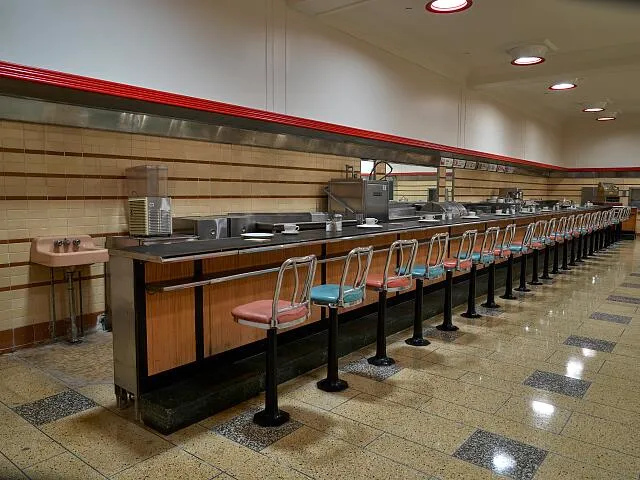
"Lunch counter at the old Woolworth's "five and dime" store, a legendary site marking the American civil-rights movement and is now the International Civil Rights Center & Museum, and the place where "sit-in" became part of the American lexicon" by Highsmith, Carol M., 1946- / Library of Congress.
On February 1, 1960, four Black college students walked into the Woolworth’s department store in Greensboro, North Carolina. They sat down at a lunch counter labeled for “whites only” and politely asked to be served. The staff refused, but the students did not leave. This event marked the beginning of the student sit-in movement, a powerful form of nonviolent protest during the Civil Rights Movement.
The United States in 1960 was a place deeply divided by segregation. Laws in many Southern states forced Black people and white people to use separate public spaces, such as schools, buses, and restaurants. This separation was unfair and unequal. African Americans and their allies wanted to end these unjust laws, but they faced resistance from those who supported segregation. The students in Greensboro used a direct action strategy, which meant confronting injustice openly and peacefully. Their sit-in was carefully planned to remain calm and respectful, even when faced with insults or threats.
After the first day, news of the sit-in spread quickly. More students joined the protest, filling the lunch counter and creating a peaceful but powerful demand for change. Within days, the movement had spread to other cities across North Carolina and throughout the South. By the end of March 1960, thousands of students in over fifty cities were participating in sit-ins. These protests required great courage and discipline, because participants risked arrest, violence, and expulsion from school.
The sit-ins challenged both the legal rules and the social customs of segregation. Protesters often faced angry crowds, police, and store owners who tried to remove them. However, the students followed the principles of nonviolence taught by civil rights leaders such as Dr. Martin Luther King Jr. They refused to respond with anger or force, even when they were insulted or attacked. This approach gained sympathy from the public and attracted widespread media attention. It became clear that the students were fighting for justice, while their opponents defended an unjust system.
The sit-in movement achieved significant results. Some lunch counters and restaurants began to integrate, serving all customers regardless of race. The sit-ins also inspired the creation of the Student Nonviolent Coordinating Committee (SNCC), a major organization that led future civil rights actions. Most importantly, the sit-ins showed that young people could be effective leaders for social change. Their actions proved that nonviolent protest could break down barriers and force the nation to confront its problems.
The 1960 student sit-ins were not the only protests against segregation, but they became a symbol of courage and determination. These events helped build momentum for later victories, including the Civil Rights Act of 1964, which outlawed segregation in public places. The sit-ins demonstrated the power of ordinary citizens to challenge injustice and change history, one seat at a time.
Interesting Fact: The original Woolworth’s lunch counter where the first Greensboro sit-in took place is now preserved at the Smithsonian National Museum of American History.
Comprehension quiz (8 questions)
1. Where did the first sit-in begin?
2. What year did the sit-ins start?
3. Who led the first sit-in?
4. Why did students use nonviolent protest?
5. What was a major result of the sit-ins?
6. How did the sit-ins spread?
7. The sit-ins used violent protest methods.
8. What does 'segregation' mean?
Common Core standards for Students Sit-Ins 1960
Explain events, procedures, ideas, or concepts in a historical, scientific, or technical text, including what happened and why, based on specific information in the text.
Determine the meaning of general academic and domain-specific words or phrases in a text relevant to a grade 4 topic or subject area.
Write informative/explanatory texts to examine a topic and convey ideas and information clearly.
Perfect for the way you teach
- Build comprehension skills
- Auto-graded quiz
- Differentiated reading
- Read together at home
- Improve fluency
- Quiet reading time
- Reading curriculum support
- Independent practice
- Track Lexile growth