Measuring Earthquakes
Interactive passage with audio narration, comprehension questions, and printable PDF.
By completing this purchase you agree to our Terms of Use and Privacy Policy. Your subscription renews automatically until you cancel. You can cancel anytime from your account settings. All sales are final and non-refundable. Digital content is available for download in your account immediately upon purchase.
What's included
Measuring Earthquakes preview and details
About this printable Measuring Earthquakes science reading passage, NGSS-aligned (Grades 5-8)
Sample passage and quiz from Measuring Earthquakes
Reading passage and comprehension quiz preview
Measuring Earthquakes
Earthquakes are sudden movements of the Earth’s crust that release energy and cause the ground to shake. These powerful events can damage buildings, change landscapes, and affect communities. To understand and respond to earthquakes, scientists need to measure both how strong they are and what effects they have. Measuring earthquakes helps us learn about Earth’s processes, improve building safety, and protect people’s lives.
Magnitude and intensity are two main ways scientists describe earthquakes. Magnitude is the amount of energy released at the earthquake’s source. The Richter scale was one of the first tools used for this. It is a logarithmic scale: each whole number increase means 10 times more ground shaking and about 32 times more energy released. For example, a magnitude 6 earthquake shakes the ground ten times more than a magnitude 5. Today, scientists use the moment magnitude scale (Mw) for large earthquakes, which measures the size of the fault, how far it slipped, and the strength of the rocks. This scale gives a more accurate picture of the earthquake’s true power, especially for very large events.
Intensity measures how much an earthquake is felt and what damage it causes at different locations. The Modified Mercalli Intensity scale (MMI) uses Roman numerals from I (not felt) to XII (total destruction). Unlike magnitude, intensity can vary from place to place, depending on distance from the epicenter, local geology, and building structures. For example, an intensity of VI might mean people are frightened and some plaster cracks, while XII means almost all buildings collapse. The MMI scale is based on observations and reports from people who experienced the earthquake, as well as damage surveys.
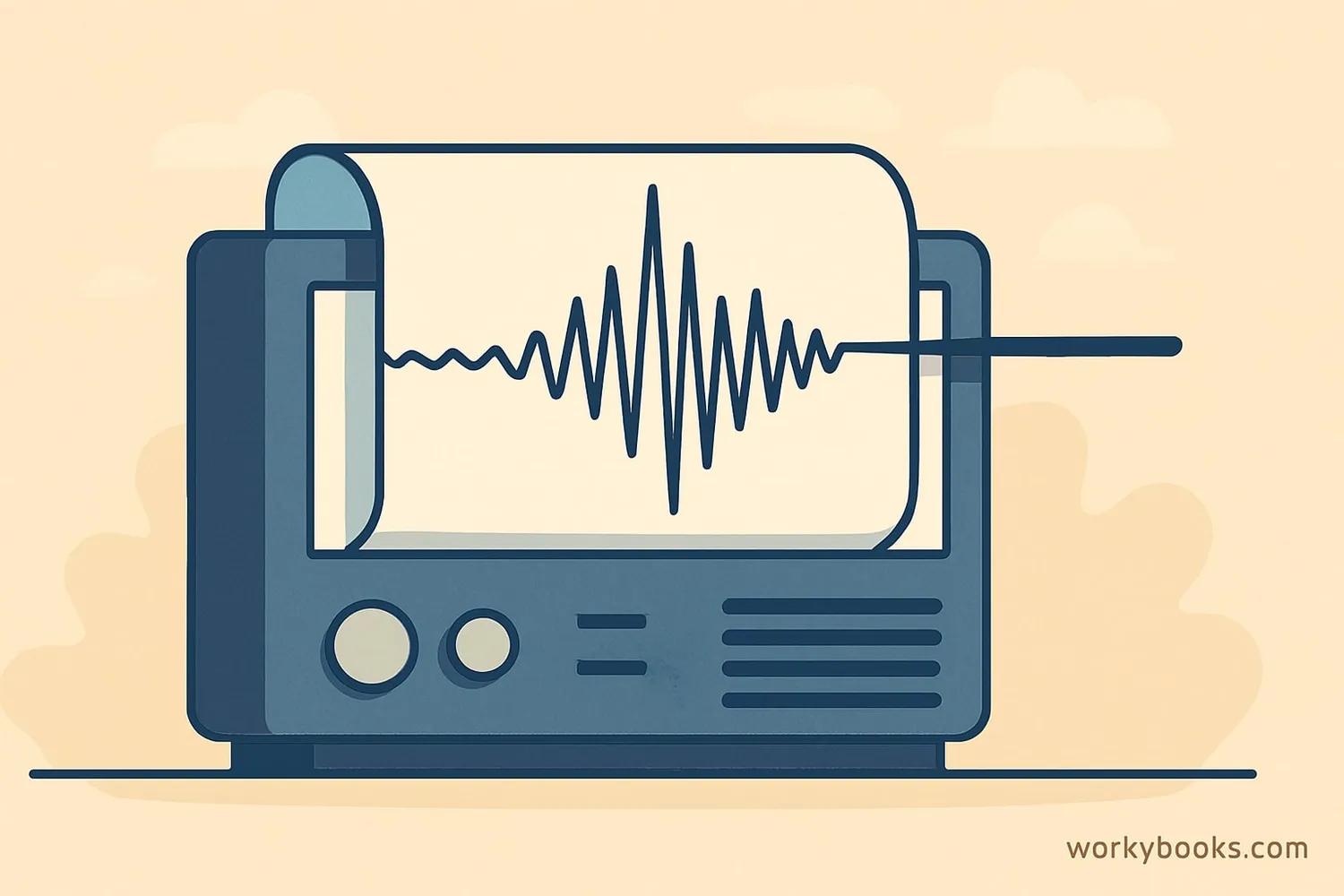
To locate an earthquake’s epicenter, scientists use data from several seismograph stations. Seismographs record the arrival times of different seismic waves, including the faster P-waves and the slower S-waves. By comparing the time difference between these waves at three or more stations, scientists use triangulation to pinpoint the earthquake’s source. This process is crucial for quick responses and for studying how earthquakes happen.
Most earthquakes are small and go unnoticed, while large, destructive ones are rare. This is because the Earth’s crust can only store so much energy before it breaks, and small slips are much more common than big ones. For every magnitude 7 earthquake, there are about 10 times as many magnitude 6 earthquakes, and 100 times as many magnitude 5s. This pattern helps explain why scientists study both large and small earthquakes to understand the risks in different regions.
Measuring earthquakes is vital for science and society. It allows us to develop better building codes, improve public safety, and advance our understanding of Earth’s dynamic systems. As technology improves, scientists continue to refine their methods, helping communities become more resilient to future earthquakes.
Interesting Fact: The largest earthquake ever recorded was a magnitude 9.5 in Chile in 1960, releasing more energy than all the world’s nuclear tests combined!
Comprehension quiz (10 questions)
1. What does the Richter scale measure?
2. Which scale is currently used to measure large earthquake magnitudes?
3. Intensity describes...
4. What is the Modified Mercalli Intensity scale based on?
5. How do scientists find the epicenter of an earthquake?
6. What does a whole number increase on the Richter scale mean?
7. Which of the following BEST describes why large earthquakes are less common than small ones?
8. If an earthquake has an intensity of XII on the MMI scale, what is most likely true?
9. True or False: The moment magnitude scale is more accurate for very large earthquakes than the Richter scale.
10. True or False: Intensity is always the same everywhere during an earthquake.
Perfect for the way you teach
- Build comprehension skills
- Auto-graded quiz
- Differentiated reading
- Read together at home
- Improve fluency
- Quiet reading time
- Reading curriculum support
- Independent practice
- Track Lexile growth