Mississippian Mounds
Interactive passage with audio narration, comprehension questions, and printable PDF.
By completing this purchase you agree to our Terms of Use and Privacy Policy. Your subscription renews automatically until you cancel. You can cancel anytime from your account settings. All sales are final and non-refundable. Digital content is available for download in your account immediately upon purchase.
What's included
Mississippian Mounds preview and details
About this printable Mississippian Mounds reading passage (Grades 5-8)
Sample passage and quiz from Mississippian Mounds
Reading passage and comprehension quiz preview
Mississippian Earthen Mounds
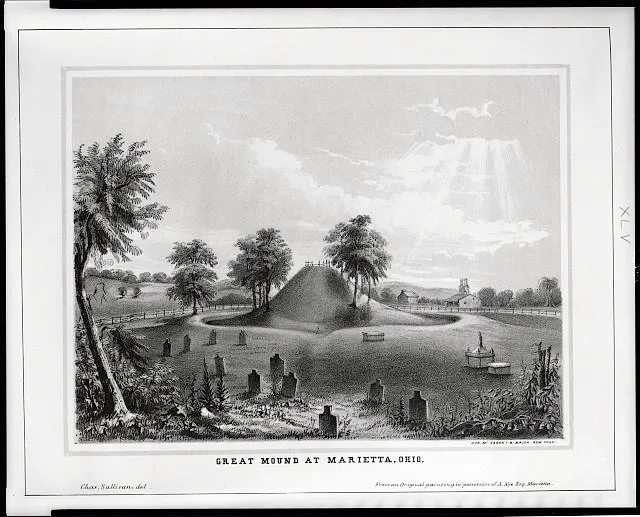
"Great Mound at Marietta, Ohio" / Library of Congress.
The Mississippian civilization flourished in North America from around 800 to 1600 CE and is best known for its construction of large earthen mounds. These monumental structures were built mainly in the Mississippi River Valley and served as important centers for religious, political, and social activities.
The most famous Mississippian site is Cahokia, located near present-day St. Louis, Missouri. Cahokia was a thriving city-state between 1050 and 1350 CE and covered nearly six square miles. Archaeologists estimate that as many as 20,000 people lived there at its peak, making it one of the largest urban settlements in prehistoric North America. The central feature of Cahokia is Monks Mound, the largest prehistoric earthwork in the Americas. Monks Mound stands about 30 meters tall and covers more than 14 acres. Its construction required moving millions of baskets of soil using only simple tools and human labor. Archaeological evidence shows that Monks Mound supported temples and possibly the residences of elite leaders, reflecting the city’s complex hierarchy and religious beliefs.
Mississippian mounds were not all the same. Some, like the platform mounds at Cahokia and Moundville (in Alabama), were used for ceremonies or as bases for important buildings. Others, such as the burial mounds at Etowah (in Georgia), held the remains of influential people, along with offerings like copper ornaments and shell beads. The arrangement of mounds often reflected the cosmology of Mississippian peoples, aligning with the cardinal directions and important celestial events. These patterns show the Mississippians’ advanced understanding of astronomy and their connection to the landscape.
Building and maintaining mounds required organized labor and cooperation among large groups. Archaeological finds, including pottery, stone tools, and food remains, offer clues about daily life. The discovery of defensive walls and evidence of feasting suggests that these cities were centers of both celebration and conflict. Over time, some Mississippian cities declined, possibly due to environmental changes, overuse of resources, or conflicts with neighboring groups. However, the tradition of mound-building continued in some areas, showing both change and continuity in Native American societies.
The Mississippian mounds are significant because they demonstrate the ingenuity and social organization of pre-Columbian peoples in North America. These earthworks reveal how geography, religion, and community needs shaped one of the continent’s most remarkable ancient civilizations. The mounds connect us to a long history of innovation and adaptation in response to the natural world.
This history of mound-building links to broader themes of technological innovation, social structure, and the relationship between humans and their environment in world history.
Interesting Fact: Archaeologists discovered more than 120 mounds at Cahokia, but only about 80 survive today due to modern development.
Comprehension quiz (8 questions)
1. Where was Cahokia located?
2. What is Monks Mound?
3. How tall is Monks Mound?
4. Why did Mississippians build mounds?
5. What do burial mounds at Etowah contain?
6. How did mound-building show social structure?
7. Cahokia had over 120 mounds. True or false?
8. What does 'hierarchy' mean?
Perfect for the way you teach
- Build comprehension skills
- Auto-graded quiz
- Differentiated reading
- Read together at home
- Improve fluency
- Quiet reading time
- Reading curriculum support
- Independent practice
- Track Lexile growth