MLK Montgomery Bus Boycott — Reading Comprehension
Rate this
Premium Resource
Present
Present in classroom. No work saved
Assign
Classroom with student accounts, Track progress
Quick Play
No student accounts, assign with a link
Grades
6
7
8
PRINT+DIGITAL RESOURCE
This learning resource is available in interactive and printable formats. The interactive worksheet can be played online and assigned to students. The Printable PDF version can be downloaded and printed for completion by hand.
This U.S. History reading passage explores the Montgomery Bus Boycott, a pivotal event in the Civil Rights Movement, and the rise of Dr. Martin Luther King Jr. as a national leader. Students will analyze the causes of the boycott, the motivations of key figures like Rosa Parks and King, and the event’s far-reaching consequences for American society. The passage encourages critical thinking by presenting multiple perspectives and addressing the complexities of nonviolent protest and segregation. Aligned with D2.His.2.6-8, D2.His.14.6-8, and RI.6.3, it models historical reasoning and evidence-based analysis. Included activities support comprehension and writing skills, and Spanish and differentiated versions ensure accessibility for all learners. Audio read-aloud and graphic organizers help students master complex content while meeting both history and ELA standards.
CONTENT PREVIEW
Expand content preview
On December 1, 1955, in Montgomery, Alabama, a woman named Rosa Parks refused to give up her seat to a white passenger on a segregated city bus. Her arrest became the catalyst for the boycott that would change American history. This event highlighted the injustice of segregation, where laws forced Black Americans to sit at the back of buses and give up their seats for white people. The Montgomery Bus Boycott soon became a powerful example of the struggle for civil rights.
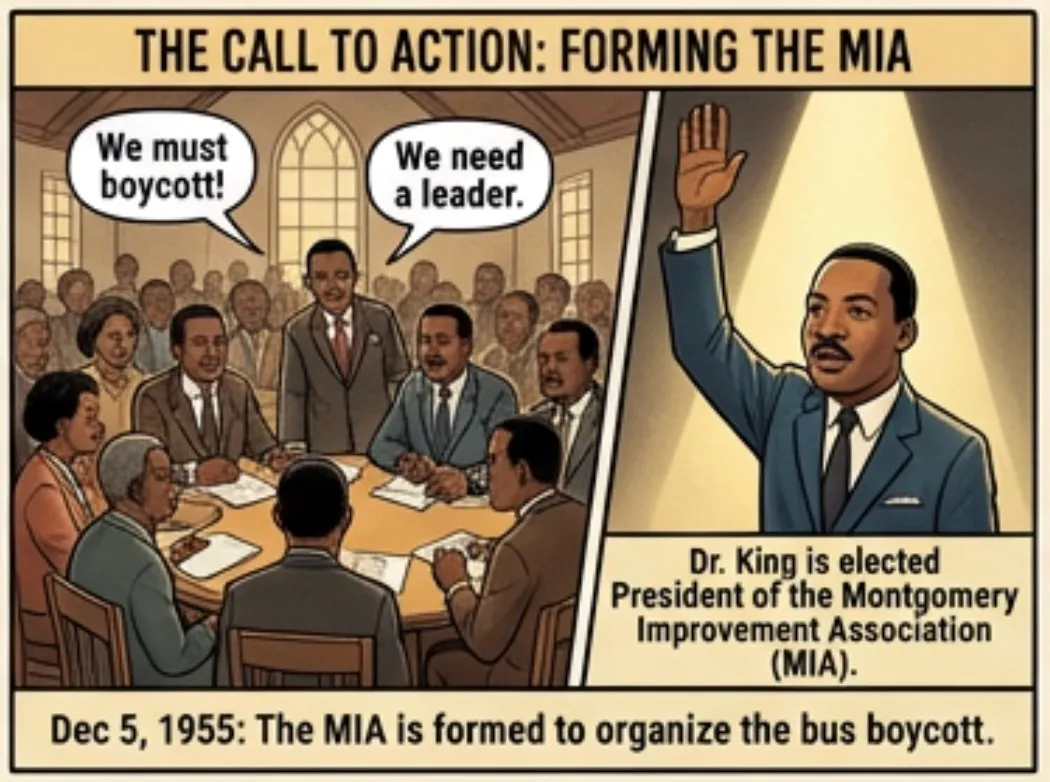
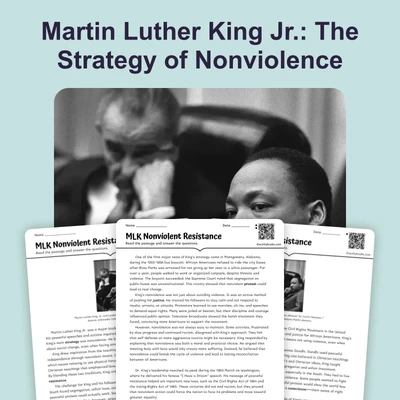
After Parks was arrested, Montgomery’s Black community leaders quickly organized to protest segregation on public buses. The newly formed Montgomery Improvement Association (MIA) chose a young pastor, Dr. Martin Luther King Jr., as their president. King’s leadership was based on his belief in nonviolence, a philosophy influenced by Mahatma Gandhi. Instead of responding with anger or aggression, King encouraged people to protest peacefully, even when faced with threats and violence from opponents.
The boycott required tremendous organization. Black citizens avoided city buses for over a year, walking long distances or carpooling to work and school. The MIA coordinated carpools, managed donations, and held mass meetings to keep the community united. This collective action was not easy. Many participants lost jobs, faced harassment, or were even arrested. Still, the commitment to the nonviolent movement remained strong.
The city government and bus companies tried to break the boycott. They used legal threats, intimidation, and even violence to discourage protesters. However, these challenges only strengthened the resolve of the Black community and their allies. King and the MIA responded by appealing to the courts and the wider American public. They argued that segregation violated the U.S. Constitution, specifically the right to equal protection under the law.
In November 1956, the Supreme Court ruled that segregation on public buses was unconstitutional. This legal victory marked a turning point in the fight for civil rights. The Montgomery Bus Boycott demonstrated that ordinary people, when united and led by strong leadership, could challenge unfair laws and change society through peaceful means. It also propelled Dr. King onto the national stage, making him the most recognized voice of the Civil Rights movement.
This historic event showed that nonviolent protest could lead to real change. The boycott inspired similar actions across the South and became a model for future civil rights campaigns. It also revealed the risks and sacrifices required to achieve justice and equality.
Interesting Fact: The Montgomery Bus Boycott lasted 381 days, and during that time, the city’s bus system lost so much money that it nearly went bankrupt before segregation ended.
Who was arrested on December 1, 1955?
Rosa ParksMartin Luther King Jr.Mahatma GandhiA bus driver
What city did the bus boycott occur in?
AtlantaMontgomeryChicagoBirmingham
How long did the boycott last?
100 days50 days381 days20 days
Why was the boycott started?
To protest bus pricesTo end bus segregationTo support the mayorFor cleaner buses
What philosophy guided King's leadership?
NonviolenceAggressionIsolationViolence
What was one effect of the boycott?
Segregation continuedBuses were shut downBus segregation endedFares increased
The Supreme Court supported bus segregation. True or false?
TrueFalse
What does 'boycott' mean in the passage?
To refuse to use somethingTo buy more busesTo ride in protestTo build new buses
Perfect For:
👩🏫 Teachers
• Reading comprehension practice
• Auto-graded assessments
• Literacy skill development
👨👩👧👦 Parents
• Reading practice at home
• Comprehension improvement
• Educational reading time
🏠 Homeschoolers
• Reading curriculum support
• Independent reading practice
• Progress monitoring
Reading Features:
📖
Reading Passage
Engaging fiction or nonfiction text
❓
Comprehension Quiz
Auto-graded questions
📊
Instant Feedback
Immediate results and scoring
📄
Printable Version
Download for offline reading
🔊
Read Aloud
Voice-over with word highlighting
Reviews & Ratings
No reviews yet. Be the first to share your experience!
Related Content
Chicano Movement: Mexican American Civil Rights
This U.S. History reading passage examines the Chicano Movement, a significant civil rights campaign led by Mexican Amer...
D2.HIS.2.3-5D2.HIS.3.3-5RI.4.3RI.4.4
Civil Rights Act of 1964
This reading passage explores the Civil Rights Act of 1964, a landmark piece of U.S. legislation that outlawed discrimin...
HSS 11.10.5RI.6-8.1RI.6-8.6
Civil Rights Movements: Fighting for Equality
This engaging world history reading passage examines 20th-century civil rights movements, focusing on the United States,...
Voting Rights for African Americans
This passage explores the important history of voting rights for African Americans in the United States, following a cle...
D2.HIS.1-6.3-5RI.4.1RI.4.3RI.4.4
Voting Rights Act 1965
This engaging passage examines the Voting Rights Act of 1965 and its impact on voting rights in the United States. Stude...
D2.HIS.2.3-5D2.HIS.3.3-5RI.6.3RI.6.4
Cesar Chavez and Farm Workers' Rights
This engaging history reading passage explores the life and impact of Cesar Chavez, a key leader in the fight for farm w...
D2.HIS.2.3-5D2.HIS.14.3-5RI.4.3RI.4.4
The Women's Rights Movement Begins
This rigorous history reading passage explores the beginnings of the women's rights movement in the United States during...
D2.HIS.2.3-5D2.HIS.3.3-5RI.4.3RI.4.4
MLK Nonviolent Resistance
This detailed passage examines Martin Luther King Jr.'s strategy of nonviolence during the U.S. Civil Rights Movement. S...
Civil War Causes
This comprehensive U.S. history reading passage investigates the complex causes of the Civil War, focusing on the debate...
D2.HIS.2.3-5D2.HIS.3.3-5RI.4.3RI.4.4
Jackie Robinson: Breaking Baseball's Color Barrier
This passage examines Jackie Robinson's historic role in breaking Major League Baseball's color barrier in 1947. Student...
D2.HIS.2.3-5D2.HIS.3.3-5RI.4.3RI.4.4
March on Washington 1963: I Have Dream
This reading passage examines the March on Washington for Jobs and Freedom in 1963 and the delivery of Dr. Martin Luther...
D2.HIS.2.3-5D2.HIS.3.3-5RI.4.3RI.4.4
New Rights for African Americans
This reading passage explores the journey of African Americans gaining new rights after the Civil War. Students will lea...
D2.HIS.1-4.3-5RI.4.1RI.4.3RI.4.4
MLK Economic Justice
This engaging U.S. history reading passage explores Martin Luther King Jr.'s vision for economic justice during the Civi...
Cesar Chavez and United Farm Workers
This history reading passage explores Cesar Chavez and the United Farm Workers' organizing efforts during the Civil Righ...
D2.HIS.2.3-5D2.HIS.3.3-5RI.4.3RI.4.4
The Civil Rights Movement
This worksheet has students read about the Civil Rights Movement. They must summarize the overall goals, paraphrase lead...
Cesar Chavez and Dolores Huerta: Yes, We Can!
This engaging U.S. history reading passage introduces students to the inspiring story of Cesar Chavez and Dolores Huerta...
D2.HIS.2.3-5D2.HIS.3.3-5RI.4.3RI.4.4
Martin Luther King Jr: Nonviolent Leader
This rigorous U.S. history reading passage examines the leadership of Martin Luther King Jr. during the Civil Rights Mov...
HSS 11.10.2RI.6-8.1RI.6-8.6
Larry Itliong and the Grape Strike
This engaging U.S. history reading passage introduces students to Larry Itliong and the Grape Strike, a key event in the...
D2.HIS.2.3-5D2.HIS.3.3-5RI.4.3RI.4.4
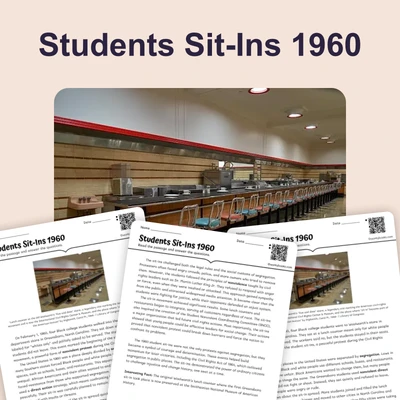
Students Sit-Ins 1960
This history reading passage explores the 1960 Sit-Ins, a pivotal moment in the Civil Rights Movement when African Ameri...
D2.HIS.2.3-5D2.HIS.3.3-5RI.4.3RI.4.4
Letter from Birmingham Jail 1963
This passage explores Martin Luther King Jr.'s historic 'Letter from Birmingham Jail' from 1963, a turning point in the ...