Native Americans in Revolutionary War — Reading Comprehension
Rate this
Premium Resource
Present
Present in classroom. No work saved
Assign
Classroom with student accounts, Track progress
Quick Play
No student accounts, assign with a link
Grades
6
7
8
Standards
D2.HIS.2.3-5
D2.HIS.3.3-5
RI.4.3
RI.4.4
W.4.2
PRINT+DIGITAL RESOURCE
This learning resource is available in interactive and printable formats. The interactive worksheet can be played online and assigned to students. The Printable PDF version can be downloaded and printed for completion by hand.
This engaging U.S. history reading passage explores how Native American nations made difficult decisions during the American Revolutionary War, often choosing to support either the British or the Patriots—or to remain neutral. Students will analyze the causes, motivations, and consequences of these choices, considering multiple perspectives and the complex factors that shaped Native American involvement. The passage includes disciplinary vocabulary, a primary source quote, and a compare/contrast structure to encourage critical historical thinking. Activities include a multiple-choice quiz, explanatory writing prompts, a T-Chart graphic organizer, and a timeline of key events. Spanish translation and read aloud audio are provided for accessibility. Aligned to C3 Framework and Common Core Reading and Writing standards (D2.His.2.3-5, D2.His.3.3-5, RI.4.3, RI.4.4, W.4.2), this resource supports deeper understanding of Native American history during the Revolutionary era and helps students practice essential skills in evidence-based analysis.
CONTENT PREVIEW
Expand content preview
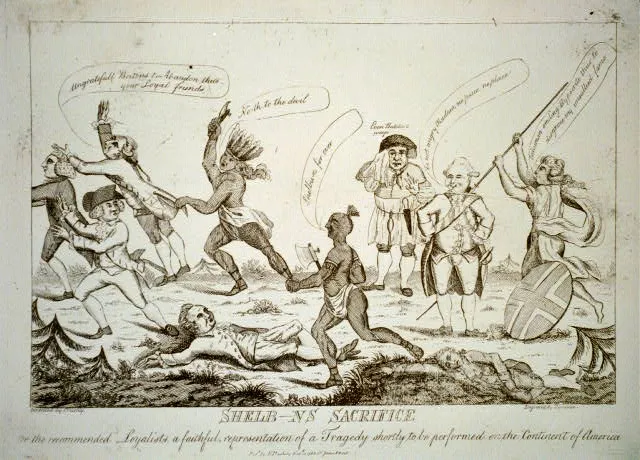
"Shelb---ns sacrifice" / Library of Congress.
The role of Native Americans in the American Revolutionary War is a story of tough choices and lasting consequences. Most Native American nations, such as the Iroquois Confederacy and Shawnee, formed an alliance with the British. The British promised to protect Native lands from growing American settlement. For many Native leaders, the threat of dispossession—losing their homelands—was a far greater danger than British rule.
This alliance was not universal. Some tribes, like the Oneida, supported the American colonists, while others attempted to maintain neutrality, hoping to avoid conflict altogether. However, neutrality proved difficult. The war’s expanding front lines and shifting alliances soon pulled many Native peoples into battles, often forcing them to pick sides or face attacks from both armies.
Native American alliances with the British were driven by historical experiences and strategic thinking. The British had issued the Proclamation of 1763, which tried to limit colonial expansion westward, offering a promise—though often broken—of protection for Native lands. The American colonists, on the other hand, wanted more land and frequently ignored these boundaries. For many Native American leaders, supporting the British seemed to offer the best chance at survival and the preservation of their cultures.
This decision, however, had serious consequences. When the war ended in 1783, the Treaty of Paris was signed by the British and Americans, but Native Americans were excluded from the negotiations. Their sovereignty, or authority to govern themselves, was ignored. Many tribes faced harsh retaliation from victorious American settlers, who saw Native alliances with Britain as a betrayal. Villages were burned, people were killed or forced to flee, and lands were taken despite earlier promises.
The aftermath of the war saw an increase in the dispossession of Native lands. The new United States government did not honor British treaties with Native nations. Instead, westward expansion accelerated, leading to new conflicts and loss of territory for many tribes. Some Native groups, like the Cherokee, tried to adapt by signing treaties with the United States, but these agreements were often broken.
The experience of Native Americans during the Revolutionary War highlights the complexities of sovereignty, loyalty, and survival in a time of upheaval. Their efforts to protect their people and lands, whether through alliance, neutrality, or resistance, show the difficult choices faced by indigenous nations during this transformative period in American history.
Interesting Fact: After the war, some Native Americans who had allied with the British resettled in Canada, where the British granted them new lands as a reward for their loyalty.
Who did most Native Americans ally with?
The BritishThe FrenchThe SpanishThe Americans
What did the British promise Native Americans?
More weaponsProtection of their landsFreedom from taxesNew trade routes
What was the Treaty of Paris?
Ended the French and Indian WarBegan the American RevolutionEnded the Revolutionary WarStarted westward expansion
Why did some tribes try neutrality?
To avoid fightingTo gain weaponsTo join FranceTo protect British forts
What happened after the war?
Native lands were protectedNative Americans gained new rightsNative Americans lost more landColonists moved to Europe
What was a main reason for choosing the British?
They offered more landThey promised protectionThey fought the SpanishThey gave more trade goods
Native sovereignty was respected after the war.
TrueFalse
What does 'retaliation' mean?
Making peaceTaking revengeTrading goodsMoving west
Perfect For:
👩🏫 Teachers
• Reading comprehension practice
• Auto-graded assessments
• Literacy skill development
👨👩👧👦 Parents
• Reading practice at home
• Comprehension improvement
• Educational reading time
🏠 Homeschoolers
• Reading curriculum support
• Independent reading practice
• Progress monitoring
Reading Features:
📖
Reading Passage
Engaging fiction or nonfiction text
❓
Comprehension Quiz
Auto-graded questions
📊
Instant Feedback
Immediate results and scoring
📄
Printable Version
Download for offline reading
🔊
Read Aloud
Voice-over with word highlighting
Reviews & Ratings
No reviews yet. Be the first to share your experience!
Related Content
Native American Tribes Across America
This engaging history reading passage introduces students to Native American tribes across America, focusing on their da...
D2.HIS.1.3-5D2.HIS.2.3-5RI.4.1RI.4.2
Teepees: Homes on the Great Plains
This engaging history reading passage introduces students to teepees, the unique homes of Native American tribes on the ...
D2.HIS.2.3-5D2.HIS.14.3-5RI.4.1RI.4.2RI.4.4
Traditional Native American Clothing
This engaging history passage explores traditional Native American clothing and how it reflected the environment, values...
D2.HIS.2.3-5D2.HIS.3.3-5RI.4.3RI.4.4
The Iroquois Confederacy: A System of Peace
This engaging U.S. History reading passage introduces students to the Iroquois Confederacy, a powerful alliance of Nativ...
D2.HIS.2.3-5D2.HIS.3.3-5RI.4.3RI.4.4
The Cherokee Nation: History and Culture
This reading passage explores the rich history and culture of the Cherokee Nation, one of the largest Native American tr...
D2.HIS.2.3-5D2.HIS.14.3-5RI.4.3RI.4.4RI.4.10
The Sioux: Warriors and Tribal Leaders
This history reading passage explores the Sioux Nation, focusing on their roles as warriors and tribal leaders. Students...
D2.HIS.1.3-5D2.HIS.2.3-5RI.4.1RI.4.3
Native American Respect for Nature
This engaging history reading passage explores Native American respect for nature, emphasizing the close relationship be...
D2.HIS.2.3-5D2.HIS.3.3-5RI.4.3RI.4.4
Jamestown: The First Permanent English Colony
This engaging history passage explores the founding of Jamestown, the first permanent English colony in America. Aligned...
D2.HIS.1.3-5D2.HIS.2.3-5RI.4.3RI.4.4
Pocahontas and the Powhatan People
This engaging reading passage explores the life of Pocahontas and the Powhatan people and their important role in early ...
D2.HIS.1.3-5D2.HIS.2.3-5RI.4.1RI.4.3
Colonial Children: School and Chores
This reading passage explores the daily lives of colonial children, focusing on their experiences at school and their ma...
D2.HIS.2.3-5D2.HIS.3.3-5RI.4.1RI.4.2RI.4.4
Colonial Clothing and Homemade Goods
This engaging U.S. history passage explores the daily life of early American colonists with a focus on colonial clothing...
D2.HIS.2.3-5RI.4.3RI.4.4
Colonial Jobs: Blacksmiths, Bakers, and Craftsmen
This engaging history reading passage explores the vital roles of blacksmiths, bakers, and craftsmen in colonial America...
D2.HIS.2.3-5D2.HIS.3.3-5RI.4.3RI.4.4
Colonial Towns and Village Life
This engaging history reading passage explores the daily life, work, and unity found in colonial towns and villages. Ali...
D2.HIS.1.3-5D2.HIS.2.3-5RI.4.3RI.4.4
Colonial Trade with England and Africa
This history reading passage explores colonial trade between the American colonies, England, and Africa, focusing on the...
D2.HIS.2.3-5D2.HIS.14.3-5RI.4.3RI.4.4
Benjamin Franklin: Printer, Inventor, and Leader
This history reading passage explores the life and achievements of Benjamin Franklin, one of America's most important ea...
D2.HIS.2.3-5D2.HIS.3.3-5RI.4.1RI.4.3
George Washington Leads the Army
This engaging history reading passage explores how George Washington bravely led the Continental Army during the America...
D2.HIS.1.3-5D2.HIS.2.3-5RI.4.3RI.4.4
Women and Children During the Revolutionary War
This reading passage explores the important roles women and children played during the Revolutionary War. Students will ...
D2.HIS.2.3-5RI.4.3RI.5.3
African Americans Fight for Freedom
This educational passage explores the brave and inspiring story of how African Americans fought for freedom in the Unite...
D2.HIS.2.3-5D2.HIS.3.3-5RI.4.3RI.4.4
The Battle of Yorktown Ends War
This engaging U.S. history reading passage explores the Battle of Yorktown, a key event that ended the American Revoluti...
D2.HIS.1.3-5D2.HIS.2.3-5RI.4.1RI.4.3
Loyalists vs. Patriots: Divided Families
This engaging U.S. history reading passage explores the division between Loyalists and Patriots during the American Revo...