Spanish Missions Impact on Native American — Reading Comprehension
Rate this
Premium Resource
Present
Present in classroom. No work saved
Assign
Classroom with student accounts, Track progress
Quick Play
No student accounts, assign with a link
Grades
6
7
8
Standards
D2.HIS.2.3-5
D2.HIS.3.3-5
RI.4.3
RI.4.4
W.4.2
PRINT+DIGITAL RESOURCE
This learning resource is available in interactive and printable formats. The interactive worksheet can be played online and assigned to students. The Printable PDF version can be downloaded and printed for completion by hand.
This reading passage explores the complex impact of Spanish missions on Native American culture in what is now the southwestern United States. Students will analyze the causes and consequences of Spanish colonization, including religious, economic, and cultural motivations. The passage highlights multiple perspectives—Spanish missionaries, Native American communities, and Spanish authorities—while addressing the conflicts, changes, and contradictions that shaped this period. A primary source quote is integrated to deepen historical reasoning. The resource aligns with D2.His.2.3-5 and RI.4.3 standards, as well as related Common Core requirements for historical analysis and textual evidence. Activities include comprehension questions, a writing task, a T-Chart graphic organizer, and a timeline, plus a glossary of key terms. Read aloud audio and Spanish translation are provided, making the content accessible and engaging for diverse learners. Ideal for developing critical thinking and understanding of U.S. history.
CONTENT PREVIEW
Expand content preview
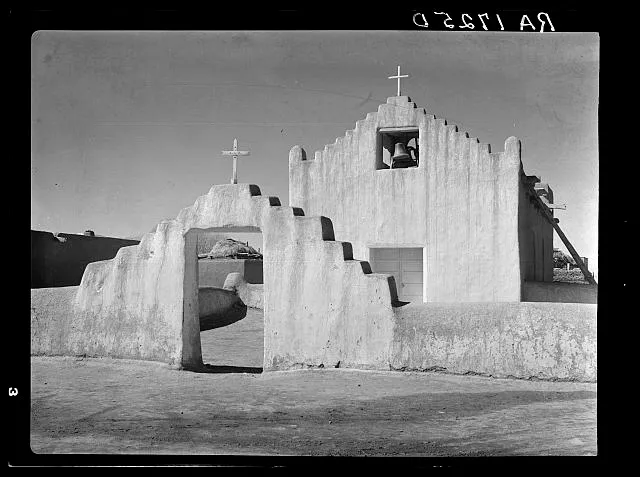
Old Spanish mission church at Taos Pueblo, New Mexico. Source: Library of Congress - Rothstein, Arthur, 1915-1985
The arrival of Spanish missions between the 1500s and 1800s significantly changed the lives of Native American peoples in what is now the United States. Spanish colonizers built a network of missions stretching from California to Florida. These religious centers were designed to spread Christianity and expand Spain’s influence. The missions, however, brought vast changes, some of which deeply disrupted Native societies.
Spanish authorities believed that conversion to Christianity was necessary for Native Americans. Priests and soldiers worked together to persuade, and sometimes force, Native people to accept new beliefs. This often involved destroying traditional spiritual practices and replacing them with Catholic ceremonies. In some cases, Native Americans were required to attend church daily, learn Spanish, and abandon their own languages and customs. This process of cultural assimilation led to the loss of many Native traditions.
The missions also relied on Native American labor. Through the encomienda system, Spanish leaders claimed the right to Native labor in exchange for promised protection and religious instruction. In reality, many Native Americans experienced harsh conditions, long hours, and strict discipline. They were required to build mission buildings, farm crops, and tend livestock, often with little reward. The work disrupted traditional roles and ways of life, causing suffering and sometimes population declines due to disease and overwork.
Despite these challenges, Native American responses to the missions were varied. Some individuals and communities chose adaptation, learning new skills and finding ways to survive within the mission system. Others engaged in resistance. This could involve fleeing missions, secretly practicing traditional customs, or even open rebellion. For example, the Pueblo Revolt of 1680 in New Mexico was a major Native uprising that temporarily drove out Spanish authorities. Resistance showed that Native peoples tried to maintain their autonomy and identity, even under pressure.
Over time, the impact of Spanish missions became clear. While some missions led to the creation of lasting settlements and blended cultures, they also caused the destruction of many Native American communities and traditions. Intermarriage, new crops, and changed economies emerged, but so did the loss of languages and the spread of European diseases. Historians today use records, archaeology, and oral histories to understand how missions shaped the region’s history.
In summary, Spanish missions brought both change and conflict to Native American peoples. The process of forced conversion and labor altered societies, yet Native Americans demonstrated agency through resistance and adaptation. Understanding these complex interactions helps us appreciate the resilience and diversity of Native cultures in American history.
Interesting Fact: The largest Native-led revolt against Spanish missions, the Pueblo Revolt of 1680, succeeded in driving Spanish forces out of New Mexico for over a decade.
Where were Spanish missions built?
California to FloridaCanada and AlaskaNew England onlySouth America only
What was the encomienda system?
A labor system for Native AmericansA trading postA type of churchA farming tool
When did the Pueblo Revolt occur?
1680150017761800
Why did Native Americans resist missions?
To keep their cultureTo become colonizersFor goldTo build churches
What is cultural assimilation?
Adopting another group's cultureBuilding new housesMaking farming toolsTrading goods
Which was an effect of the missions?
Loss of traditionsDiscovery of goldIndependence for SpainMore land for Native Americans
Spanish missions only brought positive changes. True or false?
TrueFalse
What does 'resistance' mean in the passage?
Fighting against controlBuilding missionsLearning new skillsTrading goods
Perfect For:
👩🏫 Teachers
• Reading comprehension practice
• Auto-graded assessments
• Literacy skill development
👨👩👧👦 Parents
• Reading practice at home
• Comprehension improvement
• Educational reading time
🏠 Homeschoolers
• Reading curriculum support
• Independent reading practice
• Progress monitoring
Reading Features:
📖
Reading Passage
Engaging fiction or nonfiction text
❓
Comprehension Quiz
Auto-graded questions
📊
Instant Feedback
Immediate results and scoring
📄
Printable Version
Download for offline reading
🔊
Read Aloud
Voice-over with word highlighting
Reviews & Ratings
No reviews yet. Be the first to share your experience!
Related Content
Native American Tribes Across America
This engaging history reading passage introduces students to Native American tribes across America, focusing on their da...
D2.HIS.1.3-5D2.HIS.2.3-5RI.4.1RI.4.2
Teepees: Homes on the Great Plains
This engaging history reading passage introduces students to teepees, the unique homes of Native American tribes on the ...
D2.HIS.2.3-5D2.HIS.14.3-5RI.4.1RI.4.2RI.4.4
Traditional Native American Clothing
This engaging history passage explores traditional Native American clothing and how it reflected the environment, values...
D2.HIS.2.3-5D2.HIS.3.3-5RI.4.3RI.4.4
The Iroquois Confederacy: A System of Peace
This engaging U.S. History reading passage introduces students to the Iroquois Confederacy, a powerful alliance of Nativ...
D2.HIS.2.3-5D2.HIS.3.3-5RI.4.3RI.4.4
The Cherokee Nation: History and Culture
This reading passage explores the rich history and culture of the Cherokee Nation, one of the largest Native American tr...
D2.HIS.2.3-5D2.HIS.14.3-5RI.4.3RI.4.4RI.4.10
The Sioux: Warriors and Tribal Leaders
This history reading passage explores the Sioux Nation, focusing on their roles as warriors and tribal leaders. Students...
D2.HIS.1.3-5D2.HIS.2.3-5RI.4.1RI.4.3
Native American Respect for Nature
This engaging history reading passage explores Native American respect for nature, emphasizing the close relationship be...
D2.HIS.2.3-5D2.HIS.3.3-5RI.4.3RI.4.4
Jamestown: The First Permanent English Colony
This engaging history passage explores the founding of Jamestown, the first permanent English colony in America. Aligned...
D2.HIS.1.3-5D2.HIS.2.3-5RI.4.3RI.4.4
Pocahontas and the Powhatan People
This engaging reading passage explores the life of Pocahontas and the Powhatan people and their important role in early ...
D2.HIS.1.3-5D2.HIS.2.3-5RI.4.1RI.4.3
Colonial Children: School and Chores
This reading passage explores the daily lives of colonial children, focusing on their experiences at school and their ma...
D2.HIS.2.3-5D2.HIS.3.3-5RI.4.1RI.4.2RI.4.4
Colonial Clothing and Homemade Goods
This engaging U.S. history passage explores the daily life of early American colonists with a focus on colonial clothing...
D2.HIS.2.3-5RI.4.3RI.4.4
Colonial Jobs: Blacksmiths, Bakers, and Craftsmen
This engaging history reading passage explores the vital roles of blacksmiths, bakers, and craftsmen in colonial America...
D2.HIS.2.3-5D2.HIS.3.3-5RI.4.3RI.4.4
Colonial Towns and Village Life
This engaging history reading passage explores the daily life, work, and unity found in colonial towns and villages. Ali...
D2.HIS.1.3-5D2.HIS.2.3-5RI.4.3RI.4.4
Colonial Trade with England and Africa
This history reading passage explores colonial trade between the American colonies, England, and Africa, focusing on the...
D2.HIS.2.3-5D2.HIS.14.3-5RI.4.3RI.4.4
Benjamin Franklin: Printer, Inventor, and Leader
This history reading passage explores the life and achievements of Benjamin Franklin, one of America's most important ea...
D2.HIS.2.3-5D2.HIS.3.3-5RI.4.1RI.4.3
George Washington Leads the Army
This engaging history reading passage explores how George Washington bravely led the Continental Army during the America...
D2.HIS.1.3-5D2.HIS.2.3-5RI.4.3RI.4.4
Women and Children During the Revolutionary War
This reading passage explores the important roles women and children played during the Revolutionary War. Students will ...
D2.HIS.2.3-5RI.4.3RI.5.3
African Americans Fight for Freedom
This educational passage explores the brave and inspiring story of how African Americans fought for freedom in the Unite...
D2.HIS.2.3-5D2.HIS.3.3-5RI.4.3RI.4.4
The Battle of Yorktown Ends War
This engaging U.S. history reading passage explores the Battle of Yorktown, a key event that ended the American Revoluti...
D2.HIS.1.3-5D2.HIS.2.3-5RI.4.1RI.4.3
Loyalists vs. Patriots: Divided Families
This engaging U.S. history reading passage explores the division between Loyalists and Patriots during the American Revo...