Native Americans and Slavery in Early America
Interactive passage with audio narration, comprehension questions, and printable PDF.
By completing this purchase you agree to our Terms of Use and Privacy Policy. Your subscription renews automatically until you cancel. You can cancel anytime from your account settings. All sales are final and non-refundable. Digital content is available for download in your account immediately upon purchase.
What's included
Native Americans and Slavery in Early America preview and details
About this printable Native Americans and Slavery in Early America reading passage (Grades 6-8)
Sample passage and quiz from Native Americans and Slavery in Early America
Reading passage and comprehension quiz preview
Native Americans and Slavery
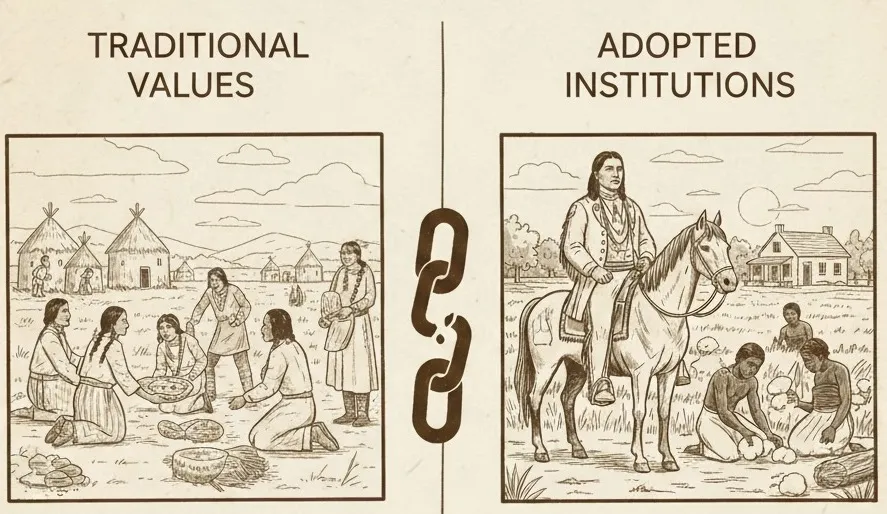
Native Americans played a complex role in the history of slavery in early America. While many people think of slavery as something that only involved Africans and Europeans, bondage and captivity also affected Native peoples in significant ways. From the 1600s through the 1800s, Native Americans were sometimes forced into slavery by European colonists, and in certain regions, some Native nations also owned African slaves themselves. This complex history reveals the intersection of different peoples, cultures, and systems of power.
When Europeans arrived in North America, they brought with them ideas of chattel slavery, a system in which people were treated as property that could be bought or sold. European colonists enslaved Native Americans, especially in the southern colonies and the Caribbean. Some Native captives were forced to work on plantations or shipped far from their homelands. These actions often led to the displacement of Native communities and the breakdown of traditional ways of life.
However, the relationship between Native Americans and slavery was not only one of victimization. Over time, some Native groups, such as the Cherokee, Creek, and Choctaw, adopted the practice of owning African slaves. This was partly due to European pressure to assimilate and partly a strategy for survival in a changing world. By participating in the slave economy, these nations hoped to protect their land and autonomy. Yet, this choice also created conflicts within their communities and led to complicated alliances with white settlers.
The experience of slavery for Native Americans differed from that of Africans in some ways. While Africans were often enslaved for life and their children were born into slavery, Native American slavery sometimes took the form of temporary servitude or adoption into other tribes. Still, both groups suffered violence, family separation, and loss of freedom. Over time, laws were passed that made African chattel slavery more permanent, while Native people were increasingly pushed off their lands or forced to assimilate.
Historians continue to study the legacy of these intertwined histories. The intersections of Native and African experiences of bondage remind us that the story of slavery in America is more complicated than many textbooks suggest. Recognizing these connections helps us understand the diversity of experiences and the difficult choices people faced under colonial rule.
Interesting Fact: In the early 1700s, more Native Americans were enslaved in the Carolinas than Africans. Some Native groups later became strong abolitionists, fighting against slavery in the 1800s.
Comprehension quiz (8 questions)
1. Who brought chattel slavery to America?
2. Which Native groups owned African slaves?
3. What did European slavery often cause?
4. Why did some Natives own slaves?
5. How was Native slavery different from African slavery?
6. What is a legacy?
7. True or false: All Natives resisted slavery.
8. What does 'bondage' mean?
Common Core standards for Native Americans and Slavery in Early America
Explain events, procedures, ideas, or concepts in a historical, scientific, or technical text, including what happened and why, based on specific information in the text.
Determine the meaning of general academic and domain-specific words or phrases in a text relevant to a grade 4 topic or subject area.
Write informative/explanatory texts to examine a topic and convey ideas and information clearly.
Perfect for the way you teach
- Build comprehension skills
- Auto-graded quiz
- Differentiated reading
- Read together at home
- Improve fluency
- Quiet reading time
- Reading curriculum support
- Independent practice
- Track Lexile growth