Slavery in the Ancient World
Interactive passage with audio narration, comprehension questions, and printable PDF.
By completing this purchase you agree to our Terms of Use and Privacy Policy. Your subscription renews automatically until you cancel. You can cancel anytime from your account settings. All sales are final and non-refundable. Digital content is available for download in your account immediately upon purchase.
What's included
Slavery in the Ancient World preview and details
About this printable Slavery in the Ancient World reading passage (Grades 6-8)
Sample passage and quiz from Slavery in the Ancient World
Reading passage and comprehension quiz preview
Slavery in Ancient World
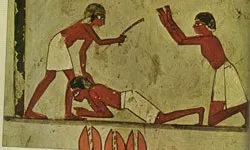
Slavebeating / Wikimedia Commons
Slavery was a major part of many ancient civilizations, including Mesopotamia, Egypt, Greece, and Rome. In these societies, enslaved people formed the lowest level of the social hierarchy. Their lives and treatment depended on the customs, laws, and economic needs of their time and place.
In ancient Mesopotamia, records from as early as 3000 BCE show that people were enslaved for many reasons. Some became slaves because of debt, while others were captured during wars. The Code of Hammurabi, written around 1750 BCE, includes rules about how slaves could be treated and even allowed some to eventually buy their freedom. Archaeological evidence, such as clay tablets, shows that slaves worked in households, on farms, and in temples. Slavery provided labor for agriculture and construction, helping Mesopotamian city-states grow and prosper.
Ancient Egypt also relied on enslaved people for building projects, farming, and even serving in wealthy households. Wall paintings from tombs near Thebes show large groups of enslaved workers hauling stones and constructing monuments like the pyramids. Most slaves in Egypt were prisoners of war or people forced into slavery because of poverty. Egyptian laws sometimes protected slaves from harsh treatment, but their lives were still controlled by their owners. The economic importance of slavery in Egypt was clear in the way it supported the power of pharaohs and enabled massive construction projects.
In Greece and Rome, slavery became even more central to society. In Athens, as many as one-third of the population was enslaved. Slaves performed many jobs, from working in silver mines to tutoring wealthy children. Ancient Greek philosopher Aristotle argued that some people were “natural slaves,” a belief that justified keeping people in bondage. In Rome, slavery expanded as the empire conquered new lands. Roman slaves came from many places, including Gaul, North Africa, and the Middle East. Some were forced to fight as gladiators, while others worked on large farms called latifundia. Occasionally, enslaved people rebelled, as in the famous revolt led by Spartacus in 73 BCE, which showed both the cruelty and danger of a society dependent on slavery.
The practice of slavery in the ancient world shaped economies, cultures, and ideas about power and freedom. While some enslaved people could earn their freedom, most lived hard lives with little control over their future. Over time, the systems of slavery changed, but the presence of enslaved people remained a constant part of ancient societies.
Understanding slavery in the ancient world helps historians study social structures, human rights, and the ways geography and conflict shaped civilizations.
Interesting Fact: In ancient Athens, some skilled slaves could save money and eventually buy their freedom, but this was rare and often depended on the goodwill of their owners.
Comprehension quiz (8 questions)
1. What was the lowest class in ancient societies?
2. Where were early slavery laws recorded?
3. Who led a famous slave revolt in Rome?
4. Why did ancient Egypt use slaves?
5. What was a latifundia?
6. How did slavery shape ancient societies?
7. Some slaves could buy freedom. True or False?
8. What does 'bondage' mean?
Perfect for the way you teach
- Build comprehension skills
- Auto-graded quiz
- Differentiated reading
- Read together at home
- Improve fluency
- Quiet reading time
- Reading curriculum support
- Independent practice
- Track Lexile growth