Spider vs. Insect: Spot the Difference — Reading Comprehension
Rate this
Premium Resource
Present
Present in classroom. No work saved
Assign
Classroom with student accounts, Track progress
Quick Play
No student accounts, assign with a link
Grades
6
PRINT+DIGITAL RESOURCE
This learning resource is available in interactive and printable formats. The interactive worksheet can be played online and assigned to students. The Printable PDF version can be downloaded and printed for completion by hand.
This engaging, audio-integrated reading passage, "Spider vs. Insect: Spot the Difference," is designed for Grade 6 students to explore the fascinating anatomical distinctions between spiders and insects. It defines key terms like 'exoskeleton,' 'segmented bodies,' and 'antennae,' helping students understand the core features of these common arthropods. By highlighting differences in body segments, leg count, and sensory organs, the passage supports the NGSS standard MS-LS4-2, which focuses on applying scientific ideas to explain anatomical similarities and differences among modern organisms to infer evolutionary relationships. The passage encourages close reading and critical thinking about biological classification, making complex concepts accessible and fun.
CONTENT PREVIEW
Expand content preview
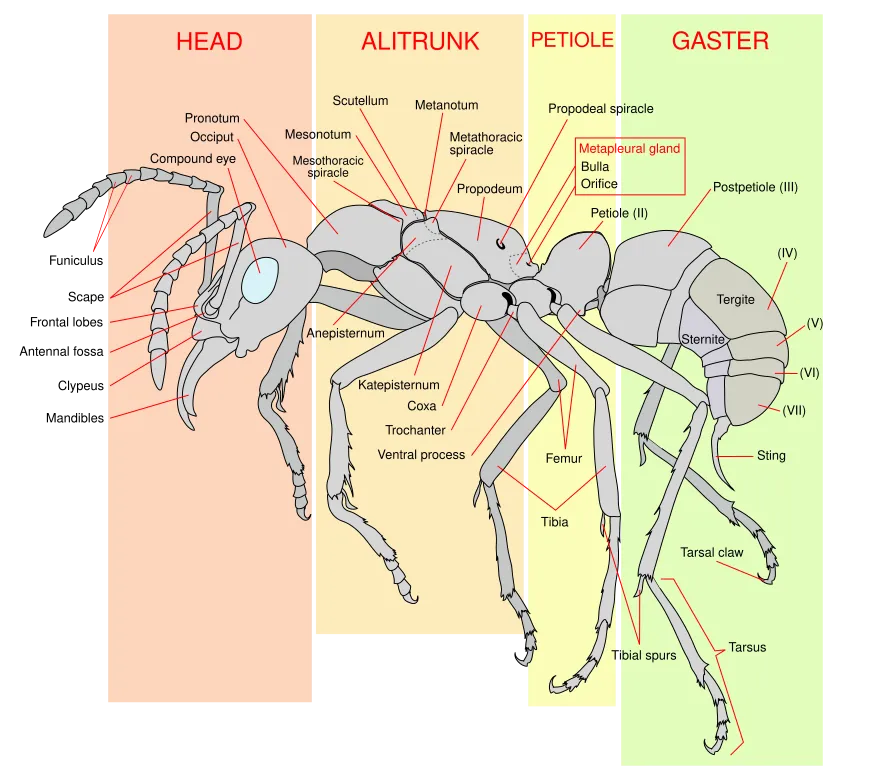
"Scheme ant worker anatomy-en" by Mariana Ruiz (LadyofHats) / Wikimedia Commons.
Imagine two small creatures scuttling across the ground. One is an eight-legged marvel, spinning intricate webs. The other buzzes by on six legs, perhaps searching for a flower. Both are tiny, often found in our homes and gardens, and sometimes we even call them 'bugs.' But are they the same? Absolutely not! While both belong to the larger group of arthropods, which are invertebrates with an exoskeleton, segmented bodies, and jointed appendages, spiders and insects have distinct features that set them apart. Understanding these differences helps us appreciate the incredible diversity of life on Earth.
One of the most obvious differences is the number of legs. Look closely: an insect, like a fly or a beetle, always has six legs. These legs are attached to the middle section of its body. A spider, on the other hand, is an arachnid, and all arachnids have eight legs. These eight legs are attached to their front body section.
Another key distinction lies in their body segments. Insects have three main body parts: the head, the thorax (middle section), and the abdomen (rear section). Each part has specialized functions. The head often has eyes, mouthparts, and antennae – sensory feelers used for touch, smell, and taste. The thorax holds the legs and, if present, wings. The abdomen contains digestive and reproductive organs. Spiders, however, have only two main body segments. Their head and thorax are fused together into one section called the cephalothorax, and then they have the abdomen. This means spiders do not have a distinct head like insects do.
What about antennae? Insects almost always have them. Think about an ant feeling its way or a butterfly tasting with its antennae. Spiders do not have antennae. Instead, they have two small, leg-like appendages near their mouth called pedipalps, which they use for sensing, manipulating food, and sometimes even reproduction. Also, most insects have compound eyes, which are made up of many small lenses. Spiders usually have simple eyes, often eight of them, arranged in different patterns depending on the species.
So, the next time you see a creature crawling or flying, take a moment to count its legs, look for antennae, and observe its body segments. You'll be able to tell if you've spotted an insect or a spider, and you'll know a little more about the amazing biodiversity around us, connecting these anatomical differences to their evolutionary paths.
Interesting Fact: While most insects have wings, no spider species in the world has wings for flight.
How many legs do insects typically have?
SixEightFourTen
What is the fused head and thorax of a spider called?
AbdomenThoraxCephalothoraxPedipalp
True or False: Spiders have antennae.
TrueFalse
Which characteristic is unique to insects?
ExoskeletonEight legsThree body segmentsJointed appendages
Based on the passage, what is an arthropod?
Vertebrate with wingsInvertebrate with exoskeletonAnimal with furPlant-eating insect
Why are pedipalps important for spiders?
For flyingFor spinning silkFor sensing and eatingFor laying eggs
If a creature has distinct head, thorax, and abdomen, what is it?
An arachnidAn insectA spiderA vertebrate
What feature helps distinguish an insect from a spider, as mentioned?
Body colorNumber of legsSizeHabitat
A scientist finds an unknown arthropod with two body segments and eight legs. What would they likely classify it as?
An insectA birdAn arachnidA fish
Which term describes animals with an exoskeleton and jointed appendages?
VertebratesMammalsArthropodsAmphibians
Perfect For:
👩🏫 Teachers
• Reading comprehension practice
• Auto-graded assessments
• Literacy skill development
👨👩👧👦 Parents
• Reading practice at home
• Comprehension improvement
• Educational reading time
🏠 Homeschoolers
• Reading curriculum support
• Independent reading practice
• Progress monitoring
Reading Features:
📖
Reading Passage
Engaging fiction or nonfiction text
❓
Comprehension Quiz
Auto-graded questions
📊
Instant Feedback
Immediate results and scoring
📄
Printable Version
Download for offline reading
🔊
Read Aloud
Voice-over with word highlighting
Reviews & Ratings
No reviews yet. Be the first to share your experience!
Related Content
Understanding Biological Evolution and Diversity
This passage addresses the NGSS standard 3-LS4-2 focusing on biological evolution and the unity and diversity of life. T...
RI.3.3RI.4.3RI.5.33-LS4-2
Theory of Evolution
This middle school science passage explains the theory of evolution and the concept of common ancestry, aligning with NG...
MS-LS4-1MS-LS4-2
The Nature of Life Science
This passage, aligned with NGSS MS-LS1-1, introduces students in grades 6-8 to the foundational concepts of life science...
MS-LS1-1
Evidence for Evolution: Comparative Anatomy
This middle school science reading passage explores the evidence for evolution through comparative anatomy, aligning wit...
MS-LS4-2MS-LS4-3
Human Evolution
This middle school science passage explains the scientific evidence for human evolution, aligning with NGSS standards MS...
MS-LS4-1MS-LS4-2
Science Vocabulary
This worksheet on domain-specific words will help students learn some science vocabulary. Students will be asked to matc...
L.3.6L.3.4.A
The Giant Isopod: Biological Evolution
This NGSS passage examines how giant isopods evolved for deep-sea survival, including slow metabolism for food scarcity,...
MS-LS4-4RI.6.3RI.7.3RI.8.8
Evidence for Evolution: The Fossil Record
This middle school science passage explains the importance of fossils as preserved evidence of ancient life and their ro...
MS-LS4-1
Simple Machines Science Report
This science writing task requires students to clearly explain how three simple machines work using precise domain-speci...
W.5.4
The Science of Hibernation
This educational module, featuring an audio-integrated reading passage titled 'The Science of Hibernation,' is designed ...
What is an amphibian
This audio-integrated reading passage, "The Life of Amphibians," is designed for 4th-grade students to explore the fasci...
The Levels of Australopithecus
This educational content offers an engaging, audio-integrated reading passage titled 'The Levels of Biological Classific...
The Nature of Science
This passage explores the nature of science for middle school students, aligning with NGSS standards MS-ETS1-4, MS-PS1-1...
MS-ETS1-4MS-PS1-1MS-LS1-1
The Pumpkin Life Cycle
This informational worksheet explores the pumpkin lifecycle, guiding students through procedural steps in a scientific t...
RI.2.3RI.2.10
What Is Earth Science?
This engaging middle school science passage introduces students to the field of Earth science, aligning with NGSS standa...
MS-ESS1MS-ESS2MS-ESS3SEP
Citizen Science and Ecological Monitoring
This engaging passage for grades 6-8 introduces the concept of citizen science and its critical role in ecological monit...
MS-LS2-1
The Life Cycle of an Angiosperm
This educational content package delves into the intriguing world of angiosperms and their complex life cycles, perfectl...
Tools and Technology in Earth Science
This middle school science reading passage explores the wide range of tools and technologies used in Earth science, from...
MS-ESS2-2MS-ESS3-2MS-ETS1-1MS-PS4-3
Barnacle Life Cycle
This audio-integrated reading passage, "Barnacle Life Cycle," delves into the intriguing growth and development of barna...
History of Life on Earth
This comprehensive middle school science reading passage provides an engaging overview of the history of life on Earth, ...