The Anther's Role in Plant Reproduction — Reading Comprehension
Rate this
Premium Resource
Present
Present in classroom. No work saved
Assign
Classroom with student accounts, Track progress
Quick Play
No student accounts, assign with a link
Grades
6
PRINT+DIGITAL RESOURCE
This learning resource is available in interactive and printable formats. The interactive worksheet can be played online and assigned to students. The Printable PDF version can be downloaded and printed for completion by hand.
This engaging passage, complete with audio integration, delves into the fascinating world of plant reproduction, focusing on the crucial role of the anther. Students will learn about the specialized structures flowers use to create new plants, including the anther's function in producing pollen. Key terms like stamen, filament, and pistil are clearly defined, making complex biological processes accessible for Grade 6 learners. This educational content aligns with the NGSS Disciplinary Core Idea LS1.B: Growth and Development of Organisms, highlighting how plants develop specialized structures for reproduction. Through this passage, students will gain a deeper understanding of plant life cycles and the delicate balance of nature, all while building their science vocabulary. It's perfect for enhancing comprehension and introducing fundamental botany concepts.
CONTENT PREVIEW
Expand content preview
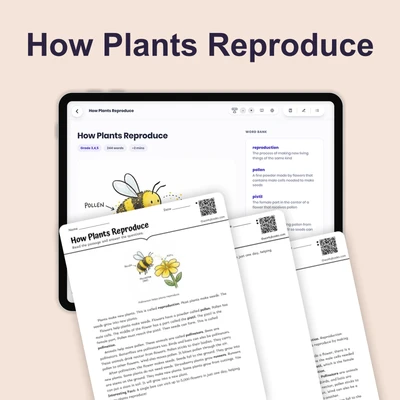
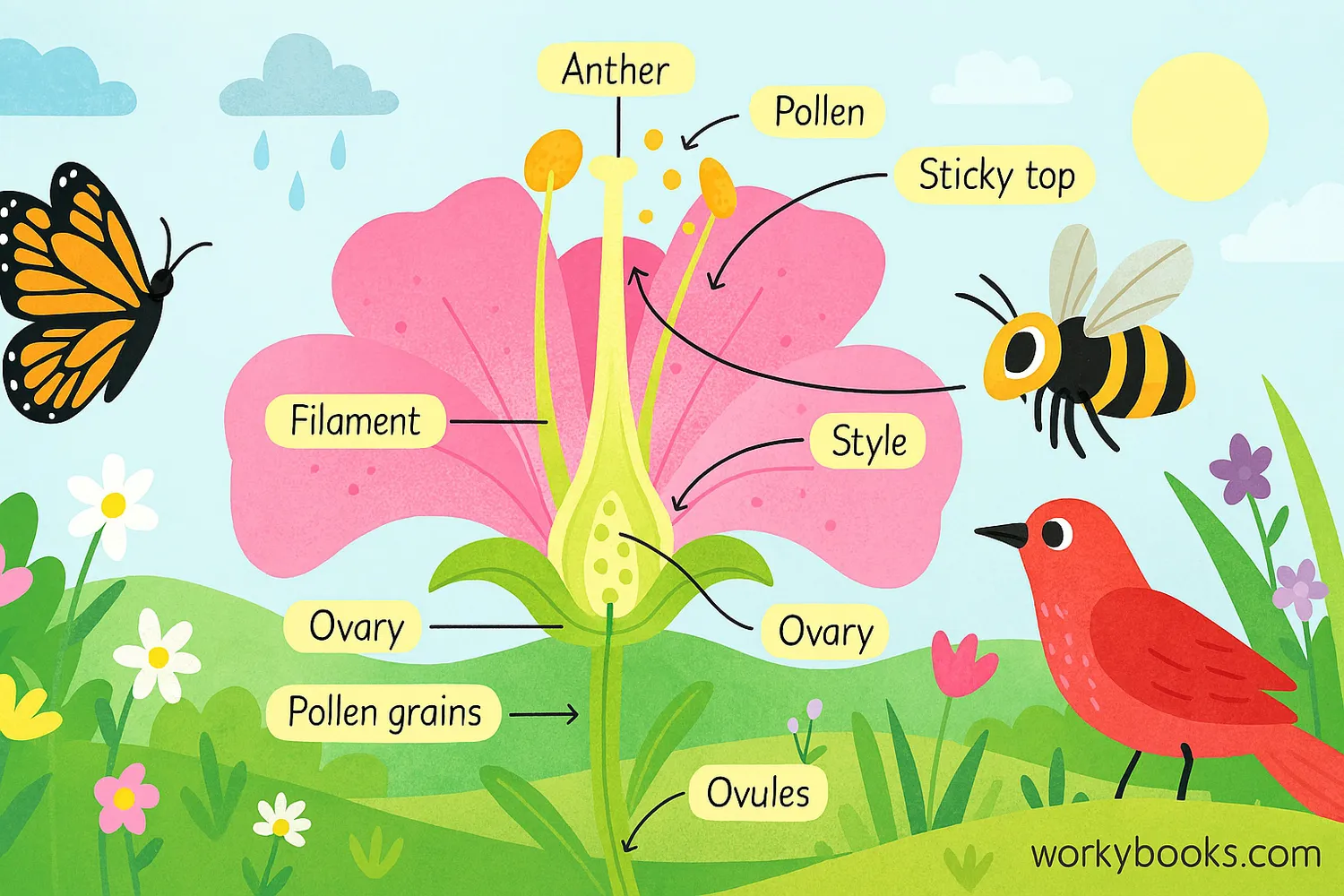
Pollinators help transfer pollen from anther to pistil, enabling flower fertilization and seed growth.
Imagine a world bursting with vibrant colors and sweet scents – the world of flowers! These beautiful creations are not just for looking pretty; they are essential for the survival of many plant species. At the heart of a flower's ability to reproduce is a tiny but mighty structure called the anther. Understanding the anther's role is key to unlocking the secrets of how plants make more of themselves.
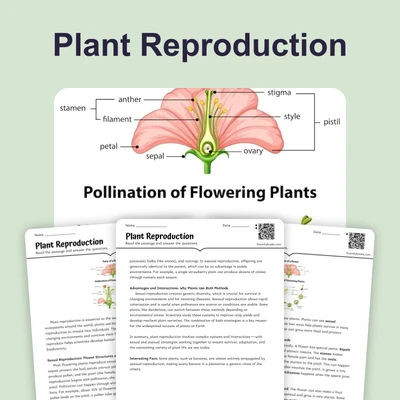
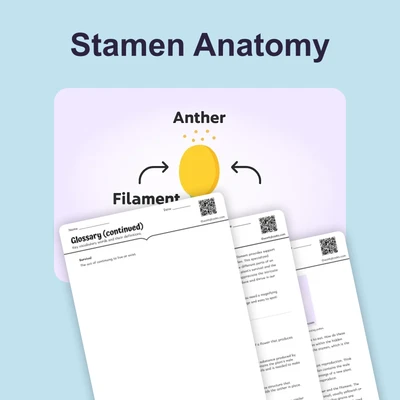
Many flowering plants have both male and female parts. The male reproductive part of a flower is called the stamen. Think of the stamen as a tiny factory that produces what's needed for plant babies. Each stamen is usually made up of two main pieces: a long, thin stalk known as the filament, and at the very top of this filament sits the anther. So, the anther is like the head of the stamen, holding all the important materials.
What exactly does the anther do? Its primary job is to produce and hold pollen. Pollen grains are tiny, dust-like particles that contain the male reproductive cells of the plant. If you've ever touched a flower and found yellow powder on your fingers, you've touched pollen! These grains are crucial for fertilization, which is the process of combining male and female cells to create a new seed.
Once the pollen is mature, the anther will open up, releasing these precious grains. From there, pollen needs to travel to the female part of the flower, called the pistil. This journey can happen in many ways: carried by the wind, by water, or most commonly, by helpful pollinators like bees, butterflies, and even some birds. When pollen lands on the sticky top of the pistil, it can grow a tube down to the ovary, where the female egg cells (called ovules) are located. This is where fertilization takes place, leading to the formation of seeds and eventually, new plants.
So, the anther, though small, plays an incredibly important role in the entire cycle of plant life. Without its ability to produce and release pollen, many plants wouldn't be able to reproduce, and our world would be a much less colorful and fertile place.
Interesting Fact: Some anthers have special pores or slits that open only when certain conditions are met, like specific humidity levels, to protect the pollen.
What is the primary job of the anther?
Produce pollenAttract insectsHold nectarSupport the leaves
What is the long, thin stalk that supports the anther called?
PistilFilamentOvaryPetal
Why is the anther described as a "tiny but mighty structure"?
It is very smallIt holds important materialsIt grows very quicklyIt is made of strong material
If a plant's anthers were removed, what would most likely happen to its ability to reproduce?
IncreaseStay the sameDecrease significantlyChange color
What part of the flower receives the pollen?
FilamentStamenPistilAnther
How do pollinators help the anther's function?
They eat the antherThey carry pollenThey make the anther growThey provide water
The absence of anthers would likely lead to fewer seeds.
TrueFalse
What is the purpose of fertilization in plants?
Make new leavesProduce sweet nectarCreate new seedsProtect the stem
If a plant relies solely on wind for pollination, what characteristics might its anthers and pollen have compared to a plant pollinated by bees?
Sticky pollen, hidden anthersHeavy pollen, colorful anthersLight pollen, exposed anthersNo pollen, very small anthers
Which of these terms describes the male reproductive part of a flower?
PistilOvaryStamenOvule
Perfect For:
👩🏫 Teachers
• Reading comprehension practice
• Auto-graded assessments
• Literacy skill development
👨👩👧👦 Parents
• Reading practice at home
• Comprehension improvement
• Educational reading time
🏠 Homeschoolers
• Reading curriculum support
• Independent reading practice
• Progress monitoring
Reading Features:
📖
Reading Passage
Engaging fiction or nonfiction text
❓
Comprehension Quiz
Auto-graded questions
📊
Instant Feedback
Immediate results and scoring
📄
Printable Version
Download for offline reading
🔊
Read Aloud
Voice-over with word highlighting
Reviews & Ratings
No reviews yet. Be the first to share your experience!
Related Content
Understanding Biological Evolution and Diversity
This passage addresses the NGSS standard 3-LS4-2 focusing on biological evolution and the unity and diversity of life. T...
RI.3.3RI.4.3RI.5.33-LS4-2
Theory of Evolution
This middle school science passage explains the theory of evolution and the concept of common ancestry, aligning with NG...
MS-LS4-1MS-LS4-2
Evidence for Evolution: Comparative Anatomy
This middle school science reading passage explores the evidence for evolution through comparative anatomy, aligning wit...
MS-LS4-2MS-LS4-3
The Nature of Life Science
This passage, aligned with NGSS MS-LS1-1, introduces students in grades 6-8 to the foundational concepts of life science...
MS-LS1-1
Human Evolution
This middle school science passage explains the scientific evidence for human evolution, aligning with NGSS standards MS...
MS-LS4-1MS-LS4-2
The Giant Isopod: Biological Evolution
This NGSS passage examines how giant isopods evolved for deep-sea survival, including slow metabolism for food scarcity,...
MS-LS4-4RI.6.3RI.7.3RI.8.8
Evidence for Evolution: The Fossil Record
This middle school science passage explains the importance of fossils as preserved evidence of ancient life and their ro...
MS-LS4-1
Science Vocabulary
This worksheet on domain-specific words will help students learn some science vocabulary. Students will be asked to matc...
L.3.6L.3.4.A
Simple Machines Science Report
This science writing task requires students to clearly explain how three simple machines work using precise domain-speci...
W.5.4
The Science of Hibernation
This educational module, featuring an audio-integrated reading passage titled 'The Science of Hibernation,' is designed ...
What is an amphibian
This audio-integrated reading passage, "The Life of Amphibians," is designed for 4th-grade students to explore the fasci...
The Levels of Australopithecus
This educational content offers an engaging, audio-integrated reading passage titled 'The Levels of Biological Classific...
The Nature of Science
This passage explores the nature of science for middle school students, aligning with NGSS standards MS-ETS1-4, MS-PS1-1...
MS-ETS1-4MS-PS1-1MS-LS1-1
The Pumpkin Life Cycle
This informational worksheet explores the pumpkin lifecycle, guiding students through procedural steps in a scientific t...
RI.2.3RI.2.10
What Is Earth Science?
This engaging middle school science passage introduces students to the field of Earth science, aligning with NGSS standa...
MS-ESS1MS-ESS2MS-ESS3SEP
The Life Cycle of an Angiosperm
This educational content package delves into the intriguing world of angiosperms and their complex life cycles, perfectl...
Citizen Science and Ecological Monitoring
This engaging passage for grades 6-8 introduces the concept of citizen science and its critical role in ecological monit...
MS-LS2-1
Tools and Technology in Earth Science
This middle school science reading passage explores the wide range of tools and technologies used in Earth science, from...
MS-ESS2-2MS-ESS3-2MS-ETS1-1MS-PS4-3
Barnacle Life Cycle
This audio-integrated reading passage, "Barnacle Life Cycle," delves into the intriguing growth and development of barna...
History of Life on Earth
This comprehensive middle school science reading passage provides an engaging overview of the history of life on Earth, ...